


BEIRUT: Supermarket owners in Lebanon have blamed “hard-line measures” from the Banque du Liban for the introduction of a new payment system for their customers.
The central bank’s change requires the payment of 50 percent of the value of purchases in cash, and 50 percent through bank cards, on account of “low liquidity” in markets, according to Nabil Fahed, head of the Syndicate of Supermarket Owners.
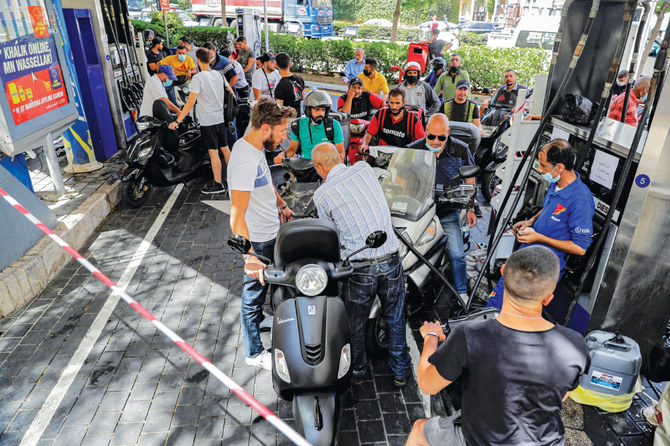
This development came the same day as gas station owners decided to stop accepting full payments for fuel via bank card.
Dr. Jassem Ajaka, an economist, described the repercussions as “economically catastrophic, as long as the amount of banknotes in Lebanese pounds that a citizen can withdraw from banks is limited while prices are rising.”
This situation, he claimed, would make people consume less, causing a decline in GDP and a larger contraction in the economy.
Charles Arbid, president of the Economic and Social Council, said that Lebanon “is experiencing inflationary depression: That is, consumption and economic movement are stalled.”
Operational prices are also rising for sectors such as energy and transportation, developments which, he said, require the immediate launch of a three-dimensional participatory dialogue at government level with employers and workers to devise solutions and take action.
He added: “No solutions are magical and readily available.”
The Association of Banks in Lebanon, meanwhile, will pay the government-approved social assistance to public sector employees, including the military.
This assistance is equivalent to half of an additional salary per month, with a minimum of 1.5 million Lebanese pounds ($993) and a maximum of 3 million pounds. Sixty percent of this is paid in cash, and other means of payment are being adopted to transfer the remaining 40 percent by bank card or check.
Nawal Nassr, president of the Public Administration Staff Association, said: “We can no longer afford to be approached with this level of absurdity.
“So far, we are committed to a day of attendance and we will stop doing so if this procedure is applied.”
The repercussions of Russia’s invasion of Ukraine, which has exacerbated the world’s oil crisis and its derivatives, have also reached Lebanon.
A gallon of gasoline in the mediterranean country currently costs 500,000 pounds, and must now be paid for in cash.
Abdo Saade, head of a group of private generator owners, warned on Saturday that monthly subscription charges would increase between 30 percent to 40 percent due to the high price of diesel for his generators.
Prices currently range between 800,000 and 2 million pounds, and possibly even more depending on consumption, he said,
“After March 15, we may turn off generators in most areas because of people’s inability to pay consumption fees and (the) lack of liquidity,” Saade added.
The severe economic crisis that Lebanon has faced for two years has prevented bank transfers abroad, with several banks introducing new rules to manage deposits.
Withdrawal ceilings in Lebanese pounds and dollars are no longer commensurate with the amount of money that citizens need to pay for their expenses.
Traders argue that they have resorted to this procedure because they pay importers in cash for their goods.
Ajaka explained: “Why do they want to pay cash? The first reason is that suppliers accept only cash, meaning that the problem is with the supplier, whose reasons to do so need to be investigated. The second reason is that traders work with illegal people. The third reason is to keep the money in cash as a safety margin in the event of a deterioration in the situation.”
He pointed out that traders “argue that banks ask them to put their daily income in (the) banks for them to transfer money in cash to their employees when paying their salaries.”
Ajaka added that reliance on cash increased tax evasion, because traders then declare less of their business, and deprived the banking sector of resources to pump back into the economy.
One Beirut bank manager, who declined to be named, told Arab News that the BdL “works by activating a banking text to dry the market from the Lebanese lira (pound), in addition to taking other measures aimed at curbing the black market that manipulates the dollar exchange rate.
“At the same time, it has decided not to respond to the banks’ requests for liquidity in the Lebanese lira, asking them to get it from the market.”
The bank manager added: “The central bank believes that the liquidity in lira that came out of it in huge quantities did not return to the central bank through the circulation. So where did this money go? It either went to storage or to supply the black market.”
The source said although Greece adopted this measure during its economic crisis, it cannot be adopted for a long time.
Ajaka believes that the authorities are likely to “issue laws and decrees to oblige traders to accept payment by bank cards because it is not possible to continue with cash in this way.”


