Saudi Arabia, UAE remain largest sources of remittances to Pakistan – central bank

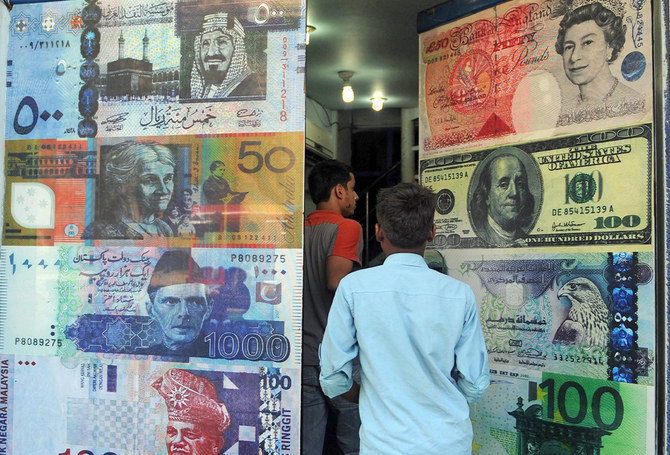
Pakistani customers enter a foreign currency exchange shop in Karachi, Pakistan, on October 14, 2010. (AFP/File)
Short Url
Updated 10 March 2022
Follow

Saudi Arabia, UAE remain largest sources of remittances to Pakistan – central bank

  • The country’s remittances increased by two percent in February on a month-on-month basis
  • Pakistan’s finance chief discusses investment opportunities for Saudi business community during a meeting

ISLAMABAD: Saudi Arabia and the United Arab Emirates remained the biggest sources of remittances to Pakistan last month by contributing $945 million to the economy of the South Asian nation, said the State Bank of Pakistan on Thursday.
Workers’ remittances in Pakistan have remained above $2 billion dollars per month since June 2020. The Pakistani central bank said that the trend also continued in February 2022 when the country received $2.2 billion in inflows.
In terms of growth, Pakistan’s remittances increased by two percent last month on a monthly basis despite fewer working days compared to January.
“Remittance inflows during February 2022 were mainly sourced from Saudi Arabia ($558 million), United Arab Emirates ($387 million), United Kingdom ($319 million) and United States of America ($210 million),” the central bank said.
“Cumulatively at $20.1 billion, remittances grew by 7.6 percent during the eight months of FY22 compared to the same period last year,” it added.
Pakistan has deep-rooted fraternal ties with Saudi Arabia and the UAE.
Nearly 2.5 million Pakistani expats live in the kingdom and more than 1.6 million in the UAE.
These Pakistanis have greatly contributed to the development of the two Gulf countries, besides constituting the biggest source of remittances to Pakistan.
Pakistan’s finance minister Shaukat Tarin also held a meeting with the chairman of Board of Investment (BOI), Azfar Ahsan, and the country’s envoy to Saudi Arabia, Ameer Khuram Rathore, on Thursday to discuss investment opportunities for Saudi investors in Pakistan.
“Both Ambassador of Pakistan to Saudi Arabia and Chairman BOI shared that Saudi government, as well as investors, are keenly interested in investment in Pakistan,” said the finance division in a statement after the meeting.
The meeting acknowledged there was a huge investment potential between the two countries that could benefit their governments and business communities.
“The Saudi business community is avidly looking toward Pakistan for business,” the statement added. “The investment avenues are being offered in various sectors of the economy. These avenues majorly include refinery, agriculture, IT and semi-conductor manufacturing sectors.”
“The finance minister also advised the BOI to enhance focus on project development in consultation with respective ministries and the provincial government,” the finance division continued. “He also urged to finalize discussion with prospective investors in Saudi Arabia.”


Pakistan’s fragile economic recovery faces risk as Iran conflict raises escalation fears

Updated 8 sec ago
Follow

Pakistan’s fragile economic recovery faces risk as Iran conflict raises escalation fears

  • KP finance chief says wider Gulf conflict could undermine $41 billion remittance target, push up energy prices
  • Economists warn oil surge would widen import bill as Iran targets neighboring countries in regional flare-up

KARACHI: Pakistan’s fragile economic recovery could come under pressure if Israel-US strikes on Iran escalate into a wider regional conflict, threatening oil supplies and remittance flows vital to the country’s balance of payments, officials and independent economists said on Saturday.

The United States and Israel struck Iran following weeks of rising tensions, while Pakistan has also faced renewed border clashes with Afghanistan in recent weeks.

Economists warn that a wider Middle East conflict could quickly destabilize Pakistan’s hard-won macroeconomic gains under a $7 billion International Monetary Fund program since the country relies heavily on Gulf states for imported fuel and worker remittances, which are projected at $41 billion this fiscal year.

Iran has already targeted several neighboring countries in an attempt to strike US military bases in the region, raising fears of a broader escalation and drawing condemnation from regional governments, including Pakistan.

“Pakistan’s western borders are in a state of war,” Muzzammil Aslam, finance minister of the country’s northwestern Khyber Pakhtunkhwa province bordering Afghanistan, told Arab News over the phone. “Given the limited trade with western borders, Pakistan exports are unlikely to be affected. However, if the war expands across the Middle East, it will definitely impact the remittances.”

Aslam warned that energy prices could also spike due to potential supply disruptions.
Pakistan’s finance adviser Khurram Schehzad and finance ministry’s spokesperson Qamar Sarwar Abbasi did not respond to questions seeking their comments on the issue.

However, the country, which is a net oil importer, has only recently posted a modest current account surplus after years of deficits, helped by import compression and higher remittances. Inflation, which peaked at 38 percent in May 2023, has eased to single digits.

Experts said a sustained surge in crude prices could reverse those gains.

“If the Iran-US conflict escalates and oil moves sharply higher, Pakistan is likely to feel it immediately,” Farrukh Saleem, an economist, said. “An increase in crude materially widens the import bill, pressures the current account and weakens the rupee.”

He said such a situation would feed inflation and limit the State Bank of Pakistan’s room to ease the policy rate which it kept unchanged at 10.5 percent in January.

“The Pakistan-Afghanistan tensions are more about security,” he continued. “They don’t move oil, but they raise country risk, delay investment, and strain fiscal space.”

In response to a question, Saleem said he did not see an immediate balance-of-payments crisis.

“Most Middle East conflicts since 2006 have followed a pattern: sharp opening strikes, controlled retaliation, backchannel de-escalation,” he said.

Former state minister for investment Haroon Sharif warned that prolonged instability would weigh on investor confidence.

“A prolonged conflict will lead to capital outflows,” he said.

Regional tensions are also affecting aviation, with Pakistan International Airlines suspending flights to the United Arab Emirates, Bahrain, Doha and Kuwait, while services to Saudi Arabia have been rerouted.

“The monetary impact of these flight suspensions can run in millions of rupees because one flight costs us as much as Rs2 million,” PIA spokesperson Abdullah Hafeez Khan told Arab News.

“Right now, we can safely say domestic carriers are expected to lose millions of rupees in view of the prevailing situation,” he added.

KP’s finance chief Aslam said Pakistan should remain diplomatically careful while dealing with the ongoing conflicts.

“Given the remittances and oil prices are correlated to the balance of payments, one can say the risk of that crisis remains,” he added.