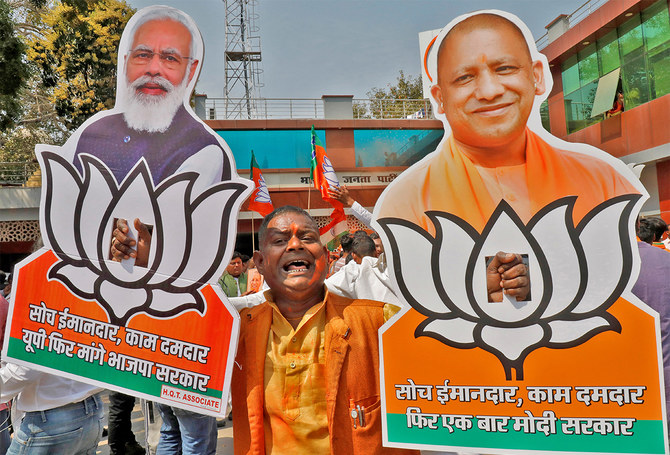
JAIPUR: The ruling Bharatiya Janata Party remained in control of India’s most populous state, Uttar Pradesh, initial results showed on Thursday, in vote that is seen a pulse check on support for Prime Minister Narendra Modi ahead of the national elections in 2024.
More than 180 million votes were cast in five Indian states — Uttar Pradesh, Uttarakhand, Punjab, Manipur and Goa — all of which went to the polls over the past month.
Uttar Pradesh is home to over 220 million people, about a fifth of India’s population. Winning the state is considered crucial for securing a majority in parliament, as it sends the most legislators of any state to the country’s supreme legislative body.
Tight races in Manipur, Goa and Uttarakhand have been in favor of the BJP, while the Aam Aadmi Party that also governs the national capital territory of Delhi is headed for a big victory in Punjab.
“But for Punjab, the BJP has achieved astounding victory in Uttar Pradesh, Uttarakhand, Goa and Manipur. “These victories would rewrite India’s political road map,” BJP spokesperson Sudesh Verma said in a statement.
Rahul Gandhi, leader of India’s main opposition Congress party, which is trailing in all five states, took to Twitter to say he accepted the result of the popular vote.
“Humbly accept the people’s verdict,” he said. “Best wishes to those who have won the mandate.”
The Hindu nationalist BJP has been in power in Uttar Pradesh since 2017, when it won 312 seats of the 384 it contested.
The 2022 win, coming despite criticism over the handling of the COVID-19 pandemic and mass antigovernment protests by farmers last year, would make incumbent Yogi Adityanath, a controversial Hindu monk, the first Uttar Pradesh chief minister to complete a full term and return to office.
It was not certain if farmers, an influential voting bloc, would support the ruling party after it pushed laws to privatize the agriculture sector triggered a yearlong protest that ended with the government revoking the plan in November.
But it still pinned hopes on a slew of development schemes carried out by local governments.
Delhi-based writer and analyst Nilanjan Mukhopadhyay told Arab News the win was an “endorsement of the BJP’s welfare politics that it has introduced by building toilets, distributing rations and all among the poorer sections of the society.”
He added that it would also consolidate majoritarian politics that Modi’s party has been introducing in the Hindu dominated country since its ascent to power in 2014: “The results show the normalization of the BJP’s majoritarian narrative that it has introduced in India’s polity in the last eight years.”

Modi’s ruling party set for landslide win in crucial Indian state polls
https://arab.news/n3u6j
Modi’s ruling party set for landslide win in crucial Indian state polls
- Winning Uttar Pradesh is seen as necessary for securing a majority in India's parliament
- Leader of India's main opposition Congress party says accepts the result of the popular vote
US allies, foes alarmed by capture of Venezuela’s Maduro
- Countries such as Russia and China, which had ties with Maduro’s government, were quick to condemn the operation but alarm also shared by France and EU
- UN Secretary-General Antonio Guterres was “deeply alarmed” by the US strikes
PARIS: The US military operation that led to the seizure of Venezuelan President Nicolas Maduro on Saturday sparked alarm across the international community, with allies and foes of Washington and Caracas expressing disquiet.
US President Donald Trump said Maduro and his wife would be taken to New York to face federal charges after military strikes and an operation which he described as looking like a “television show.”
The Venezuelan government decried what it termed a “extremely serious military aggression” by Washington and declared a state of emergency.
Countries such as Russia and Iran, which had longstanding ties with Maduro’s government, were quick to condemn the operation but their alarm was also shared by Washington’s allies including France and the EU.
Here is a rundown of the main reaction.
Russia
Russia demanded the US leadership “reconsider its position and release the legally elected president of the sovereign country and his wife.”
China
Beijing said “China is deeply shocked and strongly condemns the US’s blatant use of force against a sovereign state and its action against its president.”
Iran
Iran, which Trump bombed last year, said it “strongly condemns the US military attack on Venezuela and a flagrant violation of the country’s national sovereignty and territorial integrity.”
Mexico
Mexico, which Trump has also threatened with military force over drug trafficking, strongly condemned the US military action in Venezuela, saying it “seriously jeopardizes regional stability.”
Colombia
Colombian President Gustavo Petro — whose country neighbors Venezuela — called the US action an “assault on the sovereignty” of Latin America which would lead to a humanitarian crisis.
Brazil
Brazilian President Luiz Inacio Lula da Silva slammed the US attacks as a “serious affront” to Venezuela’s sovereignty.
Cuba
Cuba, a strong ally of Venezuela, denounced “state terrorism against the brave Venezuelan people.”
Spain
Spain offered to mediate in the crisis to find a way to a peaceful solution, while calling for “de-escalation and restraint.”
France
France condemned the US operation, saying it undermined international law and no solution to Venezuela’s crisis can be imposed from the outside.
EU
The EU more generally expressed concern at the developments and urged respect for international law, even as it noted that Maduro “lacks legitimacy.”
EU candidate country North Macedonia, along with fellow Balkan nations Albania and Kosovo, backed Washington, however.
“We stand with the United States and the Venezuelan people for freedom and democracy,” North Macedonia FM Timco Mucunski said on X.
Britain
British Prime Minister Keir Starmer said all countries should “uphold international law” and added that “the UK was not involved in any way in this operation” as he urged patience in order to “establish the facts.”
Italy
In a rare expression of support for the US operation by a major European country, far-right Italian Prime Minister Giorgia Meloni — a Trump ally — argued the US military action in Venezuela was “legitimate” and “defensive.”
Israel
Israel also hailed the operation, saying Washington acted as the “leader of the free world.”
Ukraine
Ukraine — dependent on US support in its war against invading Russia — did not address the legality of a big country like America using military force against a much smaller one like Venezuela.
Foreign minister Andriy Sybiga instead focused on Maduro’s lack of legitimacy and the Venezuelan government’s repression, while backing “democracy, human rights, and the interests of Venezuelans.”
South Africa
South Africa, which Trump accuses of alleged discrimination — and even “genocide” — of minority white Afrikaners, said: “Unlawful, unilateral force of this nature undermines the stability of the international order and the principle of equality among nations.”
UN
UN Secretary-General Antonio Guterres was “deeply alarmed” by the US strikes, with his spokesman quoting him as saying it could “constitute a dangerous precedent.”