

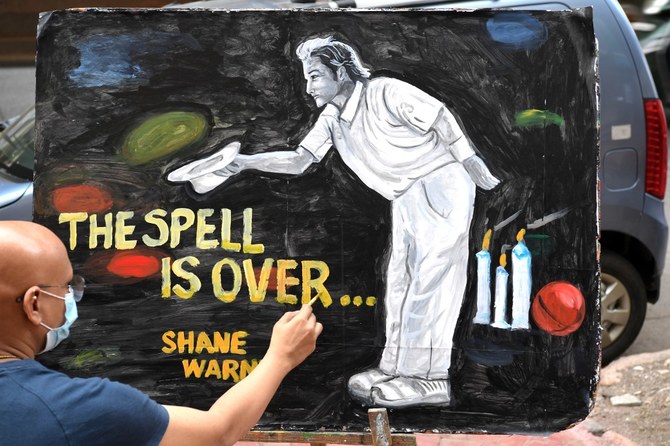

Cricket and the wider world have been stunned by the sudden loss of two greats of the Australian and international game, Shane Warne and Rod Marsh. I was fortunate to have seen them both play and watching their on-field personae gave some clues as to their off-field ones.
Warne’s hunting down of batsmen, physically and psychologically, implied a shrewd operator who pushed boundaries. He admitted as much, saying that he would not have liked to face himself on the pitch. He was, for many, the finest leg spin bowler of all time.
Former Australian captain, leg spinner and celebrated commentator Richie Benaud had no doubt, pointing out that when he took his final, 248th, Test wicket, he had played 63 Tests. It took Warne the same number to reach 300 Test wickets.
The art of leg spin bowling is the most difficult variety to master, especially in achieving consistent accuracy. Strong wrists and fingers are needed. In Warne’s case, these were developed after, aged six, he broke both of his legs and used his wrists to propel himself around on a trolley. Out of adversity came strength. However, Warne’s ambition was to play Australian rules football in Melbourne, but he did not make the grade. What a loss to cricket he would have been.
Unlike Warne, young Marsh was determined to make cricket his life, rising from the age of eight through the various cricket grades in Perth. Despite his tough and craggy competitiveness, Marsh had a keen sense of the spirit of cricket. This was apparent in several events. First, he was the wicketkeeper when his captain, Greg Chappell, ordered his younger brother, Trevor Chappell, to bowl the last ball of a match against New Zealand using an underarm delivery. This deprived the striker the opportunity to hit a six, which would have leveled the scores. Marsh stood arms folded, shaking his head in dismay, disbelief and disappointment at this blatant contravention of the spirit of cricket.
Although, at the time, it was not breaking the law, Benaud, commenting on the incident, called it “one of the worst things I have seen done on a cricket field.”
A second example was during the Centenary Test between Australia and England in 1977 when the match was in the balance. England’s Derek Randall had been given out, but Marsh insisted that he was recalled since Marsh knew that he had taken the ball on the bounce.
His brash and aggressive exterior, walrus mustache and squat physique concealed a humorous, thoughtful, astute person. The first impressions that Marsh made on the fearsome Australian fast-bowler Dennis Lillee, were that “he was a scruffy, overweight, beer-swilling intellectual, a pianist and a good singer.” Later, they became formidable allies.
After retiring from Test cricket in 1984, Marsh spent four years commentating, before spending 10 years as coach and director of the Australian Cricket Academy. Surprisingly, in 2001, he moved to head the England and Wales Cricket Board’s National Academy. The following year, much to the shock of many English cricket supporters, this one included, he also became a selector, staying until 2005, when England regained the Ashes. What a delicious irony this was, one of Australia’s most rugged competitors, fiercely “anti-pom” on the field, helping the old enemy to beat his own country, for which he played with such distinction in a long career.
It might have been so different. In his debut in the 1970-71 Ashes, Marsh made glaring errors and was christened “Iron Gloves,” leading to calls for him to be dropped. The selectors stuck by him and he went on to be the scourge of England and its long-suffering supporters for another 13 years.
There is a similarity with Warne in that his early performances for Australia were inauspicious. Midway through his third Test match in 1992, he had taken a single wicket and conceded 335 runs. Then, he claimed the last three wickets for no runs, clinching a remarkable 16-run victory for Australia. Such stunning match-winning performances were to characterize his career.
In 1993, Warne announced himself to England with his very first Test match delivery there. The so-called “Ball of the Century” swerved toward the leg stump, pitched outside it, turned sharply past the defensively positioned bat and clipped the off-stump bail. Warne described the ball as a fluke, but it immortalized his reputation as a showstopper. By the time he played his last Test at Sydney in January 2007, he had taken 708 Test wickets, of which 195 were English.
Needless to say, his landmark 700th wicket was taken against England in the previous month at Melbourne.
In his last Test match in England at the Oval in 2005, drama continued to follow Warne. Although he claimed 12 wickets in the match and bowled a spell of 31 overs, he will be remembered for dropping a crucial and straightforward catch. This was offered by Kevin Pietersen, who saved the match for England, when he had scored 15, surviving to reach 158. In an effort to recover Australia’s advantage, Warne bowled a spell of 31 overs, at the end of which he received a standing ovation, coupled with chants of “Warnie dropped the Ashes.”
It was also the time when the crowd was variously reported to have chanted “bet you wish you were English” or “we only wish you were English,” to which Warne took off his hat, doffed it and bowed. How they loved it.
Warne was theater, a cricketing genius, with a shrewd cricket brain and relatable human frailties. His blond hair, earring, sunblock and tendency to chubbiness oozed nonconformity. He strolled to his delivery stride, before looping the ball with unerring accuracy, capable of spinning it prodigiously. The respect that spectators and most fellow professionals had for him was clear, as it was for Marsh. Both harbored largely unrealized captaincy aspirations. As players in separate eras, they made cricket life for English cricketers and supporters very uncomfortable, sometimes embarrassing. Nevertheless, it was a privilege to have watched these skilled entertainers in action.


