

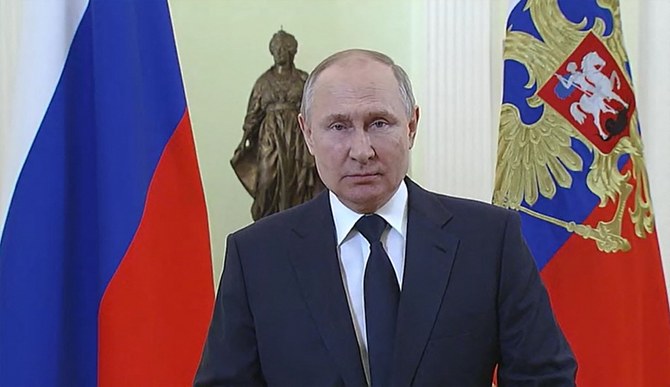

RIYADH: Russia is adhering to its obligations on energy supplies, President Vladimir Putin told a government meeting, after the United States banned Russian oil imports.
Putin said Western sanctions against Russia were not legitimate, and Western governments were deceiving their own people. Russia would calmly solve its problems, he said.
Speaking at the same meeting, Finance Minister Anton Siluanov said Russia had taken measures to limit outflow of capital and that the country would service its external debts in roubles.
HIGHLIGHTS
• Britain imposed sanctions on Chelsea soccer club owner Roman Abramovich and Igor Sechin, chief executive of Russian oil giant Rosneft, hitting them with asset freezes and travel bans over their links to Russian President Vladimir Putin
• The United States imposed a wide ban on Russian oil and gas imports, while Britain said it would stop buying its oil and oil products by the end of 2022
• The European Union has said it will also aim to wean itself off a dependency on Russian hydrocarbons
Oil prices
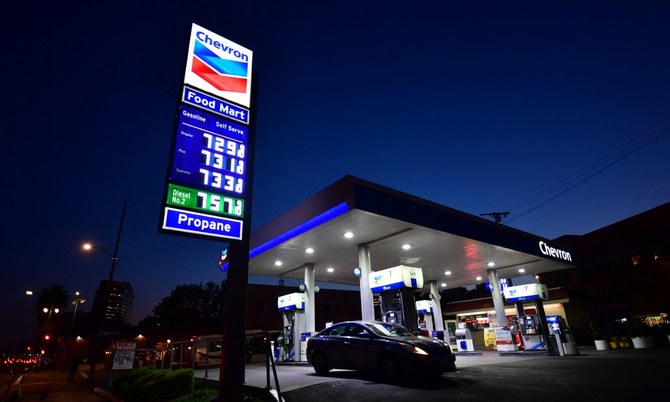
Oil prices rose on Thursday following a sharp drop in the previous session as the market contemplated whether major producers would boost supply to help plug the gap in output from Russia due to sanctions for its invasion of Ukraine.
Brent crude slightly increased by 0.18 percent, reaching $111.34 a barrel as of 5:24 p.m GMT, while US benchmark WTI traded at $108.70
UAE energy minister makes his stand clear
UAE Energy Minister Suhail Al-Mazrouei said on Twitter late on Wednesday his country is committed to the existing agreement by the Organization of the Petroleum Exporting Countries and allies including Russia, together called OPEC+, to ramp up oil supply by 400,000 barrels per day monthly following sharp cuts in 2020.
“The UAE believes in the value OPEC+ brings to the oil market,” Al-Mazrouei said. Just hours before, prices slumped on comments from UAE’s ambassador to Washington saying his country will be encouraging OPEC to consider higher output to fill the supply gap due to sanctions on Russia after it invaded Ukraine. Russia calls its incursion a “special operation” to disarm its neighbor.
The UAE's ambassador to Washington, Yousef Al Otaiba, told CNN on Wednesday the country wants to increase oil production and will encourage the Organization of the Petroleum Exporting Countries cartel to ramp up supply.
Otaiba's comments sent oil prices dropping like a rock Wednesday. US oil fell 12% to less than $109 a barrel. Brent crude, the global benchmark, fell 13% to $111 a barrel. It marked their steepest one-day decline in nearly two years.
The comments from UAE officials came as the market also took into account moves by the United States to ease sanctions on Venezuelan oil and efforts to seal a nuclear deal with Tehran, which could lead to more oil supply coming from Iran later this year.
OPEC+ agreement in its current form coming to an end?
While UAE and Saudi Arabia have spare capacity, some other OPEC+ producers are struggling to meet their output targets due to underinvestment in infrastructure over the past few years, which will limit their ability to lift output further.
“We think it will be challenging for OPEC+ to boost production in this environment,” Commonwealth Bank commodities analyst Vivek Dhar said.
However, Standard Chartered analysts predicted OPEC would look to fill the Russian supply gap, “effectively ending the OPEC+ agreement in its current form.”
Biden uses executive powers to impose a ban on Russian oil
A majority of the US House of Representatives on Wednesday voted to impose a ban on imports of Russian oil and other energy products in retaliation for Moscow’s ongoing attack on Ukraine.
With the vote still underway, the Democratic-controlled House was poised to pass the bill after President Joe Biden on Tuesday used his executive powers to impose such a ban.
Gold prices drop
Gold prices fell on Thursday, as global shares rallied tracking Wall Street gains following a retreat in oil prices, after the United Arab Emirates said it would help increase oil production, making safe-haven bullion less appealing.
Spot gold fell 0.8 percent to $1,975.79 per ounce by 0420 GMT, after prices slumped 1 percent earlier in the session. US gold futures shed 0.3 percent to $1,982.40.
The safe-haven metal pulled back about 3 percent in the previous session, its worst intraday decline since January 2021, dropping from a near-record high since August 2020 hit on Tuesday.
Russian oil
Russian firms have encountered problems in securing financing for April contracts to sell crude and oil products, but the situation can be resolved, Deputy Prime Minister Alexander Novak was quoted as saying by Interfax news agency on Thursday.
Novak said Russia has been working with the oil companies and the buyers to find other ways of payment, without a need for letters of credit.
“We are finding other ways, for example, with Chinese companies — this is not a comprehensive method, these are isolated cases,” he was quoted as saying.
Shell
Shell faces writedowns on $400 million in Russian downstream assets, it said on Thursday, having announced $3 billion worth of other projects previously.
The oil major announced on Feb. 28 that it would quit its ventures in Russia with Gazprom and related entities including the flagship Sakhalin 2 liquefied natural gas plant and the Nord Stream 2 pipeline project.
“It is expected that these decisions ...will impact the carrying value of the related assets and lead to recognition of impairments in 2022,” Shell said in its annual report on Thursday.
Shell’s looming writedowns come amid a mass exodus of western oil majors, which includes BP facing a $25 billion writedown for its planned divestment of Russian assets.


