

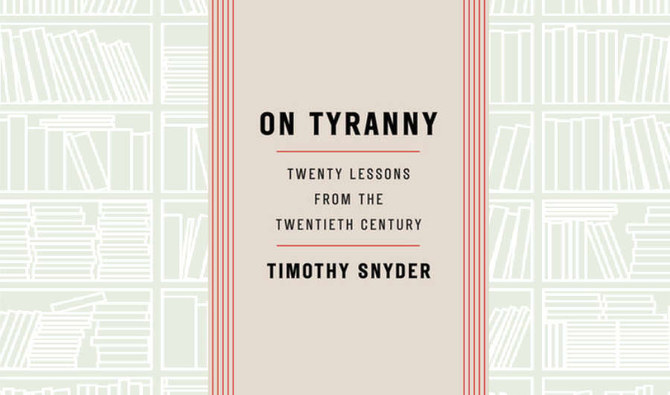
What We Are Reading Today: On Tyranny: Twenty Lessons from the Twentieth Century

Photo/Supplied
Short Url
Updated 11 March 2022
Follow

What We Are Reading Today: On Tyranny: Twenty Lessons from the Twentieth Century

Author: Timothy Snyder

“On Tyranny: Twenty Lessons from the Twentieth Century” is a timely political manifesto by multiple award-winning US historian and Yale University professor Timothy Snyder.
The book explores the notion of tyranny in its present form, drawing on lessons offered by history and past experience.
Snyder analyzes authoritarianism and shows how tyranny takes shape in contemporary  American politics.
The book is written as a guide, with topics ranging from encouraging patriotism, rather than nationalism, to contributing to good causes.
In chapter four, “Take Responsibility for the Face of the World,” Snyder shines a light on the power of gestures seeking to mobilize people toward a single agenda or viewpoint.
Readers are urged to confront humanity’s past mistakes and be aware of the threat posed by hateful symbols, such as the Soviet Union’s portrayal of wealthy farmers as pigs in order to justify their slaughter.
“On Tyranny” was published in 2017 and appeared on The New York Times bestseller list shortly afterwards where it remained until late 2021.
Snyder has also won global recognition for his history research and contributions to academia.
He graduated from Brown University and earned a Ph.D. from the University of Oxford before joining Yale as professor of modern East European political history.
Among his most celebrated books is “Bloodlands: Europe Between Hitler and Stalin,” which has translated into more than 30 languages and received 12 awards, including the Leipzig Award for European Understanding and the Emerson Prize in the Humanities.


What We Are Reading Today: ‘Rituals of War’

Photo/Supplied
Updated 29 December 2025
Follow

What We Are Reading Today: ‘Rituals of War’

  • Bahrani brings together and analyzes facets of war and sovereign power that fall under the categories of representation and display, the aesthetic, the ritualistic, and the supernatural

Author: Zainab Bahrani

“Rituals of War” is an investigation into the earliest historical records of violence and biopolitics. In Mesopotamia, ancient Iraq (ca. 3000–500 BC) rituals of war and images of violence constituted part of the magical technologies of warfare that formed the underlying irrational processes of war. In the book, three lines of inquiry are converged into one historical domain of violence, namely, war, the body, and representation.

Building on Foucault’s argument in “Discipline and Punish” that the art of punishing must rest on a whole technology of representation, Zainab Bahrani investigates the ancient Mesopotamian record to reveal how that culture relied on the portrayal of violence and control as part of the mechanics of warfare. Moreover she takes up the more recent arguments of Giorgio Agamben on sovereign power and biopolitic to focus on the relationship of power, the body and violence in Assyro-Babylonian texts and monuments of war.

Bahrani brings together and analyzes facets of war and sovereign power that fall under the categories of representation and display, the aesthetic, the ritualistic, and the supernatural.