

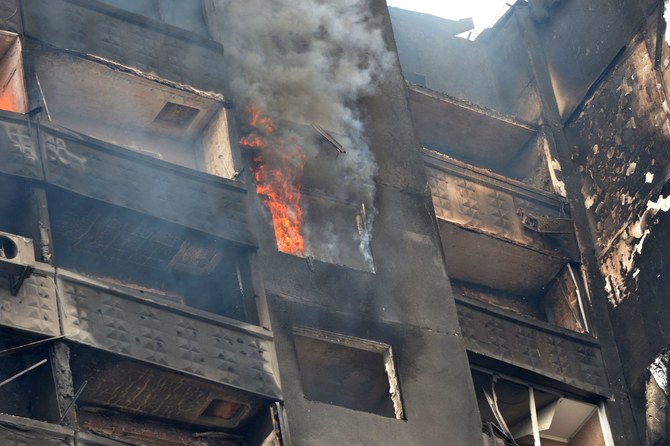

LVIV: Persistent fighting blocked efforts to evacuate 200,000 people from the besieged Ukrainian city of Mariupol for a second day in a row on Sunday as Russian President Vladimir Putin vowed to press ahead with his offensive, which he said was going to plan, unless Kyiv surrendered.
Most people trapped in the port city are sleeping underground to escape more than six days of near-constant shelling by encircling Russian forces that has cut off food, water, power and heating supplies, according to the Ukrainian authorities.
The civilian death toll from hostilities across Ukraine since Moscow launched its invasion on Feb. 24 stood at 364, including more than 20 children, the United Nations said on Sunday, adding hundreds more were injured.
The UN High Commissioner for Human Rights said most civilian casualties were caused by the use of “explosive weapons with a wide impact area, including shelling from heavy artillery and multi-launch rocket systems, and missile and air strikes.”
Moscow has repeatedly denied attacking civilian areas.
In Irpin, a town some 25 km (16 miles) northwest of the capital Kyiv, men, women and children trying to escape heavy fighting in the area were forced to take cover when missiles struck nearby, according to Reuters witnesses.
Soldiers and fellow residents helped the elderly hurry to a bus filled with frightened people, some cowering as they waited to be driven to safety.
The invasion has drawn almost universal condemnation around the world, sent more than 1.5 million Ukrainians fleeing from the country, and triggered sweeping Western sanctions against Russia aimed at crippling its economy. The Biden administration said on Sunday it was exploring banning Russian oil imports.
“War is madness, please stop,” Pope Francis said in his weekly address to crowds in St. Peter’s Square, adding that “rivers of blood and tears” were flowing in Ukraine’s war.
Putin made his demand for Kyiv to end the fighting in a phone call with Turkish President Tayyip Erdogan, who appealed for a cease-fire. Putin told Erdogan he was ready for dialogue with Ukraine and foreign partners but any attempt to draw out negotiation would fail, a Kremlin statement said.
Russian media said Putin also spoke by phone for almost two hours with French President Emmanuel Macron. Macron told Putin he was concerned about a possible imminent attack on southern Ukraine’s historic port city of Odessa, Macron’s office said.
“No to war”
Anti-war protests took place around the world including in Russia itself, where police detained more than 4,300 people, an independent protest monitoring group said. The interior ministry said 3,500 demonstrators had been held, included 1,700 people in Moscow and 750 in St. Petersburg.
Thousands of protesters chanted “No to war!” and “Shame on you!,” according to videos posted on social media by opposition activists and bloggers. Reuters was unable to independently verify the footage and photographs.
Demonstrations were also taking place in Western capitals as well as in India and Kazakhstan, after jailed Kremlin critic Alexei Navalny called for worldwide protests against the war.
In the besieged city of Mariupol, authorities had said on Sunday they would make a second attempt to evacuate some of the 400,000 residents. But the cease-fire plan collapsed, as it had on Saturday, with each side blaming the other.
The International Committee of the Red Cross said the failed attempt to evacuate 200,000 people had underscored “the absence of a detailed and functioning agreement between the parties to the conflict.”
“They’re destroying us,” Mariupol mayor Vadym Boychenko told Reuters in a video call, describing the city’s plight before the latest evacuation effort failed. “They will not even give us an opportunity to count the wounded and the killed because the shelling does not stop.”
US Secretary of State Antony Blinken said the United States has seen very credible reports of deliberate attacks on civilians in Ukraine, adding that Washington was documenting them to support appropriate organizations in their potential war crimes investigation over Russia’s actions.
Moscow calls its campaign a “special military operation,” saying it has no plans to occupy Ukraine.
A huge Russian convoy north of Kyiv appears to have made limited progress in recent days, although Russia’s defense ministry released footage on Sunday showing some tracked military vehicles on the move.
In the capital, Ukrainian soldiers bolstered defenses by digging trenches, blocking roads and liaising with civil defense units as Russian forces bombarded areas nearby.
Ukrainian President Volodymyr Zelenskiy said Russian rockets had destroyed the civilian airport of the central-western region capital of Vinnytsia on Sunday.
Russian forces opened fire at a protest against their occupation of the southern Ukrainian city of Nova Kakhovka on Sunday, wounding five people, Ukrainian news agency Interfax Ukraine said, citing eyewitnesses.
The World Health Organization said there had been several attacks on Ukrainian health care facilities during the conflict, causing deaths and injuries. It gave no details.
Plea for more weapons
Kyiv renewed its appeal to the West to toughen sanctions, and also requested more weapons, including a plea for Russian-made planes, to help it repel Russian forces.
Speaking on a trip to neighboring Moldova, Blinken said Washington was considering how it could backfill aircraft for Poland, if Warsaw decided to supply its warplanes to Ukraine.
Putin says he wants a “demilitarised,” “denazified” and neutral Ukraine, and on Saturday likened Western sanctions “to a declaration of war.”
The West, which calls Putin’s reasons for invading baseless, has expanded effort to rearm Ukraine, sending in items from Stinger missiles to anti-tank weapons. But Washington and its NATO allies have resisted Ukraine’s plea for a no-fly zone, saying it would escalate the conflict beyond Ukraine’s borders.
Ukrainians continued to pour into Poland, Romania, Slovakia and elsewhere. The United Nations said over 1.5 million had fled in Europe’s fastest growing refugee crisis since World War Two.
Western sanctions have pushed many companies to exit investments in Russia, while some Russian banks have been shut out of a global financial payment systems, driving down the rouble and forcing Moscow to jack up interest rates.
On Sunday, American Express Co. said it was suspending all operations in Russia and Belarus. Video sharing app TikTok said it was suspending livestreaming and the uploading of new content to its service in Russia.
Speaking on NBC’s “Meet the Press” show, Blinken said the United States and European partners are exploring banning Russian oil imports, but stressed the importance of steady oil supplies globally.
The West has so far refrained from direct measures on Russian energy exports after oil soared to multi-year highs.
Ukraine’s military said more than 11,000 Russian troops had been killed so far and 88 Russian aircraft shot down since the start of the invasion. Reuters could not corroborate the claim. Russia has not given regular updates on its death toll.
Tass news agency cited Russian defense ministry spokesman Igor Konashenkov as saying virtually the entire Ukrainian air force had been destroyed. In the last 36 hours alone, he said, Ukraine had lost 11 combat aircraft and two helicopters. Reuters had no way of corroborating the claim.


