



NEW DELHI: Three recent recoveries of ancient statues stolen from Indian heritage sites have put a spotlight on the country’s hunt for looted artifacts, with the government and activists vowing to increase efforts to bring missing treasures home.
Many artifacts were looted from Indian temples and religious pilgrimage sites during colonial times.
After India’s independence from British rule in 1947, they continued to fall victim to theft, forcing the country to enact a law banning the export of any sort of archaeological objects and granting archeological sites state ownership in 1972.
Despite the law, 50,000 statues and artifacts had been stolen and sold abroad according to UNESCO estimates from the late 1980s.
The current number is likely to be much higher.
Efforts to retrieve them have increased since 2014, and hundreds have been returned to their place of origin.
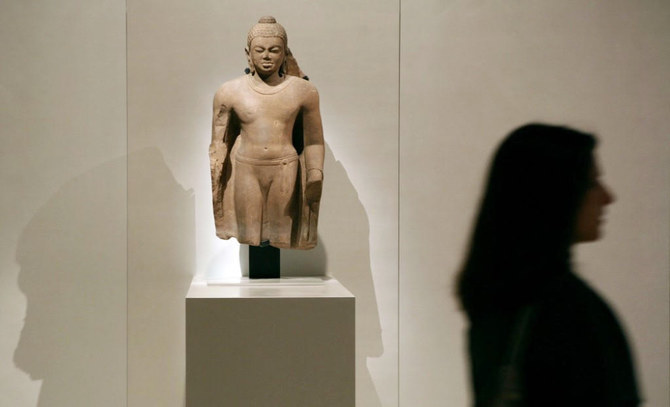
The most recent artifact repatriations were of a 10th century goat-headed Yogini sculpture from England, a 1,200-year-old Buddha relic discovered in Italy, and a 14th century Hanuman idol found in Australia.
“Since 2014, we have recovered more than 300 artifacts,” S. Vijay Kumar, who has been tracing lost Indian heritage since 2004, told Arab News this week.
Kumar founded the volunteer-run India Pride Project in 2014 to do background research on, catalogue, and track missing Indian artifacts worldwide.
His book, “The Idol Thief,” is a true account of events surrounding heritage theft, describing the story of now-jailed Indian American art dealer Subhash Kapoor, who specialized in selling antiquities from across India and Southeast Asia to museums around the world.
Kumar’s volunteer group was involved in finding the three recently recovered statues.
The Buddha statue had gone missing in early 2000 from its altar at one of India’s most important Buddhist pilgrimage sites, the Devisthan Kundalpur Temple in Bihar.
It was received by the Consulate General of India in Milan in February.
The Yogini sculpture vanished from a temple in Lokhari, Uttar Pradesh around 40 years ago and was discovered in England in 1988 on the London art market.
It was returned to Indian authorities in December.
The bronze Hanuman statue was stolen from Vellore, Tamil Nadu, in 2012. Last week, it was handed over to the Indian High Commission in Canberra.
“The whole idea of India’s Pride Project is to restore India’s pride, because our idols are being stolen and being auctioned blatantly, which I feel impacts India’s pride,” Kumar said.
“There should be strict laws dealing specifically with the theft of antiques and the local police should be interested in lodging cases when heritage is stolen.”
Christopher A. Marinello, a London-based lawyer and the founder of Art Recovery International, who specializes in tracking down looted and stolen art and has been cooperating with Kumar since the early 2000s, told Arab News that art recovery work was his “way of giving back.”
He said: “I have been to India and feel overwhelmed by its culture and people and I feel that if I can help in bringing India’s cultural heritage home, I will do it.”
The investigation to track down the Buddhist idol recovered from Italy took him and Kumar several years.
“My team and I managed to track it down and reach the actual possessor of (the) sculpture, and we presented him the evidence of it being looted from India, and he cooperated,” Marinello said.
“The owner realized that things are changing in the market, and it is no longer acceptable to own the cultural heritage of another nation.”
The recent return of the three artifacts, in which Kumar and Marinello were involved, was discussed by Prime Minister Narendra Modi in his radio program “Mann ki Baat” last week. “It is our responsibility towards Mother India to bring home these idols,” Modi said.
“These idols embody a part of the soul of India. Faith as well. They also have a cultural-historical significance. Realizing this responsibility, India increased her efforts.”


