

Death toll climbs to 63 in Pakistan mosque attack claimed by Daesh

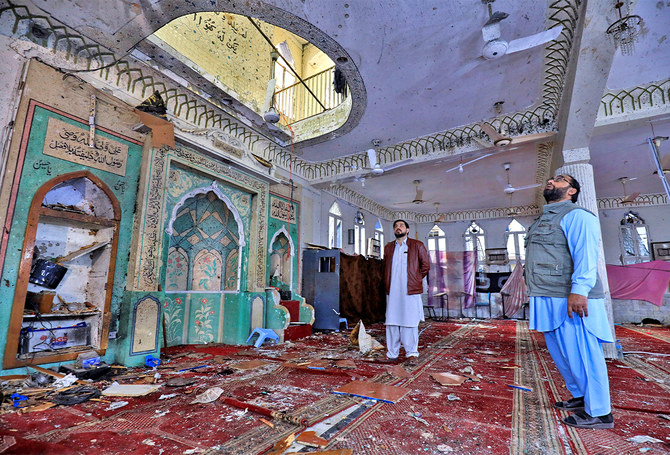
People stand amid the damages at the prayer hall after a bomb blast inside a mosque during Friday prayers in Peshawar, Pakistan, on March 4, 2022. (REUTERS)
Short Url
Updated 05 March 2022
Follow

Death toll climbs to 63 in Pakistan mosque attack claimed by Daesh

  • Official says four of 38 patients still hospitalized are in critical condition
  • Pakistan has seen renewed militant attacks after years of relative quiet

PESHAWAR: Officials vowed Saturday to hunt down and arrest the masterminds behind a deadly mosque attack, claimed by the Daesh militant group, that killed 63 people and wounded nearly 200 in Pakistan a day ago.  

Daesh said in a statement the lone suicide bomber was from neighboring Afghanistan. He shot two police guarding the Shiite mosque in northwest Peshawar before entering inside and exploding his device, it said. The attack took place as worshipers knelt in Friday prayer. 

The death toll was likely to continue to rise, said Asim Khan, spokesman for Peshawar’s Lady Reading Hospital. At least four of 38 patients still hospitalized were in critical condition, he said. 

The Taliban rulers in Afghanistan, who have been fighting Daesh, condemned the attack. Daesh has proven to be the Taliban's greatest security threat since sweeping into power last August.  

“We condemn the bombing of a mosque in Peshawar, Pakistan. There is no justification for attacking civilians and worshipers," Taliban Deputy Minister for Culture and Information Zabihullah Mujahid tweeted. He refused to comment on the Daesh claim that the suicide bomber was Afghan.  

Late into Friday night and early Saturday, Pakistanis buried their dead amid heavy security, with sniffer dogs deployed. Police carried out body searches of mourners who were then searched a second time by security provided by Pakistan's Shiite community.  

Hundreds of mourners crying and beating their chests attended funeral prayers for 13 victims late Friday and for another 11 on Saturday at Peshawar's Kohati Gate. The coffins were covered with shrouds, some with Quranic sayings. They were lined up on open ground, made visible by bare light bulbs.  

"These were human beings and worshipers inside the mosque, and they were brutally killed at a time when they were busy praying to God," Hayat Khan told The Associated Press late Friday night as he buried a relative.  

One of the police officers who was shot outside Kucha Risaldar mosque died immediately and the second died later from his wounds, police officials said.  

Pakistani Information Minister Chaudhry Fawad Hussain said in a statement that three investigation teams were established to study forensic evidence and closed-circuit TV footage to track down the attack's organizers.  

In CCTV footage seen by The Associated Press, the lone attacker concealed his bomb beneath a large black shawl. The footage showed the bomber moving quickly up a narrow street toward the mosque entrance. He fired at the police protecting the mosque before entering inside.  

Within seconds, there is a powerful explosion and the camera lens is obscured with dust and debris. The crudely made device was packed with ball bearings, a deadly method of constructing a bomb to inflict maximum carnage because it sprays deadly projectiles over a large area. The ball bearings caused the high death toll, said Moazzam Jah Ansari, the top police official for Khyber Pakhtunkhwa province, where Peshawar is the capital.  

Immediately after the bombing, Pakistan's Shiites slammed the government for lax security arrangements demanding greater attention to their safety.  

Friday's attack in Peshawar's congested old city was the worst in years in Pakistan. The country has seen renewed militant attacks after several years of relative quiet that followed military operations against militant hideouts in the border regions with Afghanistan.  

The attacks have mostly been carried out by the Pakistani Taliban since last August when the Afghan Taliban swept into power and America ended its 20-year involvement in Afghanistan. The Pakistani Taliban are not connected to the new Afghan rulers. However, they are hiding out in Afghanistan and despite Pakistan's repeated request to hand them over, none have yet been found and expelled.  

Daesh is an enemy of the Afghan Taliban and has carried out successive operations against them since coming into power last year. Pakistani security officials have insisted Daesh has little presence in Pakistan, yet in their statement claiming responsibility for the mosque attack, the group vowed to carry out more attacks in both Pakistan and Afghanistan.  

“Islamic State (Daesh) fighters are constantly targeting Shiites living in Pakistan and Afghanistan despite the intense security measures adopted by the Taliban militia and the Pakistani police to secure Shi’a temples and centers," said the Daesh statement carried on its Amaq News Agency site. 


Pakistan’s ‘Air Punjab’ faces scrutiny over Gulfstream jet purchase

Updated 6 sec ago
Follow

Pakistan’s ‘Air Punjab’ faces scrutiny over Gulfstream jet purchase

  • Punjab government calls luxury jet part of planned airline awaiting regulatory approval
  • Aviation experts question the viability of the 17-seat aircraft for commercial operations

ISLAMABAD: Aviation experts and an official on Saturday questioned the commercial viability of the move as the Punjab government said it had acquired a Gulfstream luxury aircraft as part of “Air Punjab,” an upcoming airline registered with the Securities and Exchange Commission of Pakistan (SECP) but yet to secure key regulatory approvals.

The development comes months after the federal government moved ahead with the privatization of Pakistan International Airlines (PIA), citing its inability to sustainably run the debt-ridden national carrier.

Air Punjab (Private) Limited was incorporated with the SECP on July 24, 2025, under registration number 0302317. The concept was first introduced by Punjab Chief Minister Maryam Nawaz in April 2025, with plans to launch operations within a year using leased aircraft. The provincial cabinet subsequently approved the airline’s establishment. However, an official told Arab News that the project remains at a preliminary stage.

“They have not got their license yet,” the official in the aviation department told Arab News on condition of anonymity, adding the airline still has to go through processes to be able to start operations.

The aircraft in question, a Gulfstream G500, registration N144S, arrived in Lahore from North America in December 2025 and began local flight operations on February 6, 2026. Online flight records show the jet was used at least 15 times between February 9 and February 18 for short trips to cities including Lahore, Rawalpindi, Sialkot, Dera Ghazi Khan and Faisalabad, with flight durations ranging from 14 to 37 minutes. It frequently used the call sign “Punjab 2.”

Responding to criticism that the aircraft had been inducted for the Punjab chief minister, the provincial information minister Azma Bukhari on Friday defended the purchase.

“For our ‘Air Punjab,’ we are buying various aircraft and some we will take on lease,” she said. “This means we have to build a fleet which will have all kinds of planes, and this is a part of that same link. Right now, as soon as the matters on this are finalized, I will definitely tell you.”

The aviation official said the aircraft was a 17-seater and couldn’t be used for commercial flights.

“The smallest aircraft used for commercial operations now is the ATR, which has around 48 [ATR 42-500] to 70 [ATR 72-500] seats. How can an airline be operated with a Gulfstream jet that is configured for VIP travel and has previously been used for executive flights? It is not commercially viable,” he said.

Speaking about the technical aspects, Afsar Malik, an independent aviation expert, said the provincial minister had probably been mistaken when she said the aircraft was for the upcoming airline.

“The Gulfstream is state aircraft and state aircraft cannot be used for commercial purpose,” he said. “Secondly, it’s not commercially viable. If Punjab information minister has said it, it would either be a slip of the tongue or ignorance.”

The planned launch of the provincial carrier comes as Pakistan’s aviation sector tries to recover from its deepest crisis in decades. The industry’s decline was interrupted in late 2025 by the federal government’s sale of the debt-ridden national carrier, Pakistan International Airlines (PIA), to a private consortium after the state could not sustain losses exceeding 800 billion rupees ($2.8 billion).

The private sector has proven equally volatile. Regulators recently suspended the license of Serene Air after its entire five-aircraft fleet was deemed “unserviceable,” leaving it with zero operational capacity.

“Twelve airlines have shut down since the sector’s inception,” said aviation consultant Irshad Ghani, noting that Serene Air joined a long list of failed carriers including Shaheen Air and Bhoja Air.

High capital requirements and rising airfares have hollowed out the domestic market, leaving ventures like Air Punjab facing immense skepticism in an industry Ghani describes as “fragile.”

Ghani, who heads an aviation consultancy firm, said PIA had operated 19-seater ATR turboprop aircraft in the past, particularly to serve smaller airports such as Sargodha where larger jets could not land. However, he drew a distinction between turboprops designed for commercial routes and executive jets.

“As far as the Gulfstream jet is concerned, it has been operated as a chartered aircraft, and it can also be used for charter operations by an airline. However, that would typically be the case for a well-established or large airline,” Ghani said.

He questioned the broader logic of the project.

“The question arises: when the federal government has just sold the national airline, acknowledging that the government could not successfully run it, how logical is it for a provincial government to operate its own airline?” he asked.

Ghani said he doubted it will be run successfully.

“If Punjab had the capacity to operate a public airline, why didn’t it consider purchasing PIA instead,” he wondered.

Minister Bukhari did not respond to Arab News queries regarding the Gulfstream and Air Punjab.