

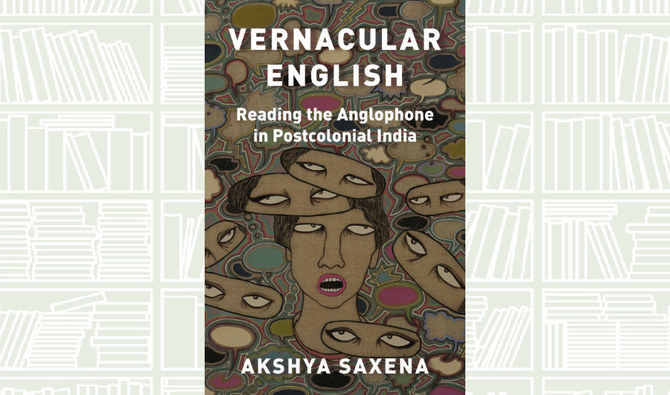
What We Are Reading Today: Vernacular English: Reading the Anglophone in Postcolonial India

Short Url
Updated 05 March 2022
Follow

What We Are Reading Today: Vernacular English: Reading the Anglophone in Postcolonial India

Author: Akshya Saxena

Against a groundswell of critiques of global English, Vernacular English argues that literary studies are yet to confront the true political import of the English language in the world today. A comparative study of three centuries of English literature and media in India, this original and provocative book tells the story of English in India as a tale not of imperial coercion, but of a people’s language in a postcolonial democracy.
Focusing on experiences of hearing, touching, remembering, speaking, and seeing English, Akshya Saxena delves into a previously unexplored body of texts from English and Hindi literature, law, film, visual art, and public protests. She reveals little-known debates and practices that have shaped the meanings of English in India and the Anglophone world, including the overlooked history of the legislation of English in India. She also calls attention to how low castes and minority ethnic groups have routinely used this elite language to protest the Indian state.
Challenging prevailing conceptions of English as a vernacular and global lingua franca, Vernacular English does nothing less than reimagine what a language is and the categories used to analyze it.


What We Are Reading Today: ‘The Treehouse’

Photo/Supplied
Updated 10 January 2026
Follow

What We Are Reading Today: ‘The Treehouse’

  • Walter excels at building tension and sustaining dread

Author: B P Walter

“The Treehouse” by B P Walter unsettles readers with a story told through the eyes of the perpetrators of a horrible crime. It follows two brothers in their 30s — Robert and Kieran — who are bound by blood, secrets, and a terrible act they committed in their youth. Their inner world is an uneasy position for the reader to inhabit, and at its best, the novel leans into that discomfort. 

This 2025 psychological thriller begins with the broadcast of a television series titled “The Treehouse.” The brothers notice a resemblance between the show and their past that is impossible to ignore.

Someone knows, or seems to know, what they did all those summers ago during a family holiday in Cornwall. Someone has taken their secret and turned it into entertainment. For Robert, especially, the fear of being exposed is suffocating. 

Walter excels at building tension and sustaining dread. The anxiety that coils through Robert’s thoughts is convincing, and the dynamic between the brothers becomes increasingly claustrophobic and toxic as the story unravels. It is clear that this is a family, a household, where love exists alongside something far darker.

The question of what exactly happened in the treehouse in 2004 hums beneath every chapter. Yet, despite a compelling premise and moments of real shock, the novel ultimately fell a little flat for me.

The opening is gripping, but once the story settles into the extended childhood timeline, the pacing begins to falter. The past is important, but it dominates the narrative to the point that the present-day thread, which felt sharper and more urgent with its high stakes, is left wanting. 

The limited presence of secondary characters also makes it ultimately feel more predictable than it should, lacking the external conflicts that made the first act of the book so promising. The twists and turns of the final act arrive in quick succession and are less than satisfying.

This was also a difficult book to emotionally connect with; The characters are flawed, often unlikable, and while that may be intentional, it created distance rather than intrigue. 

“The Treehouse” did not hold my attention in the same way as some of Walter’s previous thrillers. It’s a story that seems to linger more for the atmosphere it creates than for where it takes the reader.