

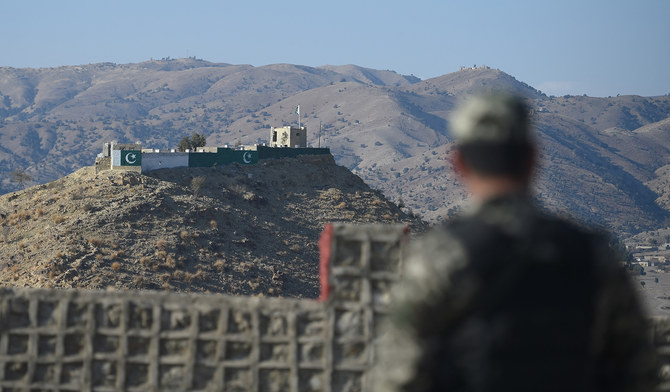

NORTH WAZIRISTAN: Islamabad was not holding any "direct talks" with the Pakistani Taliban and only diplomatic engagement with Afghanistan had been ongoing in this regard, a senior Pakistani security official said on Friday.
The Pakistani Taliban, or the Tehreek-e-Taliban Pakistan (TTP), is a separate movement from the Afghan Taliban and has fought for years to overthrow the government in Islamabad and rule with its own brand of Islamic law. The military outfit is regrouping and reorganizing, with its leadership headquartered in the neighboring Afghanistan, according to a UN report from July last year.
In December, the group declared an end to a month-long cease-fire arranged with the aid of the Afghan Taliban, accusing the Pakistan government of breaching terms, including a prisoner release agreement and the formation of negotiating committees. The government denies the accusations.
Last week, Pakistan’s interior minister Sheikh Rashid Ahmed said the government was holding talks with the Pakistani Taliban, but the two sides had not reached any conclusion so far.
"No direct talks with TTP are ongoing but only diplomatic engagement is going on with the Afghan Taliban government to control them (TTP)," the Pakistani security official told a group of foreign journalists during a briefing in North Waziristan.
“Sometimes, locals informally engage with TTP through elders, ulemas and youth. The jirgas, masharans and maliks also go to the Afghan side to engage with them, we let them do it, so they are at liberty.”
He said as the group had fought alongside the Afghan Taliban against the Western forces for 20 years, therefore the Taliban government could only put pressure on the TTP to a "certain limit."
“We need to be very cognizant of the fact that TTP has supported them for 20 years, so the diplomatic pressure that Pakistan is putting on them (Afghan Taliban) and requesting them, it will work up to a certain limit,” he said.
“We should not have very high hopes that they are going to press them to the level that can create mess and unrest [in Afghanistan].”
The official, however, said they had considerably controlled infiltration and threat from the TTP in the country's northwest through border fencing, increased troop deployment and better border management, which had resulted in improving socio-economic development of locals.
Pakistan has fenced most of the 2,600-kilometer border despite protests from Kabul, which has always contested the British-era boundary demarcation that splits families and tribes on either side. The fencing was a main reason behind the souring of relations between previous Afghan governments and Islamabad.
In recent weeks, there have been multiple incidents of Afghan Taliban border guards trying to remove the fence or disrupt construction work.
“The fencing has been completed 100 percent in North Waziristan which has reduced infiltration up to 80 percent. Pakistan has ensured security through border fencing, increased deployment and effective border management,” the security official said.
“Five years ago, incidents took place in the area daily, but now there is a significant reduction in the number of incidents.”
The statement by the security official came hours after at least 50 people were killed and scores wounded in a suicide bombing at a minority Shia mosque in the northwestern city of Peshawar, police said.
The blast took place in the congested Qissa Khawani bazaar as people were offering the weekly Friday prayers at an imambargah. No group has yet claimed responsibility for the bombing.
Around 5000-6000 TTP fighters were based inside Afghanistan, the security official said, adding, “They do try to sneak into North and South Waziristan, but I will say that the threat is considerably reduced”.
Asked about the Afghan Taliban's reluctance to recognize the Durand Line as an international border, he said Pakistan had clearly told every Afghan government that it "is an international border and must be respected."
“With the help of locals on both sides, we were able to erect this fence and there is no demand from TTA (Afghan Taliban) to remove this fence,” he said. "The only thing they are saying is that the villages which are divided, some arrangement should be made for them so that they can move without trouble."
About development and economic opportunities through investment in the region, the official said it would only be possible by ensuring security and normalcy for the investors.
“Every step that we are taking towards normalcy it will automatically attract the investors. If there is no peace then no one will come to invest,” he said. "During the last 20 years, hundreds of major and minor operations were conducted in which many terrorists and foreign fighters were eliminated and many were driven out into Afghanistan."
Shahid Ali Khan, the deputy commissioner of North Waziristan, said the provincial government had increased the development budget for tribal districts from Rs16 billion to Rs60 billion this year.
“All the major roads have been reconstructed for better connectivity,” Khan told Arab News, adding 173 damaged health facilities were reconstructed and two more colleges would be constructed along with the three already operational in North Waziristan.
Umer Khatab, an additional assistant commissioner in Miranshah town, said improved security had made it possible to have smooth trade at the Ghulam Khan border crossing between Pakistan and Afghanistan.
"Around 100 trucks crossed the border terminal daily, with seasonal fruit and coal coming from Afghanistan and cement and other such materials going from Pakistan," Khatab told Arab News.
While locals welcome the increase in trade, there are fears of a return of the horrific violence too.
Malik Wakeel Khan, an elder of the Dawar tribe, acknowledged the security situation had improved after successive military offensives, but every scattered incident raised fears of deterioration in the law and order situation.
“It is evident that whenever some incident took place, it resulted in deterioration of the situation,” he told Arab News. “We are also trying and hopeful that complete peace and stability will return to North Waziristan.”
The tribespeople appreciate government’s efforts for the development of the area, but they believe the funds provided for the purpose are insufficient. “If the government increases funds for North Waziristan, it will bring more progress and betterment in the area,” Wakeel Khan said.
Malik Riaz, a tribal elder from Mir Ali town, asked the government to get major companies to explore minerals in the region to create jobs and increase the number of mini-markets to benefit the locals.
“We have a lot of minerals but don’t have resources to explore them. We would ask government to bring big companies especially from the Middle East for exploration, which will create jobs and reduce poverty in the area,” Riaz said.
Turbat Khan, who has an import-export business at the Ghulam Khan border terminal, requested the government to facilitate import and export by increasing the transit trade facilities.


