

Ton-up Imam-ul-Haq punishes faltering Australia in first Test

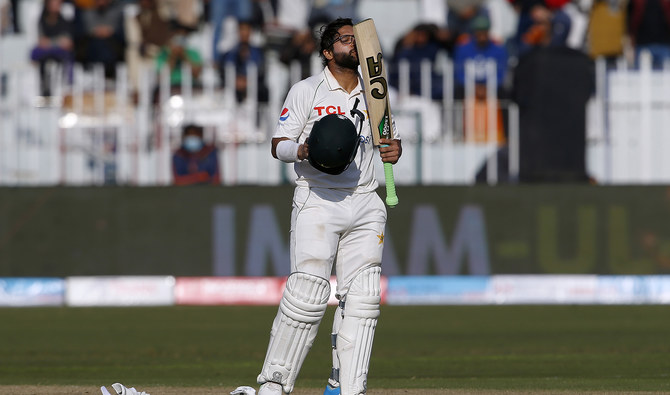
Pakistan's Imam-ul-Haq kisses his bat after completing a century during the 1st day of first cricket test match between Pakistan and Australia at the Pindi Stadium in Rawalpindi, Pakistan, on March 4, 2022. (AP)
Short Url
Updated 04 March 2022
Follow

Ton-up Imam-ul-Haq punishes faltering Australia in first Test

  • Haq reached his hundred off 220 balls, hitting 13 boundaries, two sixes
  • The last time an Australian side played cricket in Pakistan was in 1998

Recalled opener Imam-ul-Haq said his hundred against Australia was "special" as Pakistan finished the opening day of the first Test against Australia on a commanding 245-1 in Rawalpindi on Friday. 

The 26-year-old left-hander marked the first Test by Australia in Pakistan for 24 years with 132 not out, leaving the tourists frustrated on a dry and flat Rawalpindi Cricket Stadium pitch. 

"A hundred against Australia is special and different from other teams," said Haq, playing his first Test since December 2019. 

"I was not getting chances in Tests, but I was following the process -- and it's nice to take challenges like this one, against a formidable attack of Australia." 

Australia have not toured Pakistan since 1998 for security reasons, and on Friday, at least 56 people were killed and nearly 200 wounded in a suicide bomb attack at a Shiite mosque in Peshawar, about 190 kilometres (120 miles) west of Rawalpindi. 

Australian interim head coach Andrew McDonald sent condolences from the team, adding: "We will be guided by our security team, but we're in really, really good hands." 

At the close Friday, veteran batsman Azhar Ali was unbeaten on 64, having added 140 for the unbroken second wicket after Pakistan won a crucial toss and opted to bat. 

Haq put on a confident 105-run stand for the opening wicket with Abdullah Shafique as Australia used eight bowlers, but only spinner Nathan Lyon (1-87) managed a scalp in 31 tireless overs. 

Shafique miscued a lofted shot off Lyon in the penultimate over before lunch for 44. 

He was shaping well after getting a life on 21 when Travis Head dropped a sharp chance at leg slip off Lyon, who extracted spin from the outset. 

Shafique hit three boundaries and a six during his enterprising knock. 

That brought Azhar to the crease, and the Pakistanis dominated the Australian attack -- forcing skipper Pat Cummins to use part-time spinners Head, Steven Smith and Marnus Labuschagne, but to no effect. 

Haq drove pacer Mitchell Starc to the cover boundary to complete his century in 277 minutes. 

He has batted for 379 minutes, hitting 15 boundaries and two sixes, also improving on his previous best of 76 made against the same opponents in Dubai in October 2018. 

When Haq reached the milestone, the crowd of 12,000 stood as one to applaud. 

Azhar was also in sublime form, playing spin and pace with confidence in his 235-minute knock, spiced with four boundaries and a six. 

Australia will rue their questionable selection as they went into the Test with three pacers, a fast-bowling allrounder and a lone spinner in Lyon. 

In contrast, Pakistan chose two spinners, a part-time slow bowler and two frontline quicks. 

Coach McDonald refused to be judged after just one day. 

"It was obviously a tough day for bowlers -- even for spinners," he said. 

"So, the game didn't run away from us on day one in terms of selection."


Return of millions of Afghans from Pakistan and Iran pushes Afghanistan to the brink, UN warns

Updated 5 sec ago
Follow

Return of millions of Afghans from Pakistan and Iran pushes Afghanistan to the brink, UN warns

  • Afghan authorities provide care packages for those returning that include food aid, cash, a telephone SIM card and transportation
  • But the returns have strained resources in a country struggling with a weak economy, severe drought and two devastating earthquakes

GENEVA: The return of millions of Afghans from neighboring Pakistan and Iran is pushing Afghanistan to the brink, the U.N. refugee agency said on Friday, describing an unprecedented scale of returns.

A total of 5.4 million people have returned to Afghanistan since October 2023, mostly from the two neighboring countries, UNHCR’s Afghanistan representative Arafat Jamal said, speaking to a U.N. briefing in Geneva via video link from Kabul, the Afghan capital.

“This is massive, and the speed and scale of these returns has pushed Afghanistan nearly to the brink,” Jamal said.

Pakistan launched a sweeping crackdown in Oct. 2023 to expel migrants without documents, urging those in the country to leave of their own accord to avoid arrest and forcible deportation and forcibly expelling others. Iran also began a crackdown on migrants at around the same time.

Since then, millions have streamed across the border into Afghanistan, including people who were born in Pakistan decades ago and had built lives and created businesses there.

Last year alone, 2.9 million people returned to Afghanistan, Jamal said, noting it was “the largest number of returns that we have witnessed to any single country.”

Afghanistan’s Taliban rulers have criticized the mass expulsions.

Afghanistan was already struggling with a dire humanitarian situation and a poor human rights record, particularly relating to women and girls, and the massive influx of people amounting to 12% of the population has put the country under severe strain, Jamal said.

Already in just the month and a half since the start of this year, about 150,000 people had returned to Afghanistan, he added.

Afghan authorities provide care packages for those returning that include some food aid, cash, a telephone SIM card and transportation to parts of the country where they might have family. But the returns have strained resources in a country that was already struggling to cope with a weak economy and the effects of a severe drought and two devastating earthquakes.

In November, the U.N. development program said nine out of 10 families in areas of Afghanistan with high rates of return were resorting to what are known as negative coping mechanisms — either skipping meals, falling into debt or selling their belongings to survive.

“We are deeply concerned about the sustainability of these returns,” Jamal said, noting that while 5% of those who return say they will leave Afghanistan again, more than 10% say they know of someone who has already left.

“These decisions, I would underscore, to undertake dangerous journeys, are not driven by a lack of a desire to remain in the country, on the contrary, but the reality that many are unable to rebuild their viable and dignified lives,” he said.