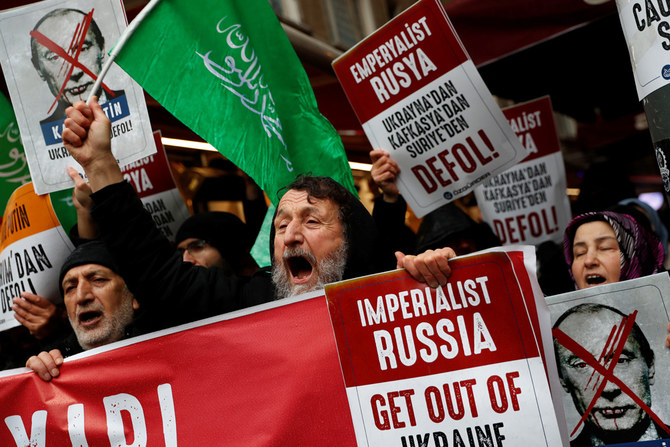

ANKARA: As Russia launched air and ground assaults on Ukraine, NATO member Turkey finds itself in a delicate position for maintaining its good relations with both countries.
Its control over the Bosporus and Dardanelles straits, key routes during such a crisis, made Turkey an indispensable partner for the West.
On Thursday, Ukraine asked Turkey to close the straits to Russian vessels.
Turkey, which has maritime borders with Ukraine and Russia, has the legal authority to control the straits under the 1936 Montreux Convention, that gives Ankara exclusive rights to restrict the passage of warships not belonging to countries bordering the Black Sea.
During wartime or under threat of aggression, Turkey can close the straits to the transit of all foreign warships, while non-Black Sea countries and littoral states should notify Ankara 15 days and 8 days in advance, respectively, for sending vessels.
For Soner Cagaptay, director of the Turkish program at the Washington Institute, if Ankara denied naval access to Russia into the Black Sea, it would open a can of worms, with the area a maritime condominium shared by Turkey and Russia.
“In that case, Moscow would ask to renegotiate the Montreux Convention and Turkey would never get a deal as good as (the) Montreux regime again. It is the reason why Ankara will not violate the existing convention,” he told Arab News.
Turkey’s gatekeeping over the straits will now test the limits of its neutral stance vis-a-vis Russia and Ukraine.
In a press statement on Wednesday, Turkish President Recep Tayyip Erdogan said that Turkey would not abandon either Russia or Ukraine.
“Turkey is currently not in a position to sacrifice its relations with Ukraine or Russia as it has developed significant strategic links with both countries in the last few years,” Prof. Emre Ersen, an expert on Russia-Turkey relations from Marmara University in Istanbul, told Arab News.
“Therefore, it will most likely continue to call for an immediate diplomatic resolution of the conflict.”
At the same time, Ersen thinks Ankara will try to implement the clauses of the Montreux Convention strictly, since this document gives Turkey the opportunity to stay neutral without having to choose a side in the current crisis.
Turkey, which finds itself in a tough spot, has close ties with Ukraine in the defense industry as it sells its drones and has an active defense deal of co-production, while it is also heavily dependent on Russian gas and defense procurement.
Turkey receives about 33 percent of its natural gas and 66 percent of wheat from Russia.
With tourism season approaching, Ukrainian and Russian tourists traditionally make up almost one fifth of Turkey’s total visitors.
But Ankara, which officially described Russian moves against Ukraine as unacceptable, still stands against applying any sanctions on Russia — which presidential spokesperson Ibrahim Kalin recently described as “useless” — and prefers de-escalation through diplomatic means and dialogue.
Aydin Sezer, an Ankara-based Russia analyst, thinks that Turkey has so far opted for a moderate stance on the Ukrainian crisis by urging the parties to follow common sense.
“However, for a year Turkey has followed a strictly pro-Ukrainian stance, which will push Russia to take a more cautious and skeptical stance against any diplomatic move by the country,” he told Arab News.
According to Sezer, if Turkey opens its Black Sea waterways to the fleets of the Western powers or if it shares any intelligence with the West about any aerial threat against Ukraine, Russia will take it as a casus belli, a justification for war.
With a statement on Thursday, Turkey’s Ministry of Foreign Affairs urged Russia to immediately end the “unjust and unlawful action” and underlined Ukraine’s territorial integrity.
Under Montreux, aircraft carriers should also seek permission from the Turkish government when crossing over the straits.
However, for Ersen, compared with the Russian-Georgian war of 2008, it will be much more difficult for Ankara to follow a middle-way policy between Russia and the West.
In 2008, Turkey denied permissions to large US military ships to enter the Black Sea based on Montreux upon Russia’s military intervention in Georgia.
“Turkey’s NATO allies will definitely increase their pressure on Ankara to reconsider its special relationship with Moscow which could also cause significant repercussions for Turkish-Russian relations, especially with regard to thorny issues like the Syrian civil war and the Russian-made S-400 missiles,” Ersen said.
Despite its strained ties with NATO upon the purchase of the Russian defense system, Turkey regained its importance within the alliance in supporting Ukraine.
Samuel Ramani, associate fellow at the Royal United Service Institute, thinks that Turkey is trying to show its solidarity with NATO consensus by supporting Ukraine’s territorial integrity.
“Turkey has also viewed Ukraine as a key partner since 2010, as it burnishes its Black Sea power status and provides it with useful commercial deals, especially in the munitions and drone spheres,” he told Arab News.
He added: “In this crisis, Turkey has tried to show its value to NATO by offering itself as a venue for talks that would complement what France is doing. The talks have not taken place and the US views Turkey’s role skeptically.”
According to Ramani, Turkey will still be a voice of support for diplomacy and oppose sanctions on Russia, as it needs to work with Moscow in several other theaters like Syria, Libya and the South Caucasus.
“However, Turkey could also use its Montreux Convention derived status to bolster its image as a contributor to Black Sea security and sell drones to Ukraine if they are requested,” he said.