

Former Turkish diplomats warn Montreux Convention must remain in place

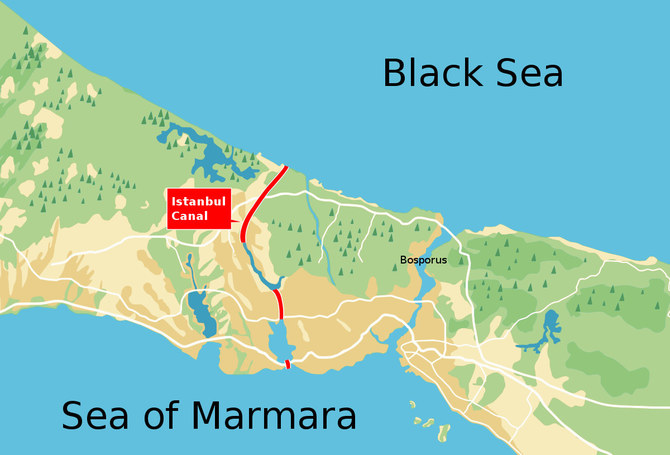
Map showing the proposed Istanbul Canal, connecting the Black Sea and the Sea of Marmara in Turkey. (Wikimedia Commons)
Short Url
Updated 03 April 2021
Follow

Former Turkish diplomats warn Montreux Convention must remain in place

  • Controversial $9.2 billion Kanal Istanbul project draws criticism

ANKARA: With discussions over the revision of the 1936 Montreux Convention regarding control of the Istanbul Straits ongoing, Turkey recently approved development plans for the controversial 45-kilometer Kanal Istanbul project.

The project has attracted criticism not only for its financial cost and environmental impact, but also its potential repercussions for maritime transit.

The artificial seaway will cost an estimated $9.2 billion, and will connect the Black Sea north of Istanbul to the Marmara Sea to the south. It is intended to ease traffic on the Bosphorus Strait.

Kanal Istanbul is being touted as an alternative global shipping lane, but the scheme — first introduced to the public as a “crazy project” — has been harshly criticized by Istanbul’s opposition mayor Ekrem Imamoglu from the beginning.

In a rare move, 126 retired Turkish ambassadors released a statement on Friday warning that the Kanal Istanbul project could put the Montreux Convention at risk and have an adverse affect on Turkish interests.

“Kanal Istanbul will open the Montreux Convention to discussion, and will lead to Turkey’s loss of absolute sovereignty over the Sea of ​​Marmara,” the statement said.

In an interview with HaberTurk on March 24, Speaker of the Turkish Parliament Mustafa Sentop was asked: “What if one day one president says, ‘I do not recognize (the) Montreux (Convention). I dissolved it’?”

Sentop replied: “He has the authority to do so. But there is a difference between possible and probable.”

In a 2018 presidential decree, Turkish President Recep Tayyip Erdogan assigned himself authority to withdraw Turkey from any international treaty or pact — such as the Montreux Convention — without parliamentary approval.

The convention grants free passage to all civilian vessels and determines the mode of entry and length of stay, as well as the tonnage, of warships from all non-littoral countries in the Black Sea.

Once completed, Kanal Istanbul will provide a shorter way for naval vessels from non-littoral countries to reach the Black Sea, so long as they pay the necessary fees.

But, if no further abrupt revision is made to the Montreux Convention, these vessels have to respect the rules of Montreux as they will enter Kanal Istanbul from the Dardanelles straits that are still determined by this decades-long international regime. 

Aydin Sezer, an Ankara-based expert on Turkey-Russia relations, believes Russia will stand against any attempts to void the Montreux Convention, however.

“This international convention was prepared by convening relevant states at an international conference. Therefore, a unilateral withdrawal is unlikely, as it will draw serious anger and retaliation from the Kremlin side,” Sezer told Arab News.

In an interview in December 2019 with Turkish journalist Murat Yetkin, Aleksey Yerkhov, Moscow’s ambassador in Ankara, said that if the canal were to be built, Russia would insist on applying the provisions of the Montreux Convention to all passages.

Ozgur Unluhisarcikli, Ankara director of the German Marshall Fund of the United States, told Arab News: “There are two opposing views on whether Kanal Istanbul would fall under the Montreux regime if it were built. While I don’t think which interpretation gains acceptance will ultimately matter so far as vessels of war are concerned, I would not say the same thing regarding merchant vessels and revenue generation.”

Unluhisarcikli believes that Turkey will ultimately decide to unilaterally apply the provisions of the Montreux Convention concerning vessels of war, as any other course of action could lead to the collapse of the Montreux regime, making Turkey subject to pressure from both its Western allies and Russia.

“However, in this case Turkey could apply different rules to merchant vessels in order to be able to generate revenue,” he added.

“If Kanal Istanbul were accepted as falling under the Montreux regime, Turkey could find it difficult to generate significant revenue, as the Montreux Convention limits the taxes and charges that can be imposed on merchant vessels,” Unluhisarcikli concluded.


How Gaza’s shattered fishing industry deepened the enclave’s food security crisis

Updated 27 min 9 sec ago
Follow

How Gaza’s shattered fishing industry deepened the enclave’s food security crisis

  • Once a pillar of local food security, Gaza’s fishing sector has been reduced to a fraction of its prewar capacity
  • UN agencies warn the destruction of boats and ports has deepened aid dependence and worsened protein shortages

DUBAI: Gaza’s fishing industry — once a critical source of food, income and affordable protein — has been largely destroyed as a result of Israel’s war with Hamas, worsening the Palestinian enclave’s food security crisis.

According to the UN Food and Agriculture Organization, fishing activity in Gaza now stands at less than 10 percent of prewar levels following the widespread destruction of boats, ports and equipment, combined with prolonged maritime closures enforced under Israel’s naval blockade.

UN and human rights organizations estimate that up to 72 percent of Gaza’s fishing fleet has been damaged or destroyed, alongside near-total devastation of related infrastructure, including landing sites, storage facilities and repair workshops.

The remaining vessels are small, damaged skiffs capable of operating only meters from shore.

Fishermen paddle on makeshift boats with destroyed buildings seen in the background in Gaza City's main fishing harbor on September 7, 2024, amid the ongoing war between Israel and the Palestinian militant group Hamas. (AFP/file photo)

Ramzy Baroud, a journalist, author and editor of The Palestine Chronicle, said the destruction of Gaza’s fishing sector must be understood as part of a deliberate policy aimed at preventing Palestinians from developing independent food-producing systems.

Baroud says Israel had pursued a strategy since 1967 to foster Palestinian dependency — first on the Israeli economy, and later on humanitarian aid entering Gaza through Israeli-controlled crossings — leaving the population permanently vulnerable to economic collapse.

“This vulnerability is functional for Israel, as it allows the Israeli government and military to leverage their control over Palestinian lives through political pressure in pursuit of concessions,” he told Arab News.


​Palestinians gather near crates of fish for sale during a ceasefire between Israel and Hamas, at the seaport of Gaza City, November 12, 2025. (REUTERS/Mahmoud Issa)

Palestinians were prevented from developing local industry through restrictions on imports and exports, while much of Gaza’s arable land was seized or turned into military targets, he said.

“Likewise, the fishing sector was deliberately crippled through direct attacks on fishermen, including arrests, live fire, confiscation of equipment, and the sinking or destruction of boats,” he added.

FAO has documented widespread destruction across Gaza’s coastal fishing areas.

“In Gaza’s fishing areas now lie broken boats, torn nets, and ruined infrastructure, standing in stark contrast to the once-vibrant industry that supported thousands of fishers for generations,” Beth Bechdol, FAO deputy director-general, said in a statement.

Caption

Before the war, more than 4,000 registered fishermen worked along Gaza’s 40-kilometer coastline, supporting tens of thousands of family members and contributing to local food security in an enclave heavily dependent on imports.

Today, the majority have been stripped of their livelihoods, as access to the sea has become sporadic, dangerous, or entirely prohibited.

For decades, fishing off Gaza was restricted to shifting maritime zones — typically between three and 12 nautical miles offshore — often tightened or closed entirely during periods of escalation.

Caption

Since October 2023, when the Israel-Hamas conflict began, humanitarian organizations say there have been extended periods of total maritime closure, effectively banning fishing and depriving Gaza’s population of one of its few remaining sources of local food production.

Baroud said the assault on Gaza’s fishing sector was not a by-product of war, but part of a deliberate strategy that intensified during the conflict.

“For Gaza, the sea represents freedom,” he said. “All of Gaza’s other borders are controlled by Israel, either directly or indirectly.”

Israel had consistently worked to deny Palestinians access to the sea, he said. And despite commitments under the Oslo Accords to allow fishing up to 20 nautical miles offshore, those provisions were never honored.

Palestinians fish during a ceasefire between Israel and Hamas, at the seaport of Gaza City, November 12, 2025. (REUTERS)

“The assault on Gaza’s fishing sector is therefore not incidental,” Baroud said. “It is about severing Palestinians from one of the few spaces not entirely enclosed by walls, checkpoints, and military control.”

Israel has generally rejected or not accepted accusations that it is unlawfully targeting Gaza’s fishermen, framing incidents at sea as enforcement of security zones or as under investigation rather than deliberate attacks on civilians.​

In past lethal incidents at sea highlighted by Human Rights Watch, the Israel Defense Forces have typically said boats “deviated from the designated fishing zone” and that forces fired after warnings were ignored.

Israel's naval blockade has Gaza's fishing industry to decline to about a tenth of pre-war levels. (Reuters photo)

According to FAO, rebuilding Gaza’s fishing sector will be impossible without a fundamental change in access and security conditions.

“For Gazans, the sea was not just a source of food, but a source of livelihood and identity,” Bechdol said.

“FAO can assist to help rebuild Gaza’s fishing industry. But for this to happen, peace must first be established and fishers must be allowed to operate their boats and cast their nets without fear of harm.”

Ciro Fiorillo, head of the FAO office for the West Bank and Gaza, said the agency is primed to offer assistance once the security situation improves.

“FAO is ready to restart projects, replenish damaged boats and equipment, and inject emergency funds as soon as these key fishing inputs for production are allowed to enter the Strip, a sustained ceasefire is in place, and access to the sea is restored,” Fiorillo said in a statement.

Since the Oct. 7, 2023, Hamas-led attack on southern Israel triggered the Israeli military assault on Gaza, much of the enclave has been flattened, tens of thousands killed, and some 90 percent of the population displaced.

Infographic from the IPC Global Initiative's latest "Special Snapshot" on the famine conditions in Gaza. The continuing analysis is being done jointly by UN agencies and NGOs.

Even since the ceasefire came into effect with the exchange of hostages and prisoners in October last year, pockets of violence have continued and humanitarian needs remain dire. The collapse of fishing has only compounded an already catastrophic food crisis.

The UN Office for the Coordination of Humanitarian Affairs has repeatedly warned that the destruction of food-producing systems — including agriculture, fisheries and markets — has pushed Gaza toward famine, with households facing extreme shortages of protein and calories.

With farmland destroyed, livestock killed and imports severely restricted, fish was once among the few foods that could still be sourced locally.

Its near disappearance has driven prices beyond reach for most families and increased dependence on limited humanitarian aid.

“This is about denying Palestinians access to life itself — to survival,” said Baroud.

An Israeli soldier stands on a naval ship as it sails on the Mediterranean Sea, amid the ongoing conflict between Israel and the Palestinian Islamist group Hamas, near Israel's border with Gaza in southern Israel. (REUTERS/file photo)

The destruction of fishing forces Palestinians into deeper dependence on humanitarian aid that Israel itself controls, effectively weaponizing food rather than allowing Palestinians to sustain themselves independently, he said.

Human rights groups documenting maritime enforcement report that fishermen attempting to operate — even close to the shore — face gunfire, pursuit, detention and arrest, contributing to a climate in which fishing has become a life-threatening activity rather than a livelihood.

According to rights monitors, the destruction of larger vessels has eliminated the possibility of reaching deeper waters, forcing the few remaining fishermen to operate in unsafe, shallow zones with damaged equipment, limited fuel and no protection.

Baroud said international law clearly obligates an occupying power to protect civilian livelihoods and ensure access to food and means of survival.

“The systematic targeting of fishermen — who are civilians engaged in subsistence activity — cannot be justified as a military necessity, especially when it results in starvation and famine,” Baroud said.

Palestinians fish during a ceasefire between Israel and Hamas, at the seaport of Gaza City, November 12, 2025. (REUTERS)

He said the Fourth Geneva Convention prohibits collective punishment, the destruction of civilian infrastructure and the targeting of livelihoods.

The Palestinian Centre for Human Rights has described the restriction of Gaza’s fishing sector as part of a broader assault on civilian survival systems, warning that the denial of access to the sea has direct implications for nutrition, employment and aid dependency.

Baroud said the recovery of Gaza’s fishing sector could not occur in isolation from the broader economy.

“Only a measure of real freedom for Palestinians — freedom of movement, access to land and sea, and the ability to import, export and produce independently — can allow Gaza’s industries and economy to recover,” he said.

Palestinians sell fish during a ceasefire between Israel and Hamas, at the seaport of Gaza City, November 12, 2025. (REUTERS)

Without ending the system of control governing Palestinian life, Baroud said, any discussion of reconstruction or recovery would remain hollow.

As famine warnings intensify, the fishing sector’s collapse stands as a stark example of how Gaza’s food system has fractured.

What was once a daily livelihood is now reduced to occasional, high-risk attempts to secure food.

With no functioning fleet and no safe access to waters, Gaza’s fishermen are operating at the edge of survival.