- Khan’s visit to Moscow, first by a Pakistani PM since 1999, comes as Russia launched invasion of Ukraine
- Khan says Pakistan had hoped diplomacy could avert a military conflict, war was not in anyone’s interest
ISLAMABAD: Prime Minister Imran Khan on Thursday urged “dialogue and diplomacy” to resolve Russia's tensions with Ukraine, saying he “regretted” that a military conflict could not been averted between the two neighbouring countries.
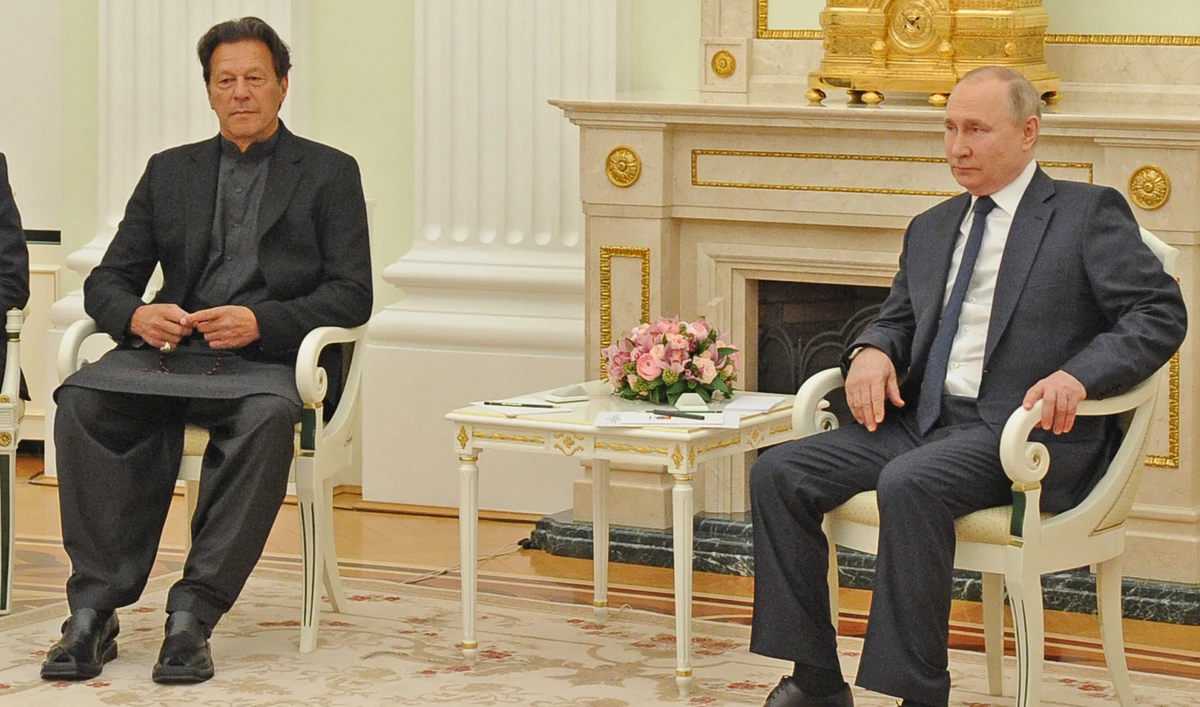
Khan’s statement came after a meeting with Russian President Vladimir Putin at the Kremlin.
His visit to Moscow, the first by a Pakistani prime minister since 1999, comes as Russia launched an all-out invasion of Ukraine by land, air and sea on Thursday, the biggest attack by one state against another in Europe since World War II.
“The Prime Minister regretted the latest situation between Russia and Ukraine and said that Pakistan had hoped diplomacy could avert a military conflict,” the prime minister’s office said in a statement. “The Prime Minister stressed that conflict was not in anyone’s interest, and that the developing countries were always hit the hardest economically in case of conflict. He underlined Pakistan’s belief that disputes should be resolved through dialogue and diplomacy.”
Khan and Putin also discussed an estimated $2.5 billion natural gas pipeline to be built in Pakistan in collaboration with Russian companies.
The Pakistan Stream Gas Pipeline Project (PSGP), formerly known as North South Gas Pipeline, is a flagship project signed by Islamabad and Moscow in 2015 to carry imported Liquified Natural Gas (LNG) from Karachi on the Arabian Sea coast to power plants in the northeastern province of Punjab.
“The Prime Minister reaffirmed the importance of Pakistan-Stream Gas Pipeline as a flagship economic project between Pakistan and Russia and also discussed cooperation on prospective energy-related projects. The Prime Minister underscored Pakistan’s commitment to forge a long-term, multidimensional relationship with Russia,” the PMO statement said.
The statement comes as missiles rained down on Ukrainian targets and Kyiv reported columns of troops pouring across the borders with Russia and Belarus stretching from the north and east, and landing on the coasts from the Black Sea in the southwest and Azov Sea in the southeast.
Fierce fighting was taking place in the regions of Sumy and Kharkiv in the northeast, Kherson and Odessa in the south, and at a military airport near the capital Kyiv, an adviser to the Ukrainian presidential office said.
President Volodymyr Zelenskiy said troops were trying to fend off Russians attempting to capture the Chernobyl nuclear power plant, just 90 km (60 miles) north of the capital. Regional officials said Ukrainian authorities had lost control of some territory in the Kherson region near Russian-occupied Crimea.
US President Joe Biden called the Russian action an "unprovoked and unjustified attack". EU Commission chief Ursula von der Leyen said the bloc would impose a new round of sanctions that would hit Russia's economy severely.
EU foreign affairs chief Josep Borrell said: "These are among the darkest hours of Europe since the Second World War."
In an interview ahead of his trip to Russia, Khan had expressed concern about the situation in Ukraine and the possibility of new sanctions and their effect on Islamabad's budding cooperation with Moscow.
It is unclear how the latest sanctions will affect the project, which is important for Pakistan - particularly the power sector - as the country's dependence on imported LNG grows in the face of dwindling indigenous gas supplies.
The pipeline project has already suffered delays because of earlier sanctions.
"This North-South pipeline suffered, one of the reasons...was the companies we were negotiating with, turned out that US had applied sanctions on them," Khan told Russia Today this week. "So, the problem was to get a company that wasn’t sanctioned."