

Sri Lanka seeks compensation for illegal waste shipment from Britain

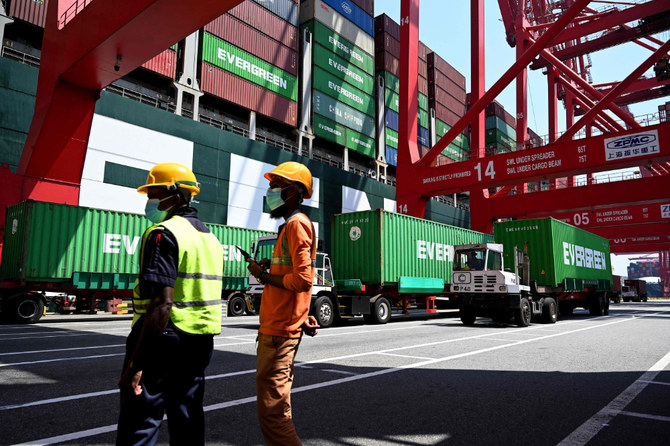
Authorities transport containers of garbage to be returned to Britain after authorities refused to process the illegally imported hazardous cargo, in Colombo on February 21, 2022. (AFP)
Short Url
Updated 22 February 2022
Follow

Sri Lanka seeks compensation for illegal waste shipment from Britain

  • Environment lawyer hails ‘significant step’ after 3,000 tons of illegally imported waste returned to the UK
  • Sri Lanka among Asian nations that have rejected exports of hazardous material from developed countries in recent years

COLOMBO: Sri Lanka is seeking compensation for damage caused by waste imported illegally from the UK, an official said on Tuesday, as the South Asian country shipped out the last of several hundred containers of unwanted refuse. 

A total of 263 shipping containers from Britain, holding more than 3,000 tons of waste, arrived at the port of Colombo under the guise of scrap metal for recycling in 2019. But a foul smell emanating from the shipment led to the discovery of rotting hazardous waste, including soiled mattresses and suspected human remains. 

“There were delays in repatriation due to COVID-19,” Ajit Weerasundara, deputy chairman of Sri Lanka’s Central Environmental Agency, told Arab News, “but the last 45 containers left (on Monday).”

Sri Lanka sent back the first batch to the UK in 2020, while the remaining containers were sealed “to make sure there was no more damage to the environment” before being returned, Weerasundara said. 

Sri Lanka is party to the Basel Convention, which controls transnational movements of hazardous waste and its disposal, especially in developing nations. 

The government has confirmed it has written to the Basel Secretariat in Switzerland, and is finalizing paperwork seeking compensation for damage caused by the hazardous material that arrived two years ago. 

Environmental lawyer and activist Jagath Gunawardene described this week’s developments as “a significant step for Sri Lanka.”

The country is one of several Asian nations to reject exports of hazardous material from developed nations in recent years. These include Malaysia, which between 2019 and April last year sent 267 containers of illegal plastic waste back to their countries of origin. 

Gunawardene highlighted efforts by the Colombo-based Center for Environmental Justice, which filed a case against the parties it held responsible for the import, specifically the CEA and Customs, following the 2020 discovery. 

“We filed because we wanted to have this garbage repatriated and because we wanted to hold those responsible accountable,” Hemantha Withanage, CEJ executive director, told Arab News. 

The government has managed to send back the waste, but the CEJ is still waiting for officials to file a case against those who imported the illegal waste. 

“There may still be other containers with material like this at the port, we don’t know — these were the only ones that were discovered,” Withanage said.


Swiss identify first bodies after deadly blaze in ski resort

People bring flowers to the sealed off blaze site in Crans-Montana, Switzerland. (AP)
Updated 5 sec ago
Follow

Swiss identify first bodies after deadly blaze in ski resort

  • Many of those injured were foreign nationals, and given Crans-Montana’s international popularity, non-Swiss citizens are also expected to figure among the dead

CRANS-MONTANA, Switzerland: The first bodies were identified on Saturday after the deadly blaze that killed 40 New Year revellers at a packed bar in the ski resort of Crans-Montana, including two minors.
Dozens of people badly burnt in the fire on Thursday in the glitzy Alpine town were taken to nearby countries for urgent treatment, while authorities pointed the finger at lit sparklers attached to beverage bottles igniting foam on the ceiling.
Police in Switzerland’s southwestern Wallis canton said on Saturday that investigators identified the remains of four young Swiss nationals who perished in the fire, including a girl and a boy, both aged 16.

FASTFACT

Police in Switzerland’s southwestern Wallis canton said on Saturday that investigators identified the remains of four young Swiss nationals who perished in the fire, including a girl and a boy, both aged 16.

Police said the bodies had been returned to their families as efforts continue to identify the other victims.
On Friday, the authorities said that 113 of the 119 people who were injured in the blaze had been identified, with most of those hurt remaining in serious condition.
Many of those injured were foreign nationals, and given Crans-Montana’s international popularity, non-Swiss citizens are also expected to figure among the dead.
People continued to bring flowers, candles, and messages on Saturday to a makeshift memorial near the scene of the tragedy at Le Constellation bar.
The disaster has left Switzerland reeling, with families of the overwhelmingly young partygoers waiting for news of their loved ones.
Among those bracing for the worst was Laetitia Brodard, who said that the last text she received from her son, Arthur, was “Mom, Happy New Year, I love you.”
“It’s been 40 hours. Forty hours since our children disappeared. So now we need to know,” she told journalists near the memorial.
The exact number of people who were at Le Constellation when it caught fire remains unclear.
The Crans-Montana website said the venue had a capacity of 300 people plus 40 on its terrace.
Le Constellation’s two French managers have been questioned as “witnesses” in the case, with one of them, Jacques Moretti, insisting to the Swiss press that all safety norms were followed.
But the chief prosecutor of the Wallis region, Beatrice Pilloud, said that the standards were among the focuses of the investigation.
Pilloud said that the leading hypothesis was that “sparklers or Bengal candles attached to champagne bottles and lifted too close to the ceiling” had ignited the deadly blaze.
One video shared on social media showed the low wooden ceiling — covered with soundproofing foam — catching alight, with flames spreading quickly as revellers continued to dance, unaware of the death trap they were in.
Once they realized, panic set in.
Eyewitnesses described scenes of chaos as people tried to break through the windows to escape, while others, covered in burns, poured out into the street.
Looking at images of the event shared on social media, experts suggested that “highly flammable” soundproofing foam covering the ceiling may have caused a flashover — a near-simultaneous ignition of everything in an enclosed space.
Nathan, who had been in the bar before the fire, saw burnt people streaming out of the site.
“They were asking for help, crying out for help,” he said.
Edmond Cocquyt, a Belgian tourist, said he saw bodies “covered with a white sheet” and “young people, totally burnt, who were still alive ... screaming in pain.”
Of the injured, Wallis police commander Frederic Gisler said that at least 71 were Swiss, 14 were French, 11 were Italian, and four were from Serbia, along with victims from Bosnia, Belgium, Poland, Portugal, and Luxembourg.
But the French Foreign Ministry said on Saturday that it now counted 16 French nationals injured in the blaze, while nine remained missing.
Swiss authorities warned it could take days to identify everyone who perished, leaving an agonizing wait for family and friends, while desperate appeals to find those missing circulated online.
Guido Bertolaso, the regional health chief for Italy’s Lombardy region, told reporters that a critically injured 15-year-old girl was expected to arrive in Milan by helicopter Saturday for treatment.
Two other boys believed to be Italian were also at the Zurich burn center, awaiting DNA testing.
“Why can’t we identify them? Because their faces are completely covered with bandages ... (and) they are intubated, so they are unable to speak,” he said.
Several memorial masses for the victims are planned, including one on Saturday evening in Crans-Montana.
“It’s very sad, deeply sad,” said a French tourist on Saturday in Crans-Montana, skis in hand, who wished to remain anonymous.
But he said it seemed “a familiar scenario.”
“A bar that, according to initial reports, was not necessarily meeting the standards, and young people who did not necessarily notice the risks.”