

New year brings tourism back to Sri Lanka despite omicron fears

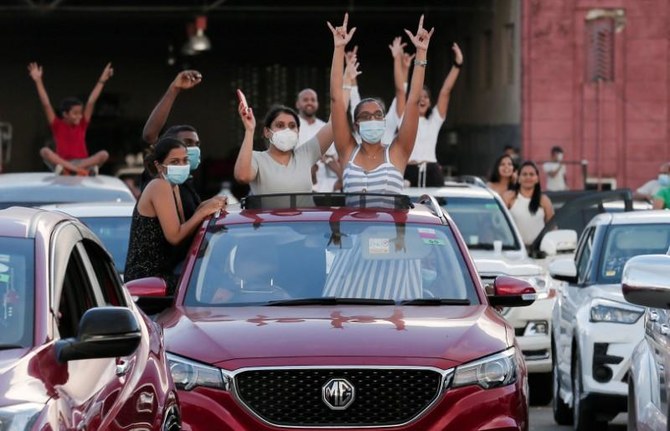
Sri Lankans celebrate the lifting of certain COVID-19 restrictions at a drive-in concert, Colombo, Sri Lanka, May 30, 2020. (Reuters)
Short Url
Updated 16 January 2022
Follow

New year brings tourism back to Sri Lanka despite omicron fears

  • Close to 30,000 visitors have arrived in Sri Lanka in first 10 days of 2022, mostly from Europe, India
  • Tourism Development Authority dismisses fears that omicron variant could force new lockdown

COLOMBO: In a makeshift kiosk, just off the Kadawatha Interchange in Sri Lanka’s western province, golden-orange king coconuts, bright green and yellow mangoes, and small, round wild oranges are stacked in neat piles. A fruit seller slices open a coconut deftly with a knife and hands it to a customer, before turning to serve the next.

Around him, waiting patiently, are a mix of people. Vehicles have pulled up to the side of the road, with drivers waiting for refreshing drinks before resuming their journeys.

Sri Lanka, once deserted due to the COVID-19 pandemic, is bustling again.

And across the island is a most welcome sight: Foreign tourists, who contribute significantly to the country’s economy. A tourism hotspot offering surf, sun, sand, cool hinterlands, and UNESCO-protected sites of cultural and architectural significance, Sri Lanka relies heavily on visitors, who before the pandemic accounted for about $5 billion of foreign exchange earnings, or almost 5 percent of gross domestic product.

Successive COVID-19 lockdowns since March 2020 resulted in the tourism sector grinding to a complete halt, depriving thousands of people of their livelihoods. Crushed by an economic crisis due to dwindling foreign reserves and mounting foreign debt, Sri Lanka is desperate to revive the tourism industry, with a target of making 2022 the “Visit Sri Lanka Year” and generating $10 billion from the sector by 2025.

January has proven that Sri Lanka may be on course to meet the target. Close to 30,000 people have arrived in the country in the first 10 days of 2022, mostly from Russia, India, Ukraine, the UK and Germany, despite global fears of over the spread of the new, highly contagious omicron variant.

“In Europe, there is a thought process of relaxing and dealing with the virus,” Kimarli Fernando, chairperson of the Sri Lanka Tourism Development Authority, told Arab News.

“EU countries treat COVID-19 like the flu, suggest people get used to living with it, and treat the virus as an endemic disease. So, this will not pose a problem.”

She said that the tourism authority expects to see about 1 million tourists visiting the country this year — half the number of visitors in 2018, which was Sri Lanka’s best year on record in terms of tourism arrivals.

“I am absolutely confident we will reach these numbers,” Fernando said, dismissing fears that the emergence of omicron could force the island nation back into lockdown. “We don’t see a potential for a lockdown at all.”

Almost 63 percent of Sri Lanka’s 22 million people have already been fully vaccinated, with tourism workers receiving jabs on priority basis to facilitate the swift reopening of the travel industry and revival of the economy.

Fernando added that besides vaccinations, tourism staff have also been properly trained to deal with the outbreak. “We’ve actually physically audited every single hotel. The staff are all trained,” she said.

“Tour guides, drivers — they are all trained. In public, everyone is wearing their masks. Everyone is diligent, in terms of sanitizing and adhering to health precautions,” she added. “We’ve never relaxed those rules, so we do not see an issue arising.”

But omicron is not the only factor that could pose a challenge to local hospitality businesses.  

To shore up its currency reserves, the government last year imposed a broad import ban to shore up foreign reserves, triggering shortages of fuel and price hikes for food and other essential goods.

Harpo Gooneratne, president of the Colombo City Restaurant Collective, told Arab News that he believed the industry, which has already withstood many challenges, will “manage.”  

He added: “We will have to look at this as a temporary setback that will last a few months, and in the meanwhile manage by keeping costs down, managing inventories and pushing an aggressive marketing plan that will look at new markets.”


Modi’s rooftop solar push slowed by reluctant lenders, states

Updated 5 sec ago
Follow

Modi’s rooftop solar push slowed by reluctant lenders, states

  • The shortfalls represent the latest challenge to India’s efforts to nearly double clean energy capacity to 500 gigawatts by 2030

SINGAPORE/MUMBAI/BHUBANESWAR, India: Indian Prime Minister Narendra Modi’s push to accelerate the rollout of rooftop solar power is falling short of targets despite ​heavy subsidies due to loan delays and limited support from state utilities, vendors and analysts say.
The shortfalls represent the latest challenge to India’s efforts to nearly double clean energy capacity to 500 gigawatts by 2030, and come as the government plans to suspend clean energy tendering targets amid a mounting backlog of awarded projects yet to be built.
Challenges to plans to increase solar uptake may mean India maintains its reliance on coal-fired power.
India’s Ministry for New and Renewable Energy created its subsidy program for residential solar panel installations in February 2024, covering up to 40 percent of the costs.
But residential installations at 2.36 million are well below the ministry’s target of 4 ‌million by March, ‌according to data from the program’s website.
“Banks’ reluctance to lend and states’ ​hesitance ‌to ⁠promote the schemes ​could ⁠derail India’s efforts to transition away from coal,” said Shreya Jai, the lead energy analyst at research firm Climate Trends in New Delhi.
Roughly three in five rooftop solar applications filed on the scheme’s website are yet to be approved while about 7 percent have been rejected, according to government data on the program, known as the PM Surya Ghar.
In a statement to Reuters about the pending applications, the renewable energy ministry pointed to accelerating installations which have benefited over 3 million households, and said the scheme enables state-owned utilities to reduce subsidy payouts to keep residential power bills in ⁠check.
“The loan rejection rate varies across states,” the statement said.
Under PM Surya Ghar, ‌consumers apply and select a vendor who handles paperwork and arranges bank ‌financing for solar panels. After loan approval and installation, the vendor ​submits proof, after which the government subsidy is credited ‌to the bank.

BANK DELAYS
However, banks have been rejecting or delaying loans for numerous reasons including lack of ‌documentation, which they say is necessary to protect public funds.
“We are working with the government to push for some standard documentation, because it is necessary to avoid bad loans. Currently if loans go bad, banks can take away these panels but what will we do with these panels?” said a senior official at a major government-owned bank.
Chamrulal Mishra, a solar vendor in ‌the eastern Indian state of Odisha, said applications are often rejected because the customer has missed electricity payments or because land records are still in the name ⁠of deceased relatives.
Residents there dispute ⁠the claims that they have missed payments, which they attribute to administrative errors after a change in utility ownership decades prior.
A spokesperson for India’s Department of Financial Services, which regulates the country’s banks, said they have responded to consumer feedback to allow co-applicants for loans to clear up title claims and the simplification of documentation requirements.
The Renewable Energy Association of Rajasthan said some banks are making collateral demands for loans under 200,000 Indian rupees ($2,208.87), despite scheme guidelines not requiring them to, which is constraining solar power additions.
State Bank of India and Punjab National Bank, some of the country’s largest lenders, did not reply to requests for comment on the matter.
State-owned utilities are also not promoting rooftop solar as much, as they are concerned about the loss of revenue as sales move off the electric grid.
“Wealthier households typically have high electricity consumption, tariffs and reliable roof access. When they shift from ​the grid, it leaves a larger financial burden,” ​said Niteesh Shanbog, an analyst at Rystad Energy.