As PM heads to Moscow, Pakistan envoy to Ukraine expresses 'support for sovereignty'

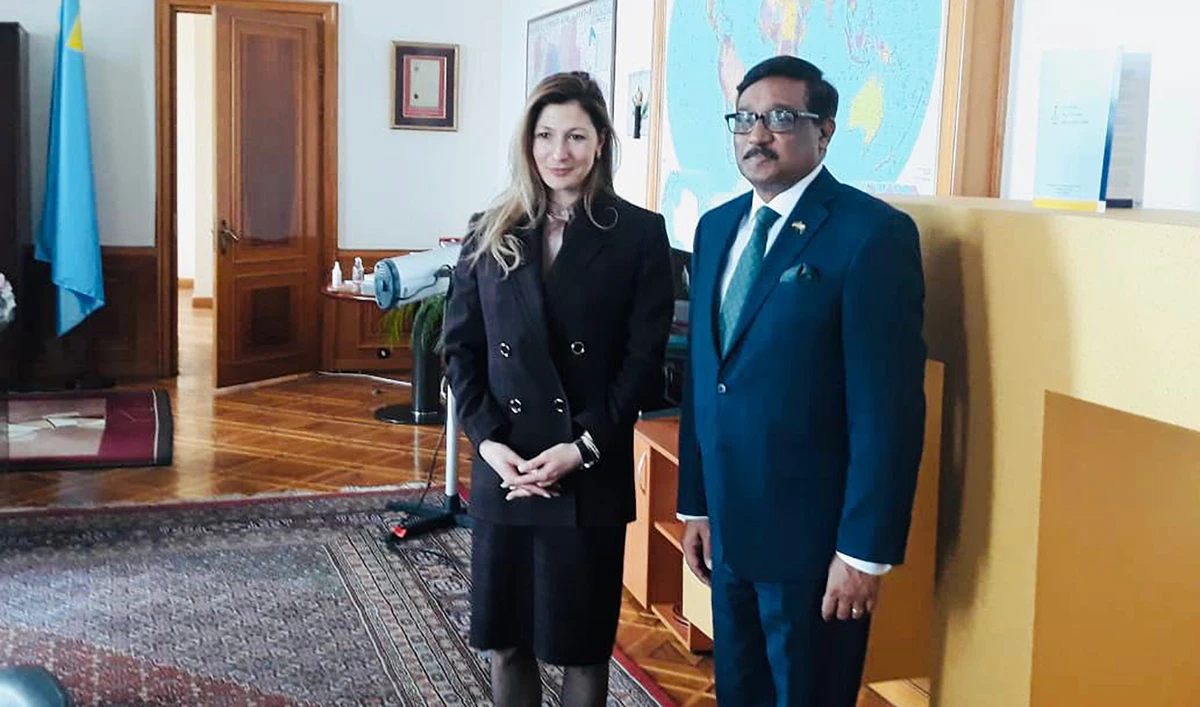
Pakistan's ambassador to Kiev, Noel Israel Khokhar, during his meeting with Ukraine's First Deputy Foreign Minister, Emine Dzheppar, on February 21, 2022. (Photo courtesy: @EmineDzheppar/Twitter)
Short Url
Updated 22 February 2022
Follow

As PM heads to Moscow, Pakistan envoy to Ukraine expresses 'support for sovereignty'

  • Ukraine’s First Deputy Minister of Foreign Affairs meets Pakistani envoy retired Maj Gen Khokhar
  • “Grateful to Pakistan for supporting Ukraine’s sovereignty and territorial integrity,” she tweeted

ISLAMABAD: As Prime Minister Imran Khan prepares to depart on a “game changing” trip to Russia amid Moscow reportedly preparing for a full-scale offensive in Ukraine that Western governments have warned about for weeks, a minister in Ukraine said on Monday she had met Pakistan’s envoy to the country who had expressed support for its “sovereignty and territorial integrity.”

Khan’s visit to Moscow comes as Russian President Vladimir Putin ordered the deployment of troops to two breakaway regions in eastern Ukraine after recognising them as independent on Monday. Putin's announcement drew US and European condemnation and vows of new sanctions.

On Monday, Ukraine’s First Deputy Minister of Foreign Affairs Emine Dzheppar tweeted that she had held a meeting with Pakistan’s Ambassador, retired Major Gen Noel Israel Khokhar, who had expressed support for her country’s sovereignty.

“Grateful to Pakistan for supporting Ukraine’s sovereignty and territorial integrity,” Dzheppar said on Twitter.


Khan will be in Moscow on February 23-24 on the invitation of President Vladimir Putin. He will be accompanied by a high-level delegation including members of his cabinet.

“The bilateral summit will be the highlight of the visit,” the Pakistani foreign office said.

Khan will be the first Pakistani prime minister to visit Russia in 23 years.

There are reports Pakistan's efforts to cosy up with Russia are in some part due to a push from longtime ally China, which enjoys a quasi-alliance with Moscow. Beijing has hinted recently it would support Russia diplomatically and perhaps economically if it invades Ukraine, worsening Beijing's already strained relations with the West, but would stop short of providing military support.

US President Joe Biden said last Friday Putin had decided to invade Ukraine within days, a claim Russia denies.

China's foreign ministry has repeatedly blamed the United States for "spreading false information" and creating tensions, urging it to respect and address Russia's demands for security guarantees.

In a show of solidarity, Putin visited Beijing for the Feb. 4 opening ceremony of the Olympics, declaring with Chinese counterpart Xi Jinping a deepening "no limits" strategic partnership. Chinese state media said the two countries stood "shoulder to shoulder in upholding justice in the world.”

A Russian invasion into Ukraine would test China's resolve to put those supportive words into action, especially given China's oft-stated foreign policy principle of non-interference.
Pakistani, Bangladeshi officials discuss trade, investment and aviation as ties thaw

Updated 10 sec ago
Follow

Pakistani, Bangladeshi officials discuss trade, investment and aviation as ties thaw

  • Pakistan and Bangladesh were once one nation, but they split in 1971 as a result of a bloody civil war
  • Ties between Pakistan, Bangladesh have warmed up since last year and both nations have resumed sea trade

ISLAMABAD: Pakistan's High Commissioner to Bangladesh Imran Haider on Sunday met Chief Adviser Muhammad Yunus in Dhaka, the latter's office said on, with the two figures discussing trade, investment and aviation.

Pakistan and Bangladesh were once one nation, but they split in 1971 as a result of a bloody civil war, which saw the part previously referred to as East Pakistan seceding to form the independent nation of Bangladesh.

Ties between Pakistan and Bangladesh have warmed up since former prime minister Sheikh Hasina’s ouster as a result of a student-led uprising in August 2024. Relations remain frosty between Dhaka and New Delhi over India’s decision to grant asylum to Hasina.

Pakistan has attempted to forge closer ties with Bangladesh in recent months and both South Asian nations last year began sea trade, followed by efforts to expand government-to-government commerce.

"During the meeting, both sides discussed ways to expand cooperation in trade, investment, and aviation as well as scaling up cultural, educational and medical exchanges to further strengthen bilateral relations between the two South Asian nations," Yunus's office said in a statement on X.

In 2023-24 Pakistan exported goods worth $661 million to Bangladesh, while its imports were only $57 million, according to the Trade Development Authority of Pakistan. In Aug. this year, the Pakistani and Bangladeshi commerce ministries signed a memorandum of understanding to establish a Joint Working Group on Trade, aiming to raise their bilateral trade volume to $1 billion in the financial year that began in July.

The Pakistani high commissioner noted that bilateral trade has recorded a 20 percent growth compared to last year, with business communities from both countries actively exploring new investment opportunities, according to the statement.

He highlighted a significant increase in cultural exchanges, adding that Bangladeshi students have shown strong interest in higher education opportunities in Pakistan, particularly in medical sciences, nanotechnology, and artificial intelligence. Haider also said that Dhaka-Karachi direct flights are expected to start in January.

"Chief Adviser Professor Muhammad Yunus welcomed the growing interactions between the two countries and emphasized the importance of increased visits as well as cultural, educational and people-to-people exchanges among SAARC (South Asian Association for Regional Cooperation) member states," the statement read.

"Professor Yunus also underscored the need to further boost Bangladesh–Pakistan trade and expressed hope that during Mr. Haider’s tenure, both countries would explore new avenues for investment and joint venture businesses."