

Pakistan hopes to achieve 6 percent GDP growth this fiscal year — finance ministry

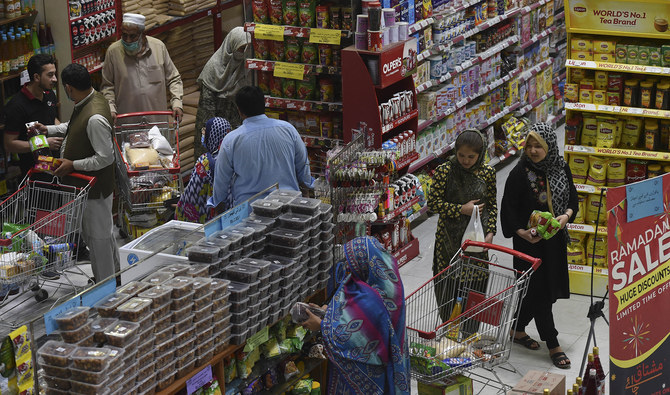
People buy grocery items at a store in Peshawar, Pakistan, on April 5, 2021. (AFP/File)
Short Url
Updated 21 February 2022
Follow

Pakistan hopes to achieve 6 percent GDP growth this fiscal year — finance ministry

  • Says increase in industrial, agricultural and exports growth show “robust economic growth”
  • Economists say given economic challenges even a 5 percent GDP growth rate would be a success

ISLAMABAD: The Pakistani government hopes to achieve six percent gross domestic product (GDP) growth this fiscal year owing to increased expansion in industrial and agricultural sectors, the finance ministry said on Sunday. 

Pakistan’s finance ministry set a 4.8 percent GDP growth rate as its target for the fiscal year 2021-22 in the annual budget in May last year. The International Monetary Fund (IMF) said earlier this month Pakistan’s economy is set to keep on recovering in this fiscal year, with real GDP growth projected at 4 percent. 

“Looking at all the recent economic indicators including industrial and agricultural growth, we are sure to achieve a six percent GDP growth rate this fiscal year,” Muzzammil Aslam, a spokesperson for the Ministry of Finance, told Arab News. 

He said electricity generation and consumption had registered an increase of 9 percent which reflected increased industrialization, manufacturing and employment in the country. 

Citing the numbers, he said Pakistan had witnessed 7.4 percent industrial growth while the South Asian country’s exports were growing at a pace of 25 percent this fiscal year along with a rise in electricity consumption. 

“These all are data proofs to show robust economic growth due to the government’s business and industry-friendly policies,” he said. 

“Cotton and sugarcane crops have registered a significant production increase this year, and this all is contributing to industrial growth and jobs creation [in the country],” he said. 

In January, Pakistan revised its economic growth rate for 2020-21 to 5.37 percent from 3.9 percent after the country's statistics bureau shifted its economy's baseline. 

With the new 2015-16 baseline, the country’s total GDP has reached $346.76 billion with a per capita income of $1,666. 

Economists say the government should focus on “sustainable growth” while keeping all challenges in the mind. 

“We have increased our interest rate and cut imports after December as part of a deal with the IMF, so this economic contraction will hold back our GDP growth to around 5 percent,” AA H. Soomro, a Karachi-based senior economist, told Arab News. 

He said the government will also spend less through the annual Public Sector Development Program (PSDP) to fulfill IMF conditions while wheat production was also expected to get a hit due to a shortage of fertilizers. 

The Russia-Ukraine conflict is also causing oil prices to surge in the international market and if this continues for the next three to four weeks, it will significantly increase Pakistan’s current account deficit, Soomro warned. 

“Keep in mind all these challenges, it will be a success even if Pakistan achieves a five percent GDP growth rate in this fiscal year,” the economist added.


Pakistani stocks breach 176,000 points barrier as investors expect further rate cuts

Updated 01 January 2026
Follow

Pakistani stocks breach 176,000 points barrier as investors expect further rate cuts

  • Pakistani financial analyst attributes surge to falling inflation, investors expecting further policy rate cuts
  • Pakistan’s finance ministry said Thursday that inflation had slowed to 5.6 percent year-on-year in December 

KARACHI: Pakistani stocks continued their bullish run on Thursday, breaching the 176,000 points barrier for the first time after trading ended, with analysts attributing the surge to investors expecting further cuts in the policy rate. 

The KSE-100 benchmark gained 2,301.17 points at close of business on Thursday, marking an increase of 1.32 percent to settle at 176,355.49 points. 

Pakistan’s central bank cut its key policy rate by 50 basis points to 10.5 percent last ‌month, breaking a four-meeting ‌hold in a move ‌that ⁠surprised ​markets. Pakistan’s consumer price inflation slowed to 5.6 percent year-on-year in December, while prices fell on a monthly basis as per data from the finance ministry. 

“Upbeat data for consumer price index (CPI) inflation at 5.6pc in December 2025 [with] investors expecting a further State Bank of Pakistan rate cuts on falling inflation data,” Ahsan Mehanti, CEO of Arif Habib Commodities Ltd., told Arab News. 

The stock market witnessed a trading volume of 1,402.650 million shares, with a traded value of Rs48.424 billion ($173 million), compared with 957.239 million shares valued at Rs44.231 billion ($158 million) during the previous session.

Topline Securities, a leading brokerage firm in Pakistan, credited the surge to strong buying at the first session.

“This positivity can be accredited to buying by local institutions on the start of the new calendar year,” it said. 

Pakistan’s Finance Adviser Khurram Schehzad highlighted that the bullish trend at the stock market reflected “strong investor confidence.”

“With lower inflation, affordable fuel, stronger reserves, rising digitization and a buoyant capital market, Pakistan’s economic outlook is clearly improving--supporting greater confidence, better investment sentiment and more positive momentum for 2026,” he said on social media platform X.