

Qassim’s Aloqailat Museum highlights Saudi industrial heritage at Made in Saudi expo

1 / 5
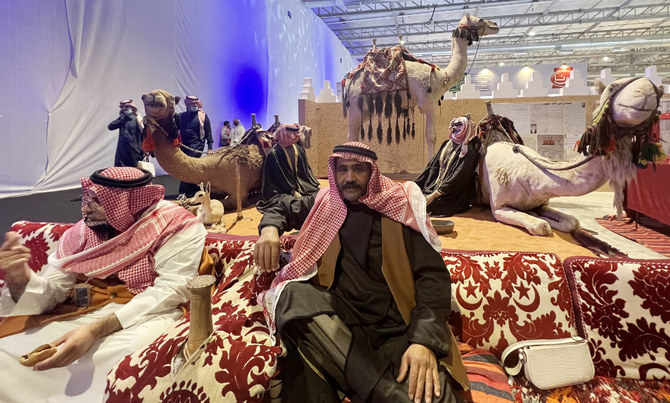
At the Made in Saudi exhibition, the museum had three life-sized camels in a desert setting and two characters telling the story of traders. (AN photo)
2 / 5
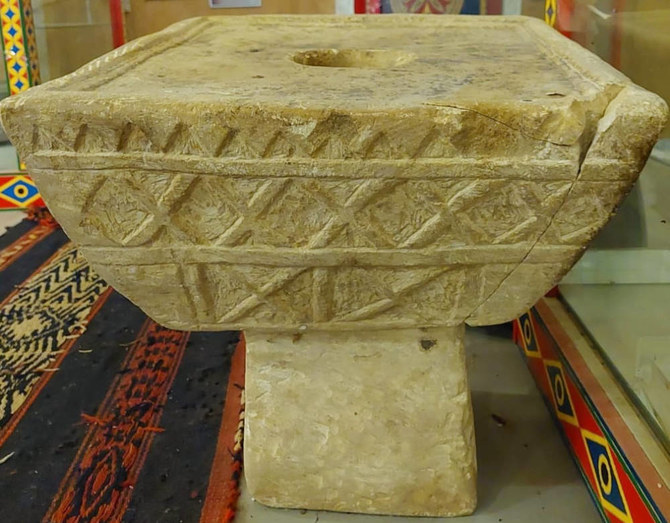
Al-Naqira is an ancient handicraft of hundreds of years carved from the stone and this one is 200 years old. (AN photo by Rahaf Jambi)
3 / 5
A wall from Aloqilat mobile museum in Saudi Made exhibition that tells the story of King Abdulaziz with Aloqilat traders. (AN photo by Rahaf Jambi)
4 / 5
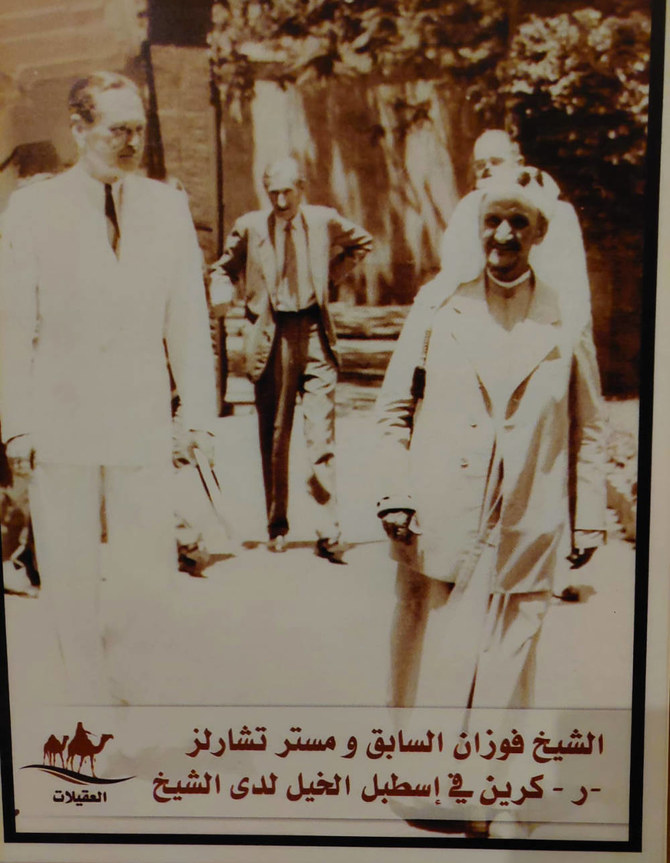
Sheikh Al-Fawzan with Charles Crane, American businessman, in the horse stables. (AN photo by Rahaf Jambi)
5 / 5
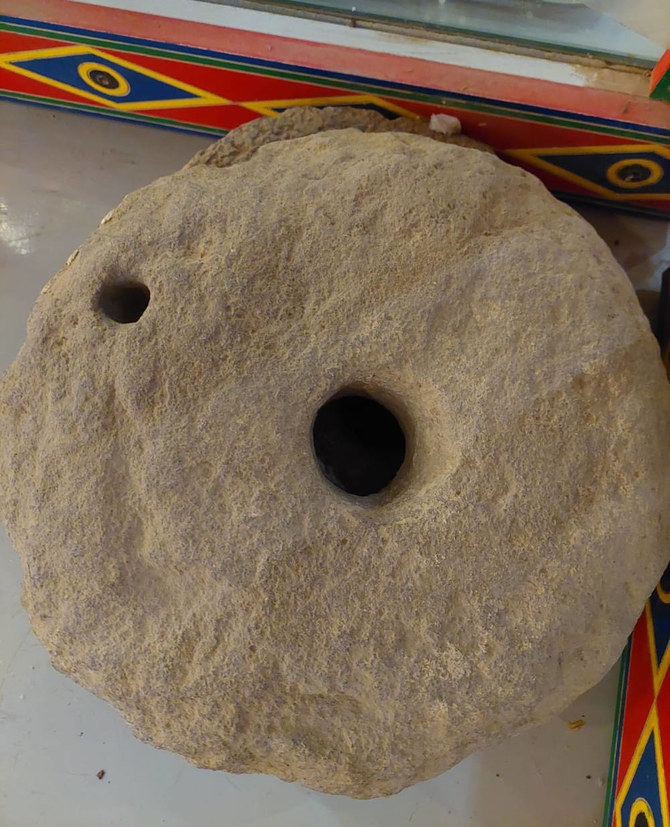
Milling machine, machine that prepares beauty cosmetics for women. Which is 230 years old in Aloqilat museum, Alqassim. (AN photo by Rahaf Jambi)
Short Url
Updated 20 February 2022
Follow

Qassim’s Aloqailat Museum highlights Saudi industrial heritage at Made in Saudi expo

  • Event showcases thousands of products from more than 150 local companies and manufacturers

RIYADH: Unlike other companies that displayed the latest technology at Riyadh’s recent Made in Saudi exhibition, the Aloqailat Museum showed visitors the history and origins of the country’s industry.

The museum, which was established 22 years ago in Qassim, took visitors on a journey to the past about Saudi culture and how trading used to be done.

“Aloqailat (trading) is a commercial profession that does not belong to a tribe or a family,” Abdulatif Alwehibi, the museum's owner and author of the Aloqailat Encyclopedia, told Arab News.

“They are traders who export camels and horses from Najd to all markets within Arab countries. They go to trade and come back with things they do not have in their countries. They also export valuable spices and deliver sheep, ghee, and weapons. Because of this, their reputation spread widely, and they made a name for themselves.”
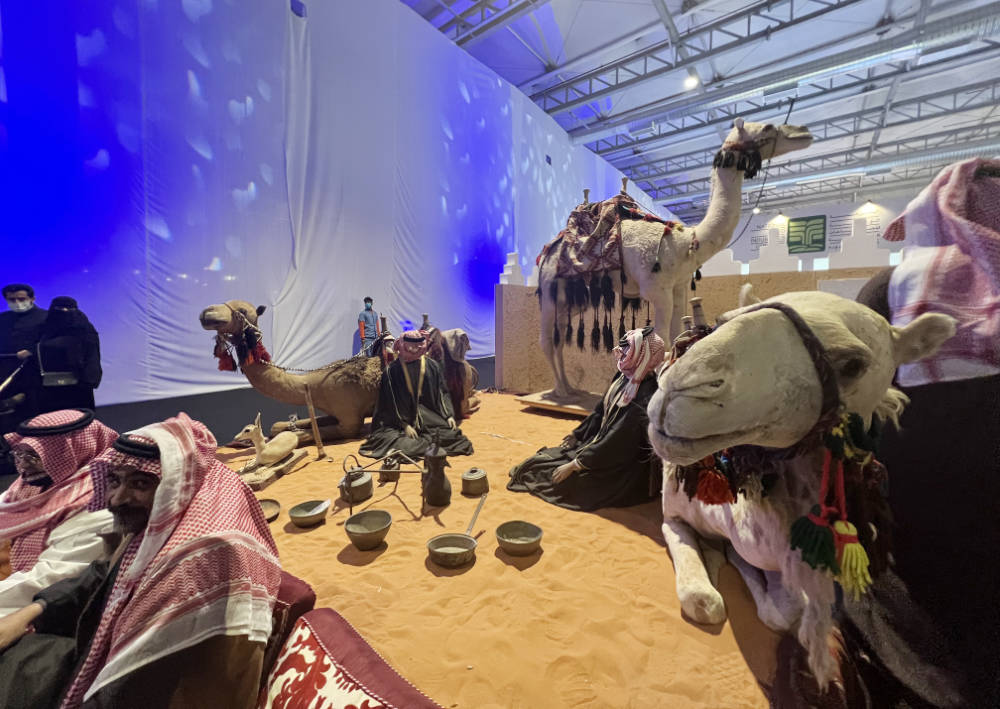


This display of two men in the desert surrounded by camels tells the story of the lack of security in the past, as there were many thieves. (AN photo by Rahaf Jambi)

The museum showcases the tools and other items that were important for their business such as guns, saddles, big pouches, ropes, everything related to camel care and trade, and also how they used to protect themselves when it came to travel.

At the expo, the museum had three life-sized camels in a desert setting and two characters telling the story of traders.

“This display of two men in the desert surrounded by camels tells the story of the lack of security in the past as there were many thieves and many looting operations. In the display, you find that there are men hiding behind the camel to protect themselves from thieves. The camels’ heads act as a radar, so if they see any stranger, their behavior changes immediately as a warning to their owners.”

HIGHLIGHT

The Made in Saudi expo showcased the products of more than 150 local companies and manufacturers with workshops, lectures covering a range of subjects, and thousands of local products.

During the pilgrimage season, the Aloqailats, who participated in business and trade matters, supplied a number of horses and 500 camels for pilgrims to Madinah and Makkah after an official command from King Abdulaziz.

Zakaria Alwehibi, deputy supervisor of the museum, said the king loved the Aloqailats and gathered them close to him.
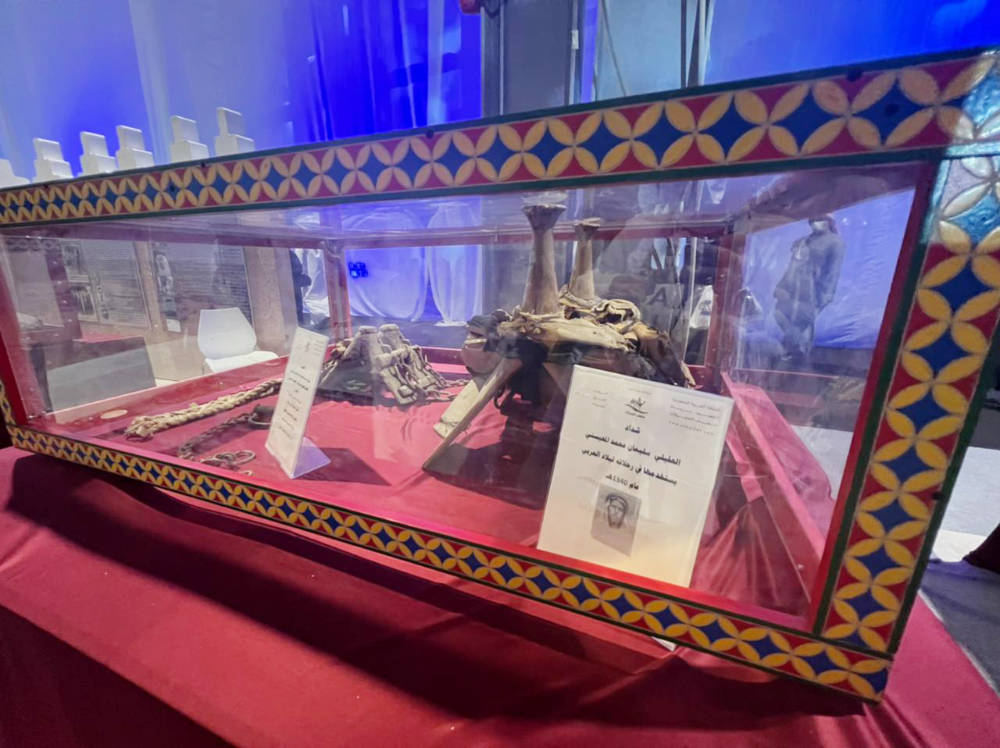


A 150 years old Camel's saddle in Aloqilat mobile museum in Saudi Made exhibition. (AN photo by Rahaf Jambi)

“As an appreciation gesture from King Abdulaziz, he assigned Aloqailats in high positions. They founded Riyadh Police, established the armed forces, and were the first ambassadors and ministers during the reign of King Abdulaziz.”

He talked about a trader called Sheikh Al-Fawzan, who is considered to be the reason for the discovery of petroleum in the Arabian Peninsula.

The story dates back to 1927, when he was Saudi Arabia’s first ambassador to Egypt. He was known for his love and passion for breeding purebred Arabian horses and he was the most famous horse breeder in Egypt.

“Charles Crane, an American businessman who was a fan of Arabian horses, was hosted by Sheikh Al-Fawzan in Egypt at his stable. Crane asked about Fawzan’s horses and was then gifted a horse by him as a form of generosity.
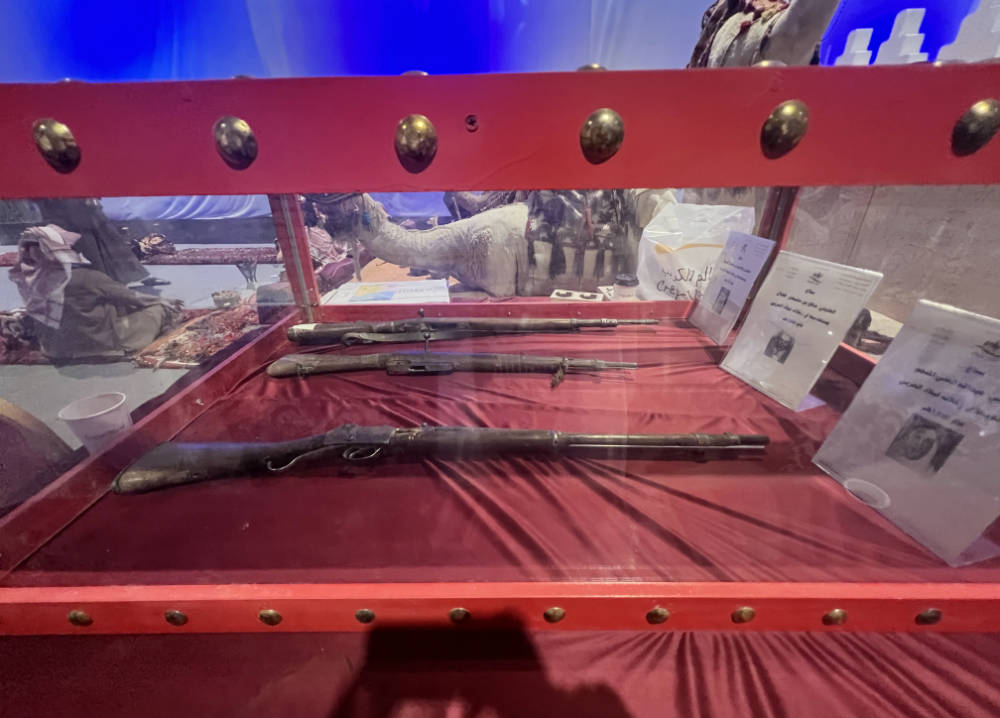


Aloqilat's rifles that date back to 100 years in Aloqilat mobile museum. (AN photo by Rahaf Jambi)

“Crane sent a message to Al-Fawzan with his desire to explore oil in the Kingdom. Then he received an invitation from the minister of industry. I think our contribution to the exhibition is important because the history of Aloqailat is important to exist as people love its history.”

The museum’s display at the Made in Saudi event included more than 50 paintings highlighting the role of Aloqailats in the Kingdom’s commercial industries, manuscripts dating back more than a century, and more than 50 local and international participants to show off the centuries-long history of Aloqailats.

Abdulatif invited people to visit the original museum in Qassim, saying it had a rich history that all citizens should know about.

The Qassim museum, which has more than 3,500 photos, aims to preserve the industrial and commercial heritage of the Kingdom and to fuse history, heritage, and culture.

The Made in Saudi expo showcased thousands of products from more than 150 local companies and manufacturers. There were also workshops and lectures covering a range of subjects.


Ministry of Culture-backed incubator helped Jeddah local create her first graphic novel

Saudi visual storyteller Noura Alashwali’s debut graphic novel began as a way to process grief in private. (Supplied)
Updated 04 January 2026
Follow

Ministry of Culture-backed incubator helped Jeddah local create her first graphic novel

  • ‘I feel seen,’ says Saudi storyteller Noura Alashwali

JEDDAH: Visual storyteller Noura Alashwali is one of a generation of Saudi artists whose personal journeys mirror the Kingdom’s cultural transformation, meaning their creative impulses are increasingly backed by public institutions and have an audience ready to listen.

“Creative expression was never just a hobby for me; it was a need,” Alashwali, 37, told Arab News. “From a young age, whether through writing or drawing, creativity felt like a part of who I was. And it still is.”

It was her education at Dar Al-Hekma University, where she obtained a degree in graphic design, that gave structure and language to an instinct she had carried since childhood. 

Saudi visual storyteller Noura Alashwali’s debut graphic novel began as a way to process grief in private. (Supplied)

“My earliest memory of drawing with pen and paper is when I was four years old, and I still have those drawings,” she said. Like many artists, she experimented with various mediums as she grew older. Eventually, she found her way to a Saudi art center that she described as “a very popular and wonderful place to learn art.”

At university, Alashwali’s work turned digital. “When I learned about the major, I immediately felt that I belonged. Graphic design is about visual communication. It’s not just about creating art, but about communicating ideas, thoughts, and stories.”

Those ideas would take on a personal weight in 2023 with “Deema and the Old Letters,” her debut graphic novel.

When an idea comes to me (now), I take it more seriously. I honor it and commit to it. I say, ‘Thank you for choosing me. I’m going do my best to manifest you.’

Noura Alashwali, Saudi storyteller

“It was a way for me to process my grief after my mother passed away in 2023,” Alashwali explained. “I was simply writing and drawing while processing very heavy emotions.” 

Noura Alashwali's creativity was supported by the Literature, Publishing and Translation Commission's Authors’ Incubator Program in 2024. (Supplied)

What transformed that intimate archive into a published work was institutional support. In early 2024, Alashwali came across an open call from the Ministry of Culture’s Literature, Publishing and Translation Commission for its Authors’ Incubator program. 

The inclusion of graphic novels and comics among the supported genres caught her attention. She assembled her materials into a PDF, applied, and was accepted.

For the six-month Riyadh-based program she was paired with a mentor, Dr. Hanan Al-Ghadi from Princess Nourah University, and supported logistically. By November 2024, she had signed with Rashm, a publishing house collaborating with the commission.

Alashwali contrasts the protagonist’s depression with the warmth of Jeddahwi landscapes. (Supplied)

Beyond the mentorship and funding, the experience reshaped her sense of self.

“It felt like a dream. Because of institutional support from the Ministry of Culture, I feel validated. I feel seen,” she said. “It encouraged me to take my practice seriously — not just as self-expression, but as something that contributes to the Saudi cultural scene.”

Initiatives such as the incubator program do not merely teach skills; they signal that deeply personal stories of grief, love and memory have a place in the public cultural sphere.

Alashwali contrasts the protagonist’s depression with the warmth of Jeddahwi landscapes. (Supplied)

While Alashwali hopes her work will be translated into English, publishing in Arabic for Saudi readers was the natural choice. “It’s great to contribute to the local scene with an Arabic graphic novel,” she said.

“Deema and the Old Letters” traces a young woman’s journey through pain and grief, using moonlit symbolism and visual poetry to explore art as a means of self-discovery and healing.

“I wanted it to feel intimate and personal. So ‘Deema’ is also designed like a journal,” Alashwali noted.

The protagonist’s depression is juxtaposed with the warmth of Jeddahwi landscapes. 

“Jeddah is home. And when you are home, you’re being your most authentic self,” Alashwali said. “It’s a very kind and happy city; very welcoming and down-to-earth.”

The literature commission’s incubator also expanded Alashwali’s creative world, connecting her to artists from across the Kingdom, including Riyadh, Baha, and the Eastern Province. 

“We have lots of beautiful cultures and stories in Saudi Arabia,” she said. “I have developed close friendships which contributed to my creative practice and personal growth.”

This sense of cross-regional exchange reflects a shift: Artists who once worked in silos are now being given room to meet, collaborate and be heard. 

“What I enjoy most about being a storyteller in Saudi Arabia is that the scene is still fresh. People notice new work and genuinely connect with it,” Alashwali said. “It doesn’t feel overcrowded and overwhelming.”

Besides the literature commission, she has worked with the Visual Arts Commission and the Heritage Commission, including a workshop on creating eyeglass frames using Saudi craft techniques, created in collaboration with Italian gallery Moi Aussi and the Saudi Artisanal Company. 

At Hayy Jameel in December, as part of the three-day “Soul of Palestine” program, Alashwali led a visual storytelling workshop where participants created digital illustrations to celebrate Palestinian heritage and culture.

Earlier in 2025, she participated in the Jeddah Book Fair and the Riyadh International Book Fair. In Jeddah, she worked with younger audiences on transforming emotions into short comics. In Riyadh, the focus shifted to books and artistic practice. 

Across these settings, her metric for success remains emotional rather than technical. “It’s when I feel the participants have opened their hearts and try to transform their emotions into a comic, regardless of the drawing skills,” she explained.

Alashwali’s next project is inspired by conversations with her five-year-old daughter. “One day, after smelling a vanilla perfume she loves, she told me: ‘Mama, I think this is the smell of my heart.’ She believed it completely,” she said. “That idea stayed with me — the thought that the world might be kinder if we could smell hearts. So, the project will take the form of a directory of heart scents.”

Her plans for 2026 are modest. “I hope to dedicate more time and energy to my art,” she said. “If that doesn’t happen, publishing my next book will be enough.”

Underpinning it all is a philosophy she returns to — one espoused in one of her favorite books, “Big Magic,” in which Elizabeth Gilbert writes about ideas as living entities searching for someone to bring them into the world.

“As a Muslim, I believe these ideas are created by God,” said Alashwali. “When an idea comes to me now, I take it more seriously. I honor it and commit to it. I say, ‘Thank you for choosing me. I’m going do my best to manifest you.’”