

How Expo 2020 Dubai showcases Arab achievements, heritage and ambitions

Expo 2020 Dubai has been such a big deal, not just for world expos but also for the Middle East and North Africa region as a whole, with the Arab world occupying center stage for the first time. (AFP/AN Photo)
Short Url
Updated 19 February 2022
Follow

How Expo 2020 Dubai showcases Arab achievements, heritage and ambitions

  • Arab pavilions are thoughtfully designed, with enormous curb appeal, cultural significance and avant-garde architecture
  • Exhibits pay homage to the feats and wisdom of past generations, while setting out concrete visions for the future 

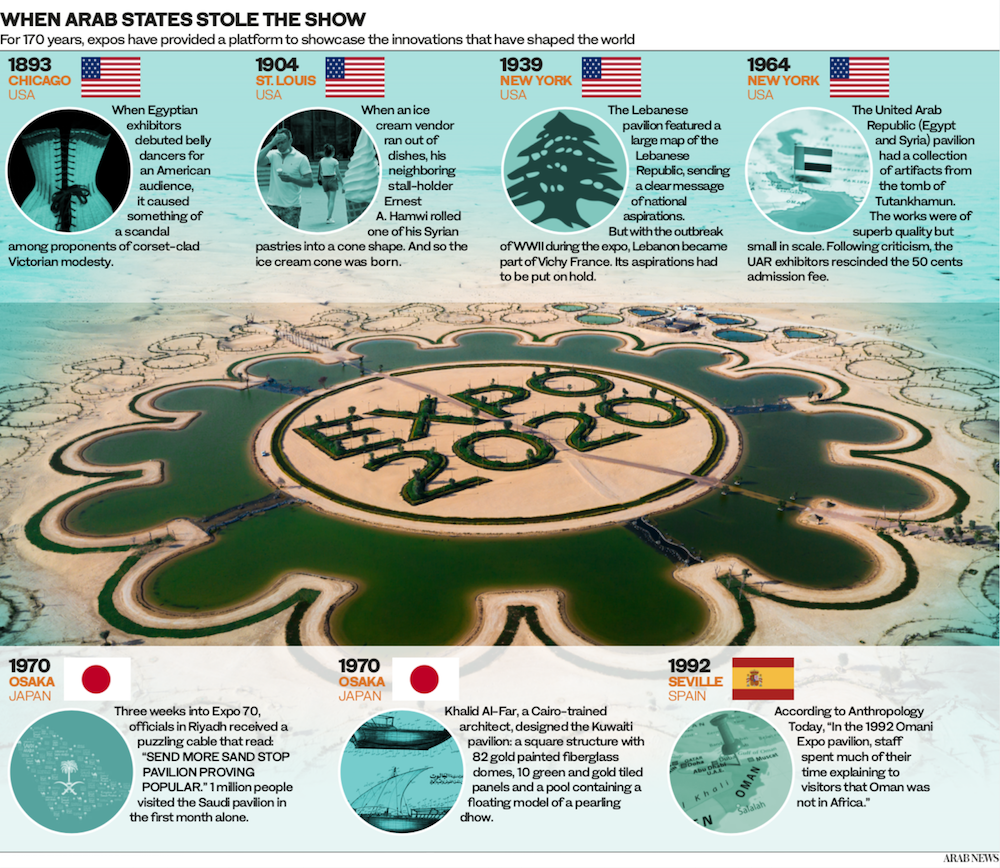
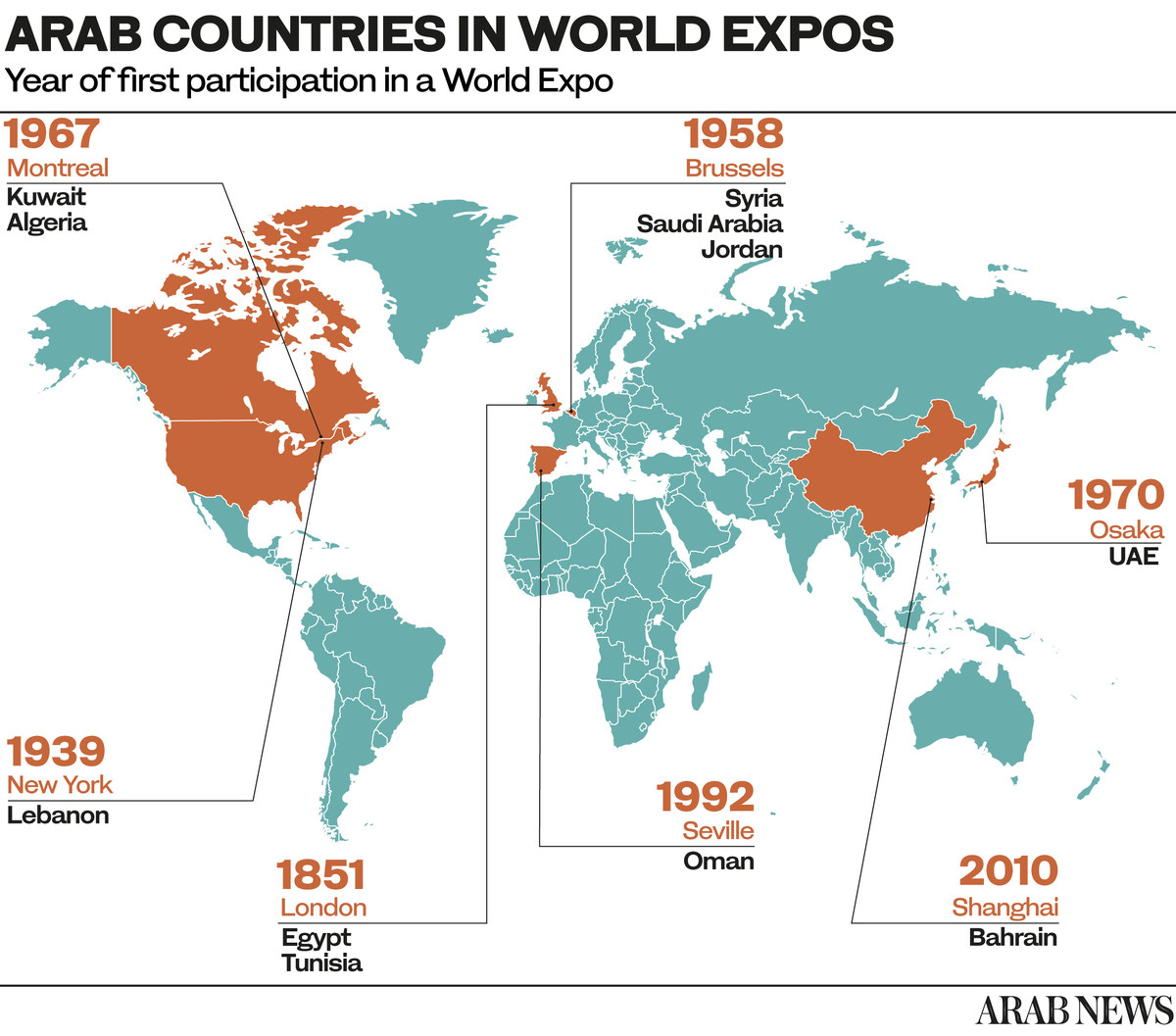
DUBAI: In 1851, the Great Exhibition set out to bring culture, history and innovations together in one place — London — for the world to see. Since this inaugural world expo, however, more than 85 percent of the global events have been hosted by either European or North American cities.

Some notable exceptions are the expos held in Asia, including Osaka in 1970, Aichi in 2005 and Shanghai in 2010, almost all of which set attendance records. But to date, these major events have been predominantly northern and western hemisphere affairs.

That is why Expo 2020 Dubai has been such a big deal, not just for world expos but also for the Middle East and North Africa region as a whole, with the Arab world occupying center stage for the first time.

As host, the UAE has offered the very essence of Arab hospitality, first by dedicating a pavilion to every participating nation, and, second, by giving every nation its own “national day” throughout the event. Saudi Arabia’s day fell on Jan. 7.
Expo 2020 Dubai has also had a distinctly Arab feel. The site is peppered with traditional Arabic design features, on its sunshades, water fountains and even public seating.

It is a well-known expo fact that pavilion positioning is everything, often indicating a nation’s global significance and its relationship with the host. With masterful design planning, the UAE was able to place participating Arab countries at the heart of the action, giving them greater visibility and prominence.

Naturally, the UAE pavilion is the largest, occupying the prime position. Its immediate neighbor is the impressive, world record-setting Saudi Arabian pavilion, and close by are Morocco, Palestine, Egypt, Kuwait and other Arab countries.

The Saudi pavilion achieved three Guinness World Records for the largest interactive light floor, the longest interactive water curtain and the largest interactive digital screen mirror. But it is not alone in showcasing avant-garde architecture ideas.

Many Arab pavilions are thoughtfully designed, with enormous curb appeal and cultural significance. They are also among the largest in the expo, and several have already been earmarked to remain as permanent structures on the site, tied to their nations as cultural centers after the event concludes.
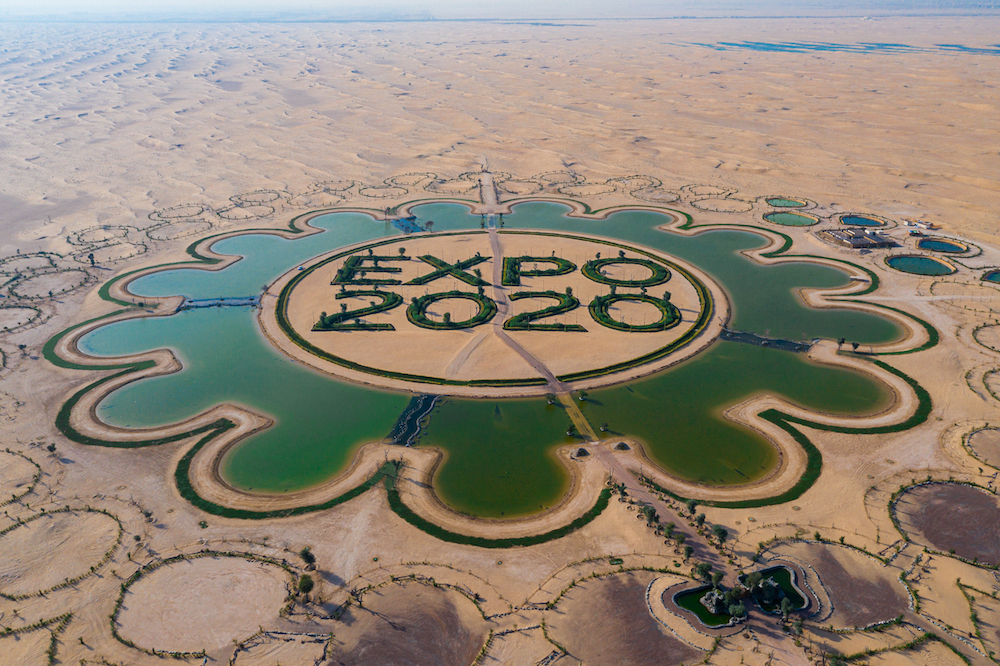


Front view of the man made EXPO 2020 lake in Dubai Desert, UAE. (Supplied)

While the expo lives up to its theme of “Connecting Minds, Creating the Future,” it also offers a visible celebration of Arab cultures and nations on a global stage.

World expos have long been used by participating states to present a national narrative, which are often framed to project the country in the most marketable way possible in order to boost trade and tourism.

Nations use the events to communicate aspects of their culture and heritage, create mutual understanding, and shape global public opinion through art, innovation, entrepreneurship, technology and policy.

Arab pavilions at Expo 2020 Dubai each tell a different story. However, a series of common themes has emerged: Celebrations of heritage; concrete and incisive approaches to the future; and a focus on cultural, social and environmental sustainability.

Themes celebrating the past are normally divided between the ancient past, such as the Bronze Age settlements of Failaka Island in Kuwait, and the more recent past, before the rapid urbanization of the last half-century.
Indeed, the Arab pavilions go to great lengths to pay homage to the feats and wisdom of past generations. For example, the first exhibit in the UAE pavilion features a stylized desert, with the soft, fine sand of Emirati dunes used as a projection surface for old film reels paying tribute to Sheikh Zayed Al-Nahyan, the UAE’s founding father. 

In the nearby Vision Pavilion, dedicated to Sheikh Mohammed bin Rashid Al-Maktoum, a guided video tour begins with the story of his stay with a Bedouin leader in the desert as a child, and the lasting impact that connection with the land made on him as a leader.

In the Saudi pavilion, ancient cultural sites, such as the tombs in Al-Hijr, At-Turaif District and the AlUla valley, are featured in a striking visual tour of the rich cultural history and natural beauty of the Kingdom.

The pavilion has hosted more than 1,800 events, activities, programs and themed weeks that reflect the Kingdom’s vibrant society, longstanding heritage and new economic opportunities.
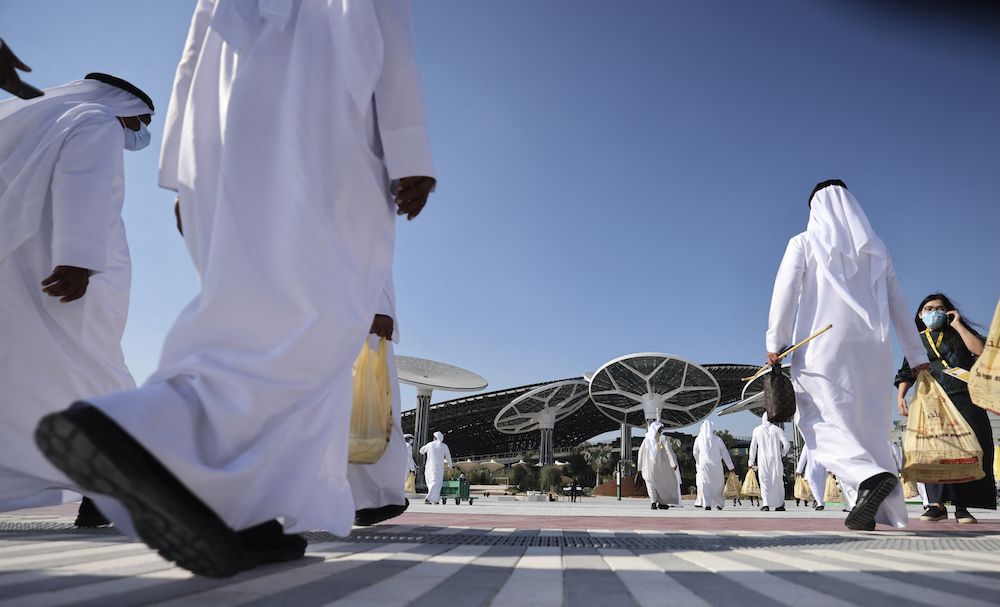


With masterful design planning, the UAE was able to place participating Arab countries at the heart of the action, giving them greater visibility and prominence. (AFP/File Photo)

In the Oman pavilion, meanwhile, a focus on frankincense highlights the sultanate’s eye-catching landscape and long trading history.

Far from focusing exclusively on their glorious past, Arab pavilions look to the future. Many have a concrete vision that highlights targets set in order to achieve desired development outcomes.

Saudi Arabia has put sustainability at the heart of its vision for the future, Vision 2030, which seeks to diversify its economy, alongside a pledge to reach net-zero carbon emissions by 2060.

Egypt has its own Vision 2030 plan, announced in 2016, which sets out eight national targets aligned with the UN’s Sustainable Development Goals, focusing on an inclusive economy, education and the environment.
Sustainability is a prominent theme across all Arab pavilions, with a particular focus on passing cultural riches, knowledge and prosperity on to the next generation.

In this vein, Kuwait’s pavilion addresses the resilience of its earliest settlements, while a stylized water tower at the pavilion’s center highlights the ways in which humans have carefully managed its natural resources in order to flourish there.

Exhibits in the pavilion also focus on Kuwait’s system of democracy and investment in its young people.

The theme of overcoming adversity can be found in several pavilions belonging to Arab states that have endured conflict and economic instability.
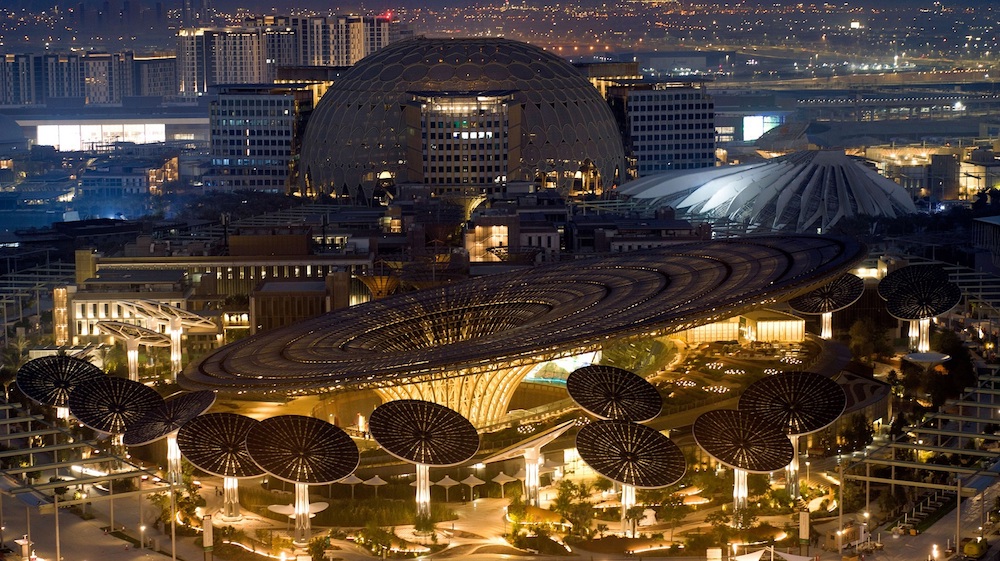


While the expo lives up to its theme of “Connecting Minds, Creating the Future,” it also offers a visible celebration of Arab cultures and nations on a global stage. (Dany Eid/Expo 2020 Dubai)

Although Lebanon’s pavilion is much more austere compared with other Arab offerings, its message is a strong reminder of the resilience of its people.

Given the multitude of challenges the nation is facing, the pavilion’s presence is a powerful statement in its own right. Like Kuwait, the pavilion’s content focuses on the country’s youth, particularly its artists.

Taken together, Arab participants in Expo 2020 Dubai have made good use of this global stage to highlight their achievements, heritage, ambitions and fortitude. In this sense, the expo can be considered an Arab triumph.


Israel’s settler movement takes victory lap as a sparse outpost becomes a settlement within a month

Updated 21 January 2026
Follow

Israel’s settler movement takes victory lap as a sparse outpost becomes a settlement within a month

  • Smotrich, who has been in charge of Israeli settlement policy for the past three years, has overseen an aggressive construction and expansion binge aimed at dismantling any remaining hopes of establishing a Palestinian state in the occupied West Bank

YATZIV SETTLEMENT, West Bank: Celebratory music blasting from loudspeakers mixed with the sounds of construction, almost drowning out calls to prayer from a mosque in the Palestinian town across this West Bank valley.
Orthodox Jewish women in colorful head coverings, with babies on their hips, shared platters of fresh vegetables as soldiers encircled the hilltop, keeping guard.
The scene Monday reflected the culmination of Israeli settlers’ long campaign to turn this site, overlooking the Palestinian town of Beit Sahour, into a settlement. Over the years, they fended off plans to build a hospital for Palestinian children on the land, always holding tight to the hope the land would one day become theirs.
That moment is now, they say.
Smotrich goes on settlement spree
After two decades of efforts, it took just a month for their new settlement, called “Yatziv,” to go from an unauthorized outpost of a few mobile homes to a fully recognized settlement. Fittingly, the new settlement’s name means “stable” in Hebrew.
“We are standing stable here in Israel,” Finance Minister and settler leader Bezalel Smotrich told The Associated Press at Monday’s inauguration ceremony. “We’re going to be here forever. We will never establish a Palestinian state here.”
With leaders like Smotrich holding key positions in Israel’s government and establishing close ties with the Trump administration, settlers are feeling the wind at their backs.
Smotrich, who has been in charge of Israeli settlement policy for the past three years, has overseen an aggressive construction and expansion binge aimed at dismantling any remaining hopes of establishing a Palestinian state in the occupied West Bank.
While most of the world considers the settlements illegal, their impact on the ground is clear, with Palestinians saying the ever-expanding construction hems them in and makes it nearly impossible to establish a viable independent state. The Palestinians seek the West Bank, captured by Israel in 1967, as part of a future state.
With Netanyahu and Trump, settlers feel emboldened
Settlers had long set their sights on the hilltop, thanks to its position in a line of settlements surrounding Jerusalem and because they said it was significant to Jewish history. But they put up the boxy prefab homes in November because days earlier, Palestinian attackers had stabbed an Israeli to death at a nearby junction.
The attack created an impetus to justify the settlement, the local settlement council chair, Yaron Rosenthal, told AP. With the election of Israel’s far-right government in late 2022, Trump’s return to office last year and the November attack, conditions were ripe for settlers to make their move, Rosenthal said.
“We understood that there was an opportunity,” he said. “But we didn’t know it would happen so quickly.”
“Now there is the right political constellation for this to happen.”
Smotrich announced approval of the outpost, along with 18 others, on Dec. 21. That capped 20 years of effort, said Nadia Matar, a settler activist.
“Shdema was nearly lost to us,” said Matar, using the name of an Israeli military base at the site. “What prevented that outcome was perseverance.”
Back in 2006, settlers were infuriated upon hearing that Israel’s government was in talks with the US to build a Palestinian children’s hospital on the land, said Hagit Ofran, a director at Peace Now, an anti-settlement watchdog group, especially as the US Agency for International Development was funding a “peace park” at the base of the hill.
The mayor of Beit Sahour urged the US Consulate to pressure Israel to begin hospital construction, while settlers began weekly demonstrations at the site calling on Israel to quash the project, according to consulate files obtained through WikiLeaks.
It was “interesting” that settlers had “no religious, legal, or ... security claim to that land,” wrote consulate staffer Matt Fuller at the time, in an email he shared with the AP. “They just don’t want the Palestinians to have it — and for a hospital no less — a hospital that would mean fewer permits for entry to Jerusalem for treatment.”
The hospital was never built. The site was converted into a military base after the Netanyahu government came to power in 2009. From there, settlers quickly established a foothold by creating makeshift cultural center at the site, putting on lectures, readings and exhibits
Speaking to the AP, Ehud Olmert, the Israeli prime minister at the time the hospital was under discussion, said that was the tipping point.
“Once it is military installation, it is easier than to change its status into a new outpost, a new settlement and so on,” he said.
Olmert said Netanyahu — who has served as prime minister nearly uninterrupted since then — was “committed to entirely different political directions from the ones that I had,” he said. “They didn’t think about cooperation with the Palestinians.”
Palestinians say the land is theirs
The continued legalization of settlements and spiking settler violence — which rose by 27 percent in 2025, according to Israel’s military — have cemented a fearful status quo for West Bank Palestinians.
The land now home to Yatziv was originally owned by Palestinians from Beit Sahour, said the town’s mayor, Elias Isseid.
“These lands have been owned by families from Beit Sahour since ancient times,” he said.
Isseid worries more land loss is to come. Yatziv is the latest in a line of Israeli settlements to pop up around Beit Sahour, all of which are connected by a main highway that runs to Jerusalem without entering Palestinian villages. The new settlement “poses a great danger to our children, our families,” he said.
A bypass road, complete with a new yellow gate, climbs up to Yatziv. The peace park stands empty.