

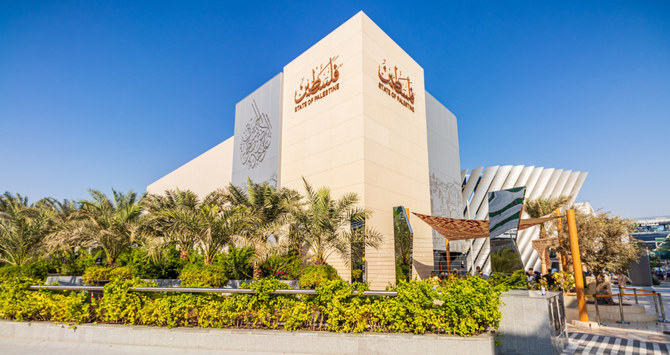

DUBAI: Palestine’s pavilion at Expo 2020 Dubai is as eye-catching as it is groundbreaking.
The pavilion, situated in a prime location along the main concourse of the Opportunity District, may not have an ornate exterior, but its simple, yet dignified, design stands out easily, especially when one considers Palestine’s geographical size and diplomatic status.
With some of the expo’s biggest pavilions nearby, including those of Saudi Arabia, Morocco and Egypt, the Palestinian pavilion gives off an air of understated grandeur and is close to the Al-Wasl dome, giving it enviable visibility in the Arab world’s first world expo.
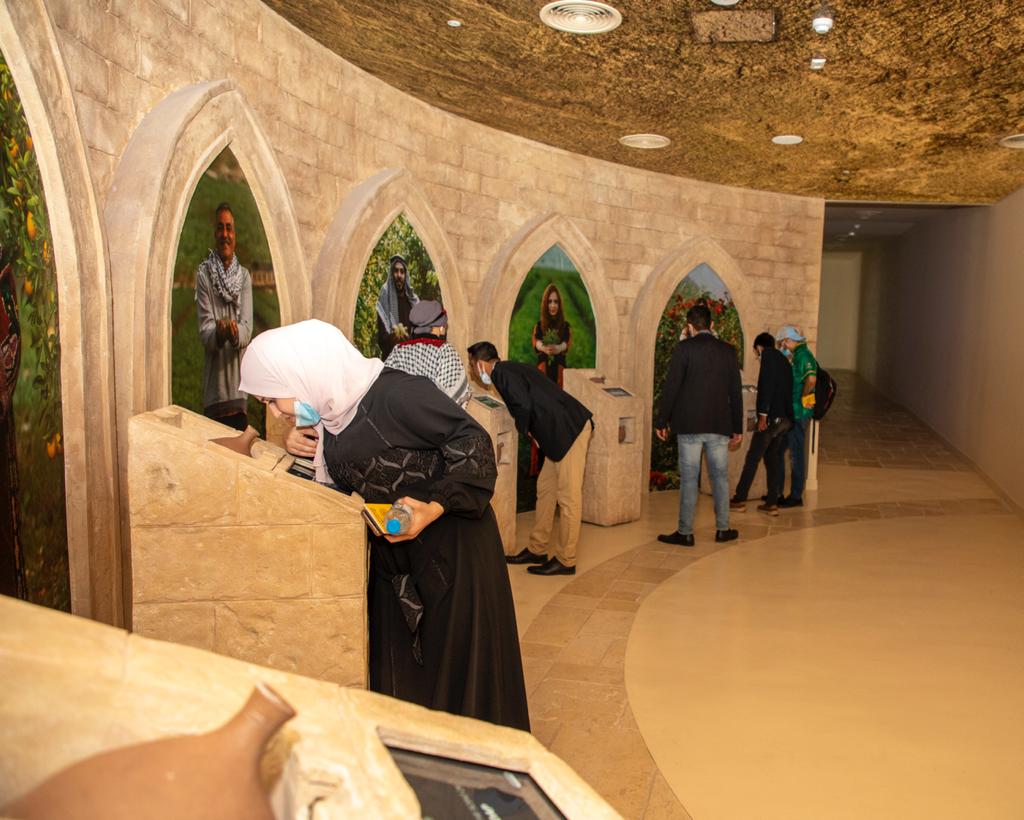
The sand-colored stones are the same that pave the streets of Jerusalem’s Old City and were brought from Palestine to adorn the pavilion. (Twitter)
On entering the pavilion, visitors are transported to an authentic Jerusalem street scene. Most guests experience the pavilion in small, guided groups of about 20 people, who are offered an informative, albeit occasionally crowded, tour of the pavilion’s displays.
Its stone-tiled floors are an immediate focal point. The sand-colored stones are the same that pave the streets of Jerusalem’s Old City and were brought from Palestine to adorn the pavilion.
According to pavilion staff, some visitors remove their shoes and kneel on the stones to be as close as possible to a land considered sacred by many.
Also paying homage to the city’s ancient architecture are modern replicas of its famous archways, floor-to-ceiling photos of the picturesque alleyways that snake through the Old City, and atmospheric audio of the city’s soundscape.
The overall sensation is immersive and hints at the pavilion’s theme — See, Hear, Touch, Smell and Taste — creating an experience of Palestine that employs all five senses.
From the entrance, visitors follow a path lined with the same latticework and mashrabiya designs that call to mind the balconies and doors of houses in Jerusalem.
The back wall features an elevator and a remarkable panoramic image of the city, looking out over the buildings and surrounding landscape.
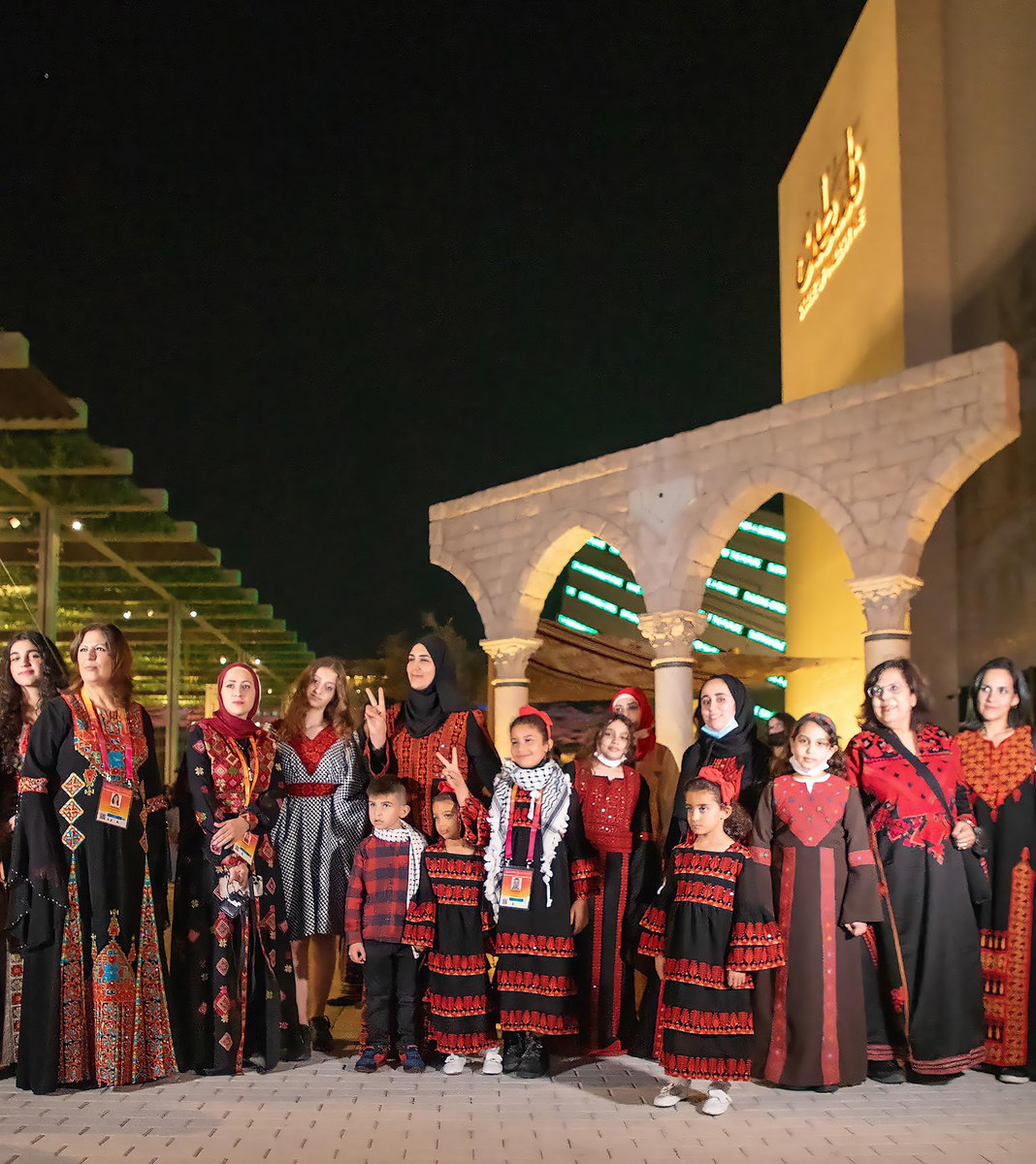
Some visitors remove their shoes and kneel on the stones to be as close as possible to a land considered sacred by many. (Supplied)
From here, visitors enter the first exhibit: “See.” A brief video plays, highlighting the natural beauty of rural Palestine, its industry, economy and welcoming culture. The video ends with an exhortation to create a “new perception of Palestine.”
From “See,” visitors move on to “Hear.” To amplify sensory perception, the “Hear” corridor is cast into darkness, with nothing on the walls but a few minimalist light drawings that help identify the sounds emanating from the speakers.
Along the corridor are different sound bubbles. In one, there is a call to prayer, followed by ringing church bells, evoking the proximity of the major religions in Jerusalem. In another, a poem about Palestine is recited in English and Arabic.
In a third, street sounds predominate, with cars and people speaking, bringing to life a typical Jerusalem street. In the last area, the sounds are of traditional Palestinian musical instruments, including the oud.
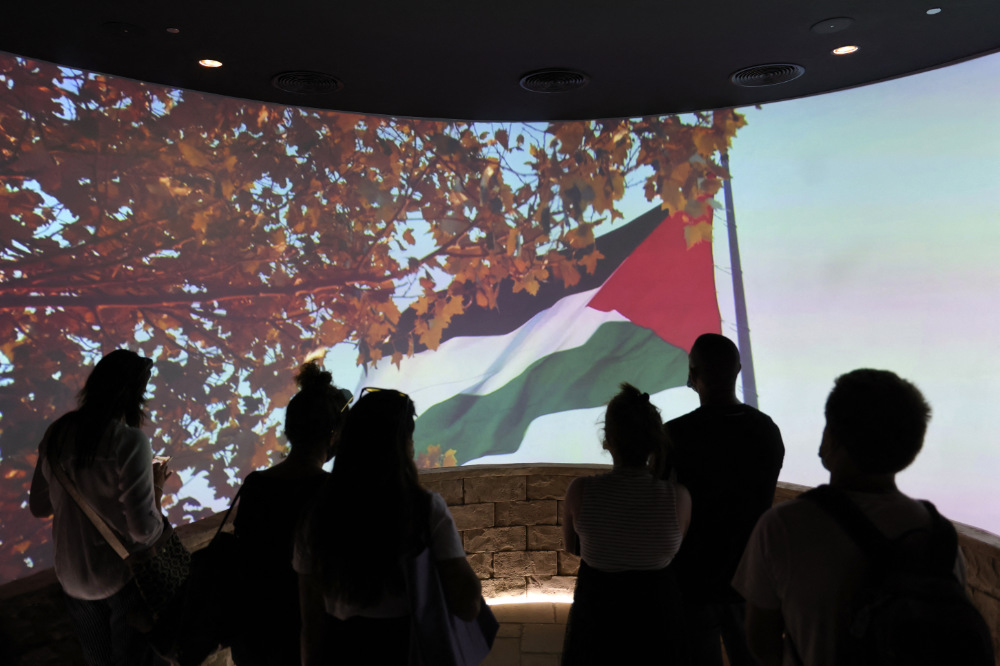
Hopes for statehood recognition. (AFP)
Walking through the next corridor, visitors arrive at “Touch.” Again, as with “Hear,” perceptions beyond the focal sense are limited. In this case, mysterious objects are placed in hidden compartments within white columns, stretching from floor to ceiling. Screens guide visitors through the process of feeling inside the column and guessing what the items are inside.
In some cases, the objects are emotionally charged. One is a large metal key, easily recognizable by touch. A screen informs the visitor that the key is a symbol of the dream to return to homes left behind in 1948, when nearly half the Arab Palestinian population was exiled in an event known as the Nakba, or catastrophe. Many displaced families have preserved the keys to their homes in Palestine.
Another easily discernible shape is a many-pointed star, symbolizing the star of nativity. This star was found in 1717 in Bethlehem, and is said to mark the place of Jesus Christ’s birth. A screen informs visitors that the Church of the Nativity was the first UNESCO World Heritage site to be listed under the name of “Palestine.”
Moving on through another corridor filled with mashrabiya shadows, visitors arrive at “Smell.” The smell of Palestine is represented through roses, sage, guava, oranges and olive oil soap. Each has a clay pot, which emits the scent, followed by a description of its significance.
Roses, for instance, represent the rose of Jericho, which wilts in the desert heat, but springs back to life with the first sign of moisture — a resilience believed to be synonymous with the people of Palestine.
Next is sage, or maramiya, a popular tea ingredient in Palestine, consumed after meals as a digestive aid. In the pavilion’s words, it is “a quintessentially Palestinian pleasure.”
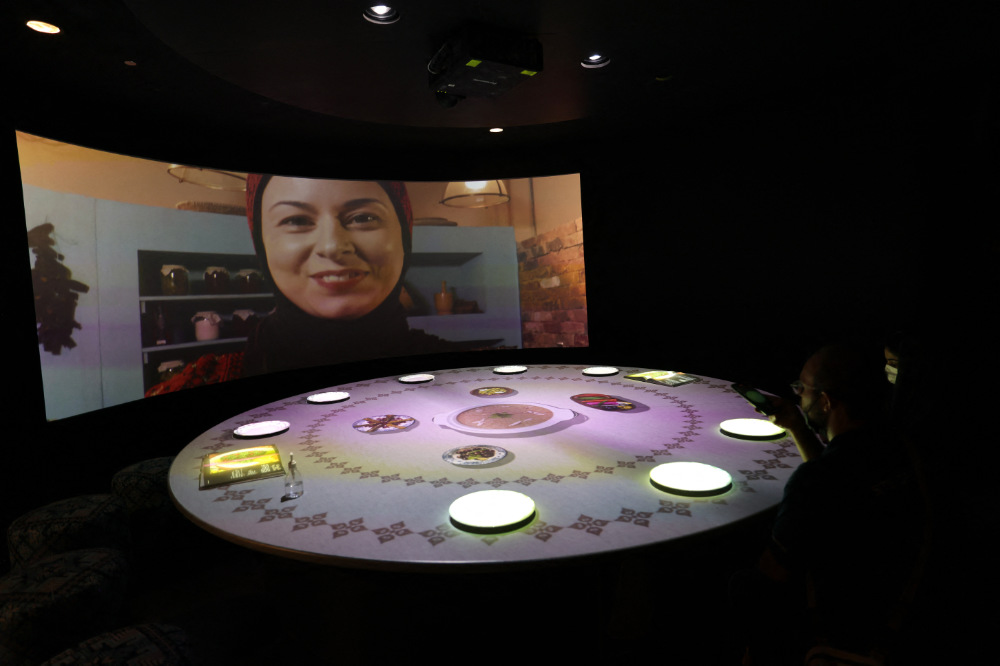
Images of luscious olives, lemons, rice, meat and spices are projected from above on to empty white plates. (Supplied)
Olive oil soap, which has been used in the region for millennia, is also featured, its strong and refreshing fragrance lingering on the nostrils as visitors move on to the next exhibit: “Taste.”
Somewhat surprisingly, there is nothing to eat in the Taste exhibit, although the pavilion’s cafe, Mamaesh, is nearby. Instead, images of luscious olives, lemons, rice, meat and spices are projected from above on to empty white plates set on a table in the center of the room, while a short film about Palestinian cuisine is projected on an adjacent wall.
The film features tantalizing close-up shots of zaatar, falafel and kunafa, while also lingering on the people preparing these dishes. Rather than simply focusing on the cuisine, the exhibit leaves visitors with a taste of Palestine’s warmth and hospitality.
Once visitors have experienced all five senses, they are brought to a room and handed virtual reality headsets. In this immersive experience, the full sensory experience is brought together on a journey through Jerusalem’s top historical sites, from the Dome of the Rock to the Church of the Holy Sepulcher.
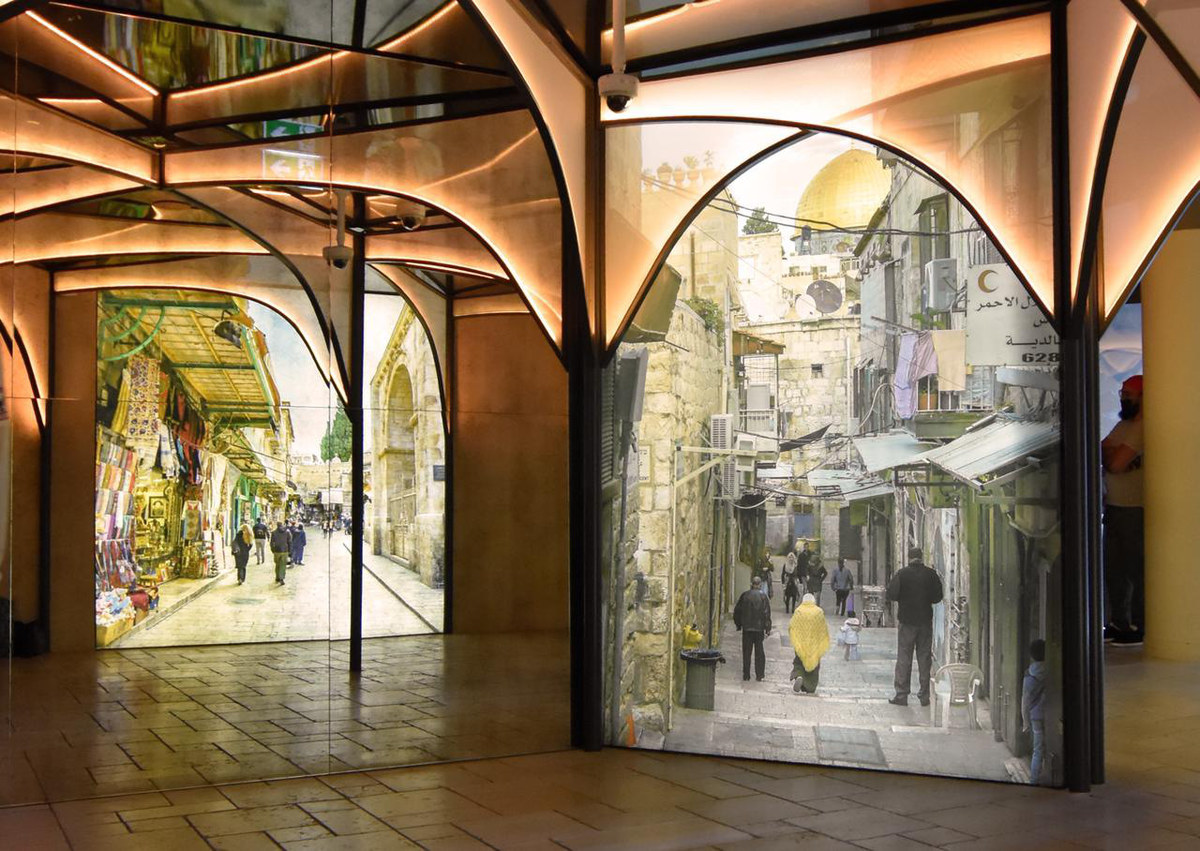
Palestinian pavilion does not focus solely on the future, nor does it dwell excessively on the past. (Supplied)
Unlike many other Arab offerings at Expo 2020 Dubai, the Palestinian pavilion does not focus solely on the future, nor does it dwell excessively on the past. Rather, everything about the pavilion, not least the channeling of perception through the five senses, creates a feeling of immediacy and connection.
Indeed, in the video from the pavilion’s “See” exhibit, a line references the “pulsation of the present.” A visit to the Palestinian pavilion creates a shared moment in the here and now, which is both unique and irreplaceable, much like Palestine itself.


