

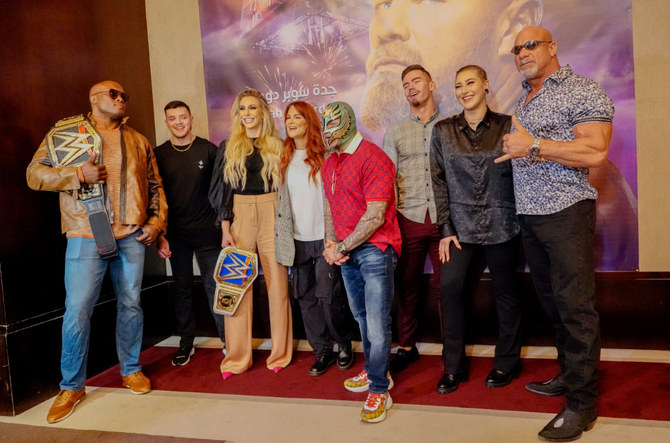
Jeddah audience to witness its first WWE Elimination Chamber match

The event will also feature US tag team twins Joshua Samuel Fatu and Jonathan Solofa Fatu, better known by their ring names Jey Uso and Jimmy Uso. (AN photo by Huda Bashatah)
Short Url
Updated 19 February 2022
Follow

Jeddah audience to witness its first WWE Elimination Chamber match

  • ‘Best of the best’ are in town, says Bobby Lashley

JEDDAH: A WWE Elimination Chamber match is taking place on Saturday in Saudi Arabia for the first time, featuring some of wrestling’s biggest names.

The event is being held in Jeddah, at the world’s largest freestanding dome, and is being organized by the General Entertainment Authority.

On Friday, Arab News had the chance to talk to some of the wrestlers about their expectations for the event.

WWE champion Bobby Lashley is defending the title against a group of veteran wrestlers including Brock Lesnar, Riddle, Theory, and AJ Styles.

It is his fourth time in Saudi Arabia.



Bobby Lashley. (AN photo by Huda Bashatah)

“I’m super excited about tomorrow’s event. Every time we come here, the crowd is so alive and so exciting. S that makes us happy. You know, we have a good crowd, we always put on great matches. You see here, the people that we brought, we brought the best of the best in the entire wrestling business. So, we’re going to put on the greatest show that they have ever seen.

“I’ve been in one same room as before I came down to Victorious. So, this will be my second one. That’s probably one of the most grueling nights so I am 100 percent sure that I’m gonna walk out like a WWE champion tomorrow.”

Bill Goldberg said he was “extremely excited” about the event.  “I truly am. I’m at peace. So be careful what you ask for tomorrow night, you may get 20 times what you ask for.”
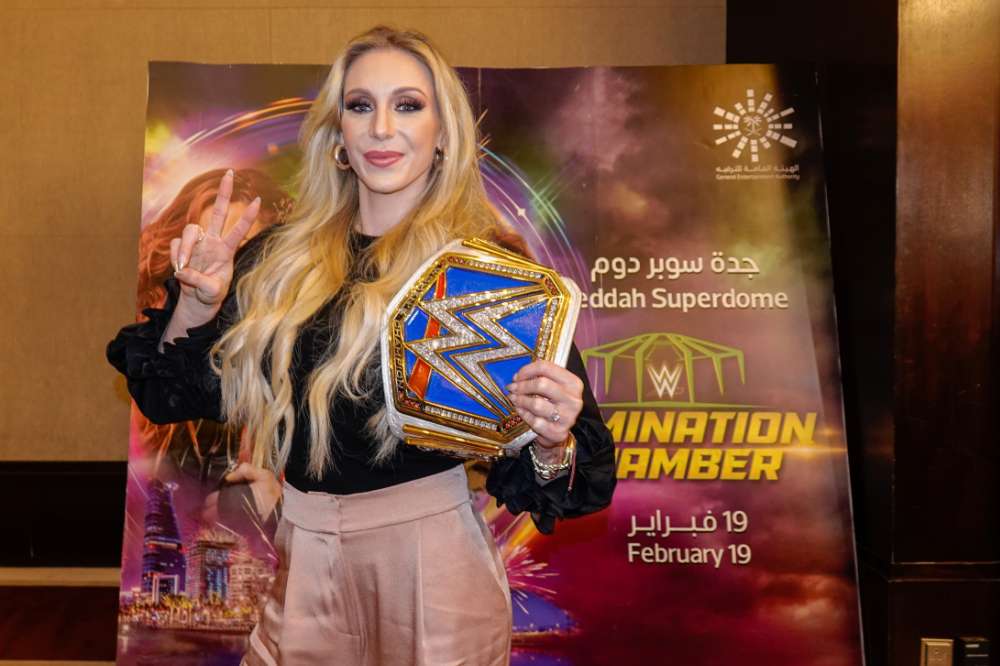


Charlotte Flair. (AN photo by Huda Bashatah)

When asked who he was planning to beat, he replied: “My biggest adversary is myself. And I’ve been at battle with him for six years, and I’ve defeated him. Okay, so whoever’s in front of me. Better hold on. It doesn’t matter to me when the bell rings. If I’m in a prison, if I’m in a shed, if I’m in an Elimination Chamber, I don’t care where I am, because the only thing that matters is whoever’s in front of me.”

Ronda Rousey will join forces with Naomi against SmackDown Women’s Champion Charlotte Flair and Sonya Deville.

Flair told Arab News: “I can’t imagine what it’s going to be like in the dome tomorrow. I’ve had the opportunity to pretty much perform everywhere except for here. So, I’m really excited to bring the smackdown title. I’m very excited. I’m going to win the match. Wow.”

The youngest participating wrestler is Austin Theory Aged 24, he said that Saturday was a really big day for him.
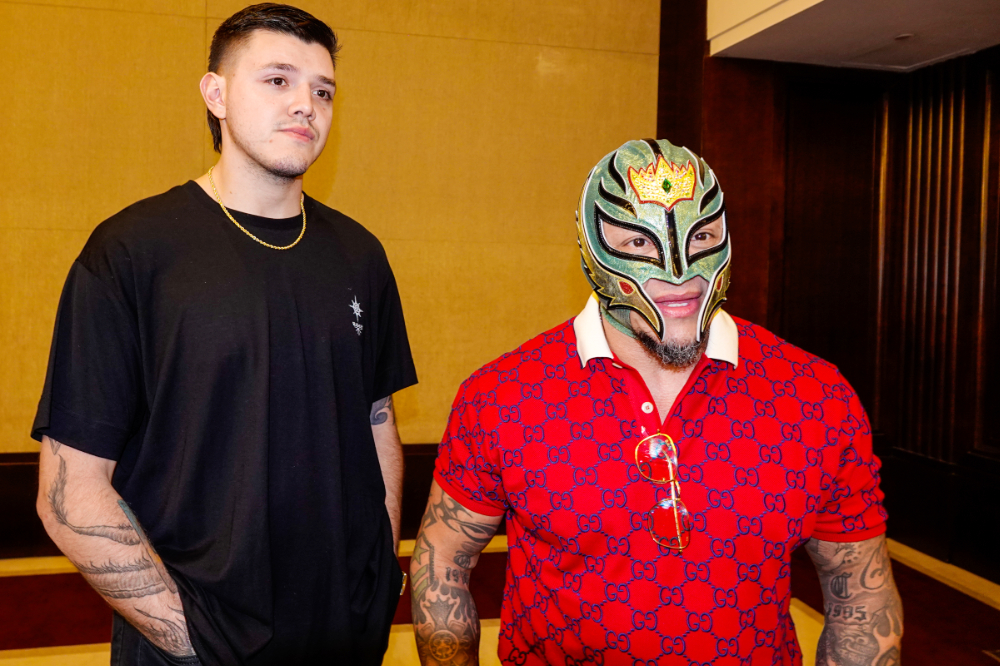
“It’s actually a lot of records,” he told Arab News. “I could start tomorrow. So tomorrow will be my first time performing in Saudi Arabia. It’d be my first time in the Elimination Chamber. It’s my second opportunity at a WWE Championship. But if I won tomorrow, which you know, possible in theory, why not? I can become the youngest WWE Champion in history.”

Theory said that the Elimination Chamber was one of the hardest fights. “It is for the WWE Championship, so I’m going to go crazy tomorrow.”

The event will also feature US tag team twins Joshua Samuel Fatu and Jonathan Solofa Fatu, better known by their ring names Jey Uso and Jimmy Uso.

The event is part of the GEA’s program of activities and international shows. It is also part of its cooperation with WWE to present its global shows in the Kingdom.

WWE Elimination Chamber matches are usually held in the US and they will be held outside the country for the first time since the event started in 2002.

Elimination Chamber matches are hugely popular all over the world as they are considered to be an exciting but brutal spectacle.

The fight has six wrestlers in the ring. It begins with the entry of two wrestlers and, every five minutes, the door is opened for another to enter the arena. This process continues until all the wrestlers enter.

Tickets are available at ticketMX.com and prices range from SR50 ($13.33) to SR900.

The battle begins at 8 p.m. and ends at midnight.


Akio Fujimoto discusses RSIFF Golden Yusr winner ‘Lost Land’ 

Akio Fujimoto at the Red Sea International Film Festival in Jeddah. (Getty Images)
Updated 19 December 2025
Follow

Akio Fujimoto discusses RSIFF Golden Yusr winner ‘Lost Land’ 

  • The Japanese filmmaker on his groundbreaking Rohingya-language feature

JEDDAH: Some stories demand to be told. Not just as narratives, but as acts of witness.  

Japanese filmmaker Akio Fujimoto’s “Lost Land” is one such story. Billed as the first feature film in the Rohingya language, the movie took home the top prize — the Golden Yusr — at this year’s Red Sea International Film Festival. 

“Lost Land” — which premiered in the Horizons section at this year’s Venice Film Festival, where it won the special jury prize — follows two young Rohingya siblings, Somira and Shafi, fleeing persecution in Myanmar as they undertake a perilous journey d to join their uncle in Malaysia. 

Shomira Rias Uddin (R) and Muhammad Shofik Rias Uddin in 'Lost Land.' (Supplied) 

Presenting the Golden Yusr to Fujimoto, RSIFF jury head, the US filmmaker Sean Baker, said the film “confronts the plight of displaced children with unflinching empathy and poetic urgency.” 

Fujimoto’s journey to this film is a profound narrative of personal reckoning. Having worked in Myanmar for more than a decade, he recognized the unspoken tensions surrounding discussions about refugee experiences but never spoke out himself due to fear of persecution. The 2021 military coup in Myanmar, he said, forced him to confront a lingering sense of guilt about his previous silence on the subject. 

“Looking back on my decade of work, I realized I had been avoiding topics I wanted to focus on as a filmmaker,” Fujimoto said in an interview with Arab News at RSIFF. 

That self-reflection became the catalyst for “Lost Land,” transforming personal hesitation into a powerful act of cinematic storytelling. 

Eschewing traditional casting methods, Fujimoto discovered his lead actors through serendipity during community fieldwork. Shomira Rias Uddin and Muhammad Shofik Rias Uddin, real-life siblings who play the film’s young leads, were found walking near interview locations, compelling the filmmaker to reshape the entire script around their natural chemistry. While the original script was written with two teenage brothers in mind, the discovery of the Rias Uddin siblings led Fujimoto to alter the script significantly. 

Communication between the cast and crew became an intricate dance of translation and cultural bridge-building. With Fujimoto speaking primarily Japanese and some Burmese, the team relied on Sujauddin Karimuddin, a Rohingya translator who did far more than linguistic conversion. “He wasn’t just translating words but conveying messages, creating trust, and establishing a collaborative atmosphere,” said Watanabe, Fujimoto’s translator. 

One of the most remarkable aspects of “Lost Land” is its linguistic significance. Beyond being a narrative, the film serves as a critical instrument of cultural preservation. Karimuddin, who is also a producer on the film, approached his role like a linguistic curator. “As a Rohingya myself, I had the privilege of choosing words carefully, trying to instill poetry, capturing linguistic nuances that are slowly disappearing. So, the film is very important when it comes to the preservation of a people’s language. It was a privilege for me to contribute to it,” he said. 

As they were making the first fiction film focused on Rohingya experiences, the team felt an immense responsibility. “Lost Land” aims to humanize a community often reduced to statistics, giving voice and complexity to individual experiences.

Shomira Rias Uddin and Muhammad Shofik Rias Uddin (R) in 'Lost Land.' (Supplied) 

“In our film, we had around 200 people — including extras — who were all part of the Rohingya community. I felt in order to show their feelings and their voice; it was really important to bring in the Rohingya people and tell the story together with them,” said Fujimoto. 

For Fujimoto, whose previous films include “Passage of Life” (2017) and “Along the Sea” (2020), the film represents more than an artistic achievement. It’s a form of personal and collective redemption. “I can now clearly talk about these people without hesitation,” he said. 

The filmmaker’s future ambitions involve expanding on this project. He sees “Lost Land” as a crucial first step, and hopes to support Rohingya filmmakers in telling their own stories directly. 

“The next phase is bringing narratives from the Rohingya perspective, directed by Rohingya filmmakers,” he said.