Israel shoots down Hezbollah drone, fails to intercept another

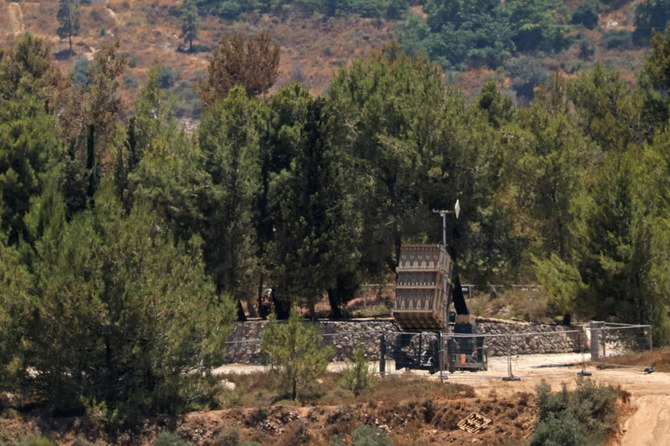
The military said the incursion set off air raid sirens in northern Israel, and that Iron Dome interceptors were deployed and fighter jets were patrolling the skies. (File/AFP)
Short Url
Updated 18 February 2022
Follow

Israel shoots down Hezbollah drone, fails to intercept another

  • The move comes just a day after Israel shot down what it said was another Hezbollah drone
  • Neither Lebanon nor Hezbollah gave immediate comment

BEIRUT: Israeli warplanes carried out mock raids over southern Lebanon on Friday, after Israel’s Iron Dome defense system failed to intercept and lost track of a drone coming from its neighbor, according to the Israel Defense Force, which later said that “the drone returned to Lebanon.”

The planes flew low over the Lebanese capital Beirut, with a Reuters witness reporting two jets being spotted.

“It is clear from the preliminary investigation that earlier today, a small drone was spotted inside Lebanon, flying toward Israeli territory,” IDF spokesman Avichay Adraee tweeted.

“Helicopters and warplanes were summoned, in addition to launching an interceptor missile from the Iron Dome without being able to intercept it,” he added. “Investigations revealed that it was a small Hezbollah recon drone.”

Friday’s infiltration came a day after the IDF downed a drone that it said was launched into Israeli airspace by Hezbollah.

UN Interim Force in Lebanon spokesperson Andrea Tenenti said: “The Israeli army informed UNIFIL ... that it had downed a drone south of the Blue Line. We informed the Lebanese Armed Forces and we are following up on the incident with the concerned parties.”

This incident constitutes a dangerous development that could contribute to an escalation in Hezbollah-Israel confrontations, especially since Hezbollah Secretary-General Hassan Nasrallah boasted on Wednesday about “the resistance having the capability to convert its missiles into precision missiles,” adding: “In Lebanon, for a long time, we have started to manufacture drones.”

Retired Lebanese Armed Forces Brig. Gen. Nizar Abdel-Kader told Arab News: “This escalation under the current circumstances can only be explained as attempts by Nasrallah to attribute more weakness to the (Lebanese) state, and it can be linked to his previous speech, in which he attacked the Lebanese army.”

He added: “Any escalation on the southern Lebanese border harms Lebanon, the implementation of Resolution 1701 and the reputation of the Lebanese army and its role in establishing security in the area south of the Litani River.”

Abdel-Kader noted: “Nasrallah talking about manufacturing drones and inviting buyers to place their orders harms Lebanon on all levels. Everyone is talking about the parliamentary elections, waiting for them and relying on them. Does this aim to create a security issue on the borders that leads to a dangerous escalation in preparation to postpone the elections?”

Nasrallah’s speech about manufacturing drones was met with official Lebanese silence, while anti-Hezbollah voices accused him of “overstepping Lebanese state institutions and crossing every red line there is.”

The Southerners for Freedom group criticized “the political foolishness that controls those leading the political system.”

The group addressed Nasrallah, saying: “Do your foolish and smart missiles feed a hungry Lebanese in Baalbek-Hermel, Bint Jbeil, Tyre, Hasbaya or Marjayoun? Do your drones provide diesel or firewood for a family in need of warmth in this freezing cold? Your missiles and drones will not benefit anyone, but will only increase destruction and chaos. Had you set up a factory or a development project in Baalbek-Hermel, Brital, Bint Jbeil, Aita al-Shaab and other towns, you would have created job opportunities for Lebanese youth instead of forcing them to emigrate to all corners of the earth to escape your projects and adventures.”

This development coincides with an internal Lebanese debate about the demarcation of the southern maritime border after President Michel Aoun announced last week that “Line 23 is Lebanon’s negotiating ceiling in indirect negotiations with the Israeli side under US mediation.”

This was also stressed by Foreign Minister Abdullah Bou Habib who said: “I am convinced that Line 23 is what serves Lebanon’s best interest.”

The Lebanese negotiating delegation had put Line 29 as a basis for negotiation, which would give Lebanon an additional area estimated at 2,290 square km in the disputed area and 1,430 square km from Line 23.

However, Line 23 gives Lebanon, according to delegation head Brig. Gen. Bassam Yassin, 860 square km only.

Yassin had recently criticized “making free concessions in the negotiations and achieving what Israel wants, while we gain nothing.”

Amos Hochstein, the US envoy for energy affairs, who is mediating the indirect negotiations, had been visiting Lebanon and Israel in an attempt to find a middle ground to resume negotiations and has confirmed progress.


Syrian military tells civilians to evacuate contested area east of Aleppo amid rising tensions

Updated 15 January 2026
Follow

Syrian military tells civilians to evacuate contested area east of Aleppo amid rising tensions

  • Syria’s military has announced it will open a “humanitarian corridor” for civilians to evacuate from an area in Aleppo province
  • This follows several days of intense clashes between government forces and the Kurdish-led Syrian Democratic Forces

DAMASCUS: Syria’s military said it would open a corridor Thursday for civilians to evacuate an area of Aleppo province that has seen a military buildup following intense clashes between government and Kurdish-led forces in Aleppo city.
The army’s announcement late Wednesday — which said civilians would be able to evacuate through the “humanitarian corridor” from 9 a.m. to 5 p.m. Thursday — appeared to signal plans for an offensive in the towns of Deir Hafer and Maskana and surrounding areas, about 60 kilometers (40 miles) east of Aleppo city.
The military called on the Kurdish-led Syrian Democratic Forces and other armed groups to withdraw to the other side of the the Euphrates River, to the east of the contested zone.
Syrian government troops have already sent troop reinforcements to the area after accusing the SDF of building up its own forces there, which the SDF denied. There have been limited exchanges of fire between the two sides, and the SDF has said that Turkish drones carried out strikes there.
The government has accused the SDF of launching drone strikes in Aleppo city, including one that hit the Aleppo governorate building on Saturday shortly after two Cabinet ministers and a local official held a news conference there.
The tensions in the Deir Hafer area come after several days of intense clashes last week in Aleppo city that ended with the evacuation of Kurdish fighters and government forces taking control of three contested neighborhoods. The fighting killed at least 23 people, wounded dozens more, and displaced tens of thousands.
The fighting broke out as negotiations have stalled between Damascus and the SDF, which controls large swaths of northeast Syria, over an agreement to integrate their forces and for the central government to take control of institutions including border crossings and oil fields in the northeast.
Some of the factions that make up the new Syrian army, which was formed after the fall of former President Bashar Assad in a rebel offensive in December 2024, were previously Turkiye-backed insurgent groups that have a long history of clashing with Kurdish forces.
The SDF for years has been the main US partner in Syria in fighting against the Daesh group, but Turkiye considers the SDF a terrorist organization because of its association with the Kurdistan Workers’ Party, or PKK, which has waged a long-running insurgency in Turkiye. A peace process is now underway.
Despite the long-running US support for the SDF, the Trump administration has also developed close ties with the government of interim Syrian President Ahmad Al-Sharaa and has pushed the Kurds to implement the integration deal. Washington has so far avoided publicly taking sides in the clashes in Aleppo.
The SDF in a statement warned of “dangerous repercussions on civilians, infrastructure, and vital facilities” in case of a further escalation and said Damascus bears “full responsibility for this escalation and all ensuing humanitarian and security repercussions in the region.”
Adm. Brad Cooper, commander of US Central Command, said in a statement Tuesday that the US is “closely monitoring” the situation and called for “all parties to exercise maximum restraint, avoid actions that could further escalate tensions, and prioritize the protection of civilians and critical infrastructure.” He called on the parties to “return to the negotiating table in good faith.”
Al-Sharaa blasts the SDF
In a televised interview aired Wednesday, Al-Sharaa praised the “courage of the Kurds” and said he would guarantee their rights and wants them to be part of the Syrian army, but he lashed out at the SDF.
He accused the group of not abiding by an agreement reached last year under which their forces were supposed to withdraw from neighborhoods they controlled in Aleppo city and of forcibly preventing civilians from leaving when the army opened a corridor for them to evacuate amid the recent clashes.
Al-Sharaa claimed that the SDF refused attempts by France and the US to mediate a ceasefire and withdrawal of Kurdish forces during the clashes due to an order from the PKK.
The interview was initially intended to air Tuesday on Shams TV, a broadcaster based in Irbil — the seat of northern Iraq’s semi-autonomous Kurdish region — but was canceled for what the station initially said were technical reasons.
Later the station’s manager said that the interview had been spiked out of fear of further inflaming tensions because of the hard line Al-Sharaa took against the SDF.
Syria’s state TV station instead aired clips from the interview on Wednesday. There was no immediate response from the SDF to Al-Sharaa’s comments.