

‘Coca’ pits indigenous Colombians against soft drink giant

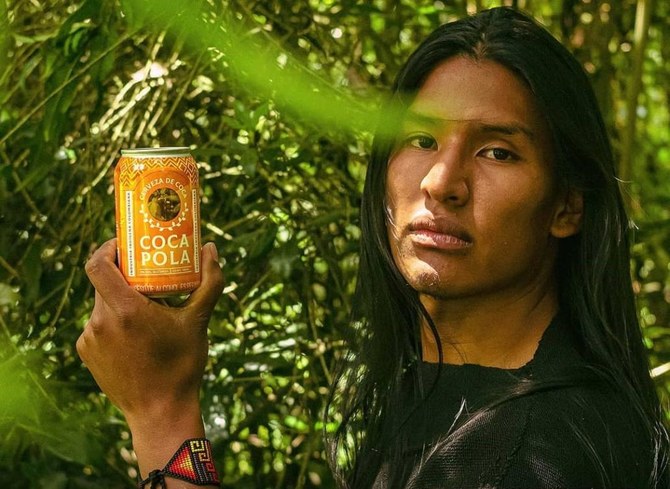
The Nasa and Embera Chami tribes are threatening Coca-Cola with ‘judicial and commercial measures’ including ‘the prohibition of the sale of its products in indigenous territories.’ (Twitter Photo)
Short Url
Updated 18 February 2022
Follow

‘Coca’ pits indigenous Colombians against soft drink giant

  • Coca-Cola asked the Coca Nasa company — run by members of the indigenous Nasa community — to ‘cease and desist permanently from using the name Coca Pola’
  • Representatives of the Nasa and Embera Chami tribes replied by sending a letter to Coca-Cola giving it 10 days to explain its ‘non-consensual use’ of the word ‘Coca’ in Coca-Cola

BOGOTA: Indigenous Colombians are going head to head with the world’s biggest soft drink company over the commercial use of the word “coca” — the name of an indigenous South American plant.
Representatives of the Nasa and Embera Chami tribes are threatening to ban the sale of Coca-Cola in their territories after the Coca-Cola Company incurred their ire by taking issue with the name of the locally-produced Coca Pola.
They sent a letter to the multinational corporation, a copy of which AFP has seen, giving it 10 days to explain its “non-consensual use” of the word “Coca” in Coca-Cola — the world’s most popular fizzy drink.
If the company fails to reply, the communities threatened “judicial and commercial measures” including “the prohibition of the sale of its products in indigenous territories.”
These reserved territories, according to Colombia’s National Land Agency, cover almost a third of the country, or 33 million hectares, though less than 10 percent of the population identifies as indigenous.
For centuries, indigenous peoples in Colombia, Peru and elsewhere on the continent have chewed the coca leaf and defended it as part of their cultural heritage.

Indigenous peoples in Colombia are allowed by law to grow the plant and market products manufactured from it.
One such product, Coca Pola, has been manufactured by local company Coca Nasa for four years.
Three months ago, Coca-Cola threatened legal action against Coca Nasa, which employs about 20 people and produces food, traditional medicine, drinks and other coca products.
Coca-Cola asked the company — run by members of the indigenous Nasa community — to “cease and desist permanently from using the name Coca Pola or any similar term that could be confused with the commercial brands” owned by the drinks giant.
In turn, the Nasa and Embera Chami now claim the more than 100-year-old Coca-Cola trademark, registered without consulting them, amounts to an “abusive practice” that violates “the national, Andean and international human rights systems.”
Nasa leader Fabiola Pinacue, who signed the letter to Coca-Cola, defended her community’s right to use the trademark Coca Pola.
“The coca leaf is a key element of the Nasa culture,” insisted Pinacue.


Japan’s beloved last pandas leave for China as ties fray

Updated 10 sec ago
Follow

Japan’s beloved last pandas leave for China as ties fray

TOKYO: Two popular pandas are set to leave Tokyo for China Tuesday, leaving Japan without any of the beloved bears for the first time in 50 years as ties between the Asian neighbors fray.
Panda twins Lei Lei and Xiao Xiao are due to be transported by truck out of Ueno Zoological Gardens, their birthplace, disappointing many Japanese fans who have grown attached to the furry four-year-olds.
“Although I can’t see them, I came to share the same air with them and to say, ‘Hope you’ll be OK,’” one woman visiting the zoo told public broadcaster NHK.
The pandas’ abrupt return was announced last month during a diplomatic spat that began when Japanese Prime Minister Sanae Takaichi hinted that Tokyo could intervene militarily in the event of an attack on Taiwan.
Her comment provoked the ire of Beijing, which regards the island as its own territory.
The distinctive black-and-white animals, loaned out as part of China’s “panda diplomacy,” have symbolized friendship between Beijing and Tokyo since they normalized diplomatic ties in 1972.
Their repatriation comes a month before their loan period expires in February, according to the Tokyo Metropolitan Government, which operates Ueno Zoo.
Japan has reportedly been seeking the loan of a new pair of pandas.
However, a weekend poll by the liberal Asahi Shimbun newspaper showed that 70 percent of those surveyed do not think the government should negotiate with China on the lease of new pandas, while 26 percent would like them to.
On Sunday, Ueno Zoo invited some 4,400 lucky winners of an online lottery to see the pandas for the last time.
Passionate fans without tickets still turned out at the park, sporting panda-themed shirts, bags and dolls to demonstrate their love of the animals.
China has discouraged its nationals from traveling to Japan, citing deteriorating public security and criminal acts against Chinese nationals in the country.
Beijing is reportedly also choking off exports to Japan of rare-earth products crucial for making everything from electric cars to missiles.
However, China routinely removes pandas from foreign countries and the latest move may not be politically motivated, said Masaki Ienaga, a professor at Tokyo Woman’s Christian University and an expert in East Asian international relations.
“If you talk about (Chinese) politics, the timing of sending pandas is what counts,” and pandas could return to Japan if bilateral ties warm, he said.
Other countries use animals as tools of diplomacy, including Thailand with its elephants and Australia with its koalas, he added.
“But pandas are special,” he said. “They have strong customer-drawing power, and... they can earn money.”
kh/aph/mjw