US in ‘very final stages’ of Iran nuclear talks, State Dept. says

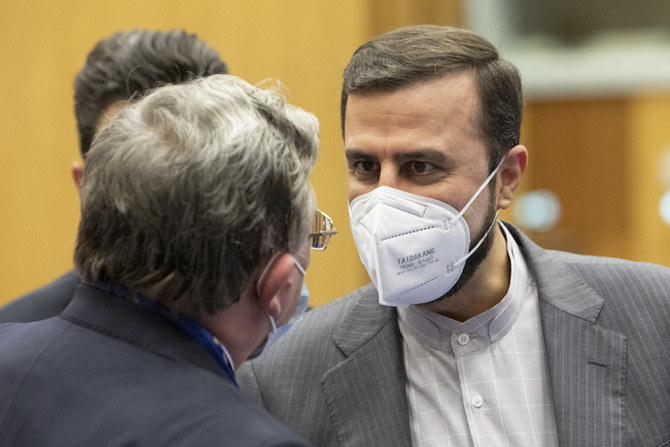
Iran’s Governor to the International Atomic Energy Agency Kazem Gharib Abadi (R) talks to Russia’s Governor to the IAEA Mikhail Ulyanov, during a meeting in Vienna, Austria. (File/AFP)
Short Url
Updated 17 February 2022
Follow

US in ‘very final stages’ of Iran nuclear talks, State Dept. says

  • Iran’s top nuclear negotiator says ‘we are closer than ever to an agreement’
  • France’s Le Drian warns Tehran it only has days left to agree to nuclear deal

LONDON: The United States is in “the midst of the very final stages” of indirect talks with Iran aimed at salvaging a 2015 deal limiting Tehran’s nuclear activities, State Department spokesperson Ned Price said on Wednesday.
“This is really the decisive period during which we’ll be able to determine whether a mutual return to compliance with the JCPOA is in the offing, or if it’s not,” Price — using an abbreviation for the Joint Comprehensive Plan of Action, the 2015 deal with world powers — told reporters.
Iran’s lead nuclear negotiator Ali Bagheri Kani responded in a tweet, calling on Western powers “to be realistic, avoid intransigence and heed lessons of past 4yrs. Time for their serious decisions.”
“After weeks of intensive talks, we are closer than ever to an agreement; nothing is agreed until everything is agreed, though,” he tweeted.

World powers are entering the final stage of talks with Iran in Vienna aimed at reviving the 2015 deal, which was rendered moribund by the US walking out of the accord in 2018.
The administration of president Donald Trump reimposed sanctions against Iran, battering the Iranian economy, while Tehran ramped up its nuclear work in response in violation of the Joint Comprehensive Plan of Action (JCPOA).
Earlier on Wednesday, France said Tehran had just days left to accept the deal, warning that a major crisis would be unleashed if there is no agreement.
“It is not a question of weeks, it is a question of days,” French Foreign Minister Jean-Yves Le Drian told the Senate, adding that the “moment of truth” had now arrived in the marathon process.
“We need political decisions from the Iranians. They have a very clear choice,” Le Drian said.
“Either they unleash a serious crisis in the next days... or they accept an agreement that respects the interests of all the parties, especially those of Iran,” he said.
He described a deal as being “within grasp” and noted there was now agreement on an accord between the European powers in the negotiations — France, Germany and Britain — as well as China, Russia and the US.
“We have found convergence significant enough to enable an agreement that is within grasp right now,” he said.
But he said that time was running out because Iran was continuing to intensify its nuclear activities in violation of the 2015 deal, which aimed to provide safeguards that Tehran would never seek a nuclear weapon.
“The more this goes on, the more Iran is accelerating its nuclear procedures,” he said.
China’s envoy to the talks said that Iran was being constructive by putting everything on the table in response to US approaches. “They have not only adopted this straightforward approach but also made a political decision based on give and take,” Wang Qun told Reuters.
Meanwhile, Iran urged the US Congress to issue a “political statement” that Washington will stay committed to a possible agreement in Vienna talks to restore the deal.
Iran’s Foreign Minister Hossein Amir-Abdollahian urged the US guarantee on the JCPOA in an interview with the Financial Times published on his ministry’s website.
“As a matter of principle, public opinion in Iran cannot accept as a guarantee the words of a head of state, let alone the United States, due to the withdrawal of Americans from the JCPOA,” he said.
He stressed he had asked Iranian negotiators to propose to the Western parties that “at least their parliaments or parliament speakers, including the US Congress, can declare in the form of a political statement their commitment to the agreement and return to the JCPOA implementation.”
“Iran’s commitments are as clear as a mathematical formula,” said Amir-Abdollahian.
“It is absolutely clear what we are supposed to do and how these measures will be verified” through the UN’s International Atomic Energy Agency, he said, adding that the other parties must have “no concern.”
“But we remain concerned primarily about the guarantees” from the US side, he noted, adding that “we are facing problems during this period because the other party lacks a serious initiative.”
He also said Iran was ready to enter into the process of direct talks with the US, adding if Washington’s intentions are “genuine” they should take some “practical and tangible steps on the ground before any direct talks and contacts can take place.”
(With Reuters and AFP)


Yemeni border security chief reveals drug smuggling networks linked to Houthis

Updated 5 sec ago
Follow

Yemeni border security chief reveals drug smuggling networks linked to Houthis

  • Al-Wadiah security force foils attempt by Houthi leader to enter Saudi Arabia using forged Umrah visa
  • Col. Osama Al-Assad: Saudi security measures are strong, the level of vigilance is high, and we coordinate with them on smuggling cases that are being closely monitored

AL-WADIAH, Yemen: Most of the drug-smuggling networks from Yemen to Saudi territory are directly linked to the preventive security apparatus affiliated with the Houthi terrorist group.

This is according to Col. Osama Al-Assad, commander of Yemen’s Security and Protection Battalion at the Al-Wadiah border crossing.

Al-Assad told Asharq Al-Awsat that the battalion recently arrested a Houthi leader while he was trying to enter Saudi Arabia using a forged passport and Umrah visa, suggesting that the motives for his entry were of a security nature, and not to perform religious rites as he claimed.

Al-Assad said the battalion faced several patterns of smuggling attempts, foremost among them prohibited items, in addition to people smuggling, forgers, and persons of unknown identity.

But, he said, that the battalion’s high cumulative expertise enabled them to thwart these illegal activities.

Al-Assad added that the level of coordination with the Saudi side was conducted at the highest levels. He expressed gratitude to the Kingdom for its continuous support to Yemen in general, and to the battalion in particular, in a manner that contributed to strengthening border security between the two countries.

He said the battalion’s mission was focused on securing and protecting the crossing, and combating various forms of smuggling, whether prohibited items or people smuggling, noting that the battalion apprehended about 10 people a day in possession of forged Umrah visas.

Al-Assad said that the battalion’s security coverage extended to “the crossing and its surroundings for a distance of 30 km westward up to the borders of Al-Rayyan in Al-Jawf.”

He added that among the battalion’s tasks was to arrest wanted members of Al-Qaeda, in addition to persons fleeing the implementation of judicial rulings issued against them.

He said the majority of smuggling operations were directly linked to the preventive security apparatus of the Houthi group in Sanaa, explaining that investigations with the detainees revealed direct connections to this apparatus.

Al-Assad said that “during one operation to stop a smuggling vehicle, a network linked to the Houthis offered a sum of SR1 million ($266,650) in exchange for releasing only the smuggler, while relinquishing the vehicle and the confiscated goods.”

Investigations revealed that smugglers affiliated with the Houthi preventive security apparatus held meetings in the border areas with Oman, indicating that some secret meetings were held in the city of Al-Ghaydah in the Al-Mahra Governorate (eastern Yemen).

He said that a man called Ali Al-Harizi had strong connections to smuggling operations and was considered a leader in this network.

“Saudi security measures are strong, the level of vigilance is high, and we coordinate with them on smuggling cases that are being closely monitored,” he said

He thanked the Kingdom for the “efforts and sacrifices it is making to restore the Yemeni state, combat Persian expansionism, and sever the arms of Iran and its supporters inside Yemen.”

He added: “We particularly appreciate the Kingdom’s backing for the Al-Wadiah security battalion through the support it provides at the logistical, financial, and other levels, which positively reflects on the battalion’s performance and its security tasks.”

Al-Assad revealed that the Al-Wadiah protection battalion recently arrested a Houthi commander who was trying to enter Saudi Arabia with a forged Umrah visa, describing the arrest operation as “dramatic.”

He said: “About a month and a half ago, one of the battalion members recognized the Houthi commander, as the soldier himself was a former prisoner of the Houthis. When he saw him, he asked him: ‘Where to, Abu Assad?’ The Houthi commander was startled and replied fearfully: ‘I’m at your mercy. Watch out for me, and you can have whatever you want.’”

He added: “The soldier firmly replied: ‘You will not advance a single step,’ and he was immediately arrested.”

According to Al-Assad, the Houthi commander was a communications officer in the Central Security prison in Sanaa and was using a forged passport issued by the Houthi-controlled areas themselves.

Al-Assad said Al-Wadiah Battalion also arrested four other Houthi operatives at different times, in addition to apprehending 15 murder suspects. A suspect believed to be affiliated with the terrorist organization Al-Qaeda was also detained.

He said that the Houthi group, acting as an Iranian proxy, had moved toward establishing drug-production facilities in Sanaa and Saada following the fall of the Bashar Assad regime in Syria.

He said Yemen’s Ministry of Interior foiled, several months ago, a drug factory in Al-Mahrah Governorate.

“According to available intelligence, the factory was under the direct supervision of Al-Harizi, with a production capacity of approximately 10,000 pills per hour,” he said.

Al-Assad noted that “the facility was seized after intensive surveillance and precise intelligence operations,” and that “security agencies continue to monitor and investigate the case to uncover further details and links.”

The most significant challenges facing the unit are limited resources and capabilities, he said, underlining that operations rely primarily on manual effort and human expertise.

“Our personnel have years of accumulated experience that enable them to identify suspicion even from the way a person speaks or from subtle features of a vehicle,” he said. “We have requested the provision of heavy machinery and equipment to establish an earthen security belt and to dig trenches to curb internal smuggling activities.”

Of smuggling methods, he said that trafficking networks constantly changed and refined their techniques, yet security forces remained vigilant. “In some cases, smugglers modify the vehicle itself, hiding contraband in the dashboard, beneath seats, between the roof and interior lining, inside pillars, and even in public transport buses, where prohibited items are concealed in places one would never expect,” he said.

“On one occasion, they dismantled the vehicle’s frame, opened the metal rocker panel at the base, hid the goods inside, and then welded everything back together.”

Al-Assad emphasized that operations at the Al-Wadiah border post were characterized by a high level of integration and coordination among all relevant agencies, foremost among them the National Shield Forces, alongside passport and customs authorities, an approach that significantly enhanced the effectiveness of joint security efforts.