

Human rights lawyers in bid to bring Syrian, Iranian war-crime cases to court

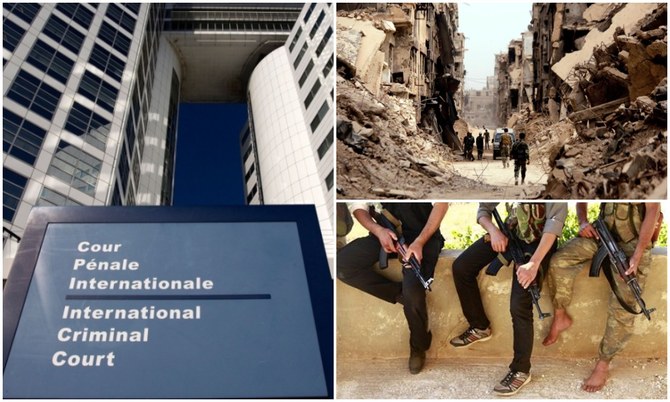
An attempt has been launched to bring cases of war crimes allegedly committed by Iranian and Syrian military officials to the International Criminal Court. (AP/AFP/Reuters/File Photos)
Short Url
Updated 16 February 2022
Follow

Human rights lawyers in bid to bring Syrian, Iranian war-crime cases to court

  • Evidence alleging crimes by Iranian, Syrian officials against civilians forced to flee to Jordan brought to international court

LONDON: An attempt has been launched to bring cases of war crimes allegedly committed by Iranian and Syrian military officials to the International Criminal Court, it was reported on Wednesday.

The US-based Iran Human Rights Documentation Center, working with British barrister Haydee Dijkstal, is bringing evidence gathered from Syrians forced to flee into Jordan as a result of attacks and intimidation by Syrian President Bashar Assad’s government and Iranian-backed militia groups, the Guardian reported.

According to the IHRDC evidence, the Syrian victims — who include journalists — were targeted between 2011 and 2018 on the grounds of their professional activities, which were deemed by the Syrian regime as “opposition activities.”

The evidence being presented in The Hague says the Syrian civilians felt forced to flee in the face of bombardments, extrajudicial killings, arbitrary arrest, and detention, along with other civil liberty abuses.

It adds that Iranian-backed militias, including Lebanon’s Hezbollah, attacked their towns and cities with the help of armed factions of the Syrian government.

The case would mark the first time Iranian officials had been made to answer for their actions in Syria, and forms part of an increased push for them to be held accountable for their alleged crimes in international courts. Ongoing efforts at the UN have stalled in the face of stiff opposition from Russia.

Gissou Nia, a lawyer on the legal team bringing the case, said: “Up until now, little public attention has been paid to the legal responsibility of the Islamic Republic of Iran in the decade-long Syrian conflict, despite the significant intervention of Iranian officials in Syria and perpetration of atrocities.

“Iran has provided a vast range of military and non-military support to achieve its objectives, chiefly to prevent the fall of disgraced Syrian President Bashar Assad at any cost.

“Unfortunately, that goal has been fought at the cost of hundreds of thousands of killed, injured, and displaced Syrian civilians,” she added.

Syria is not a signee of the ICC’s Rome Statute, but the IHRDC said the court has jurisdiction in the case because the victims, who are predominantly Sunni Muslims and at odds with the Alawite Assad regime backed by Shiite Iran, fled into Jordan — a state party to the treaty.

In a previous case in 2018, the ICC was ruled to have jurisdiction over the Rohingya people after they were forced to flee into Bangladesh, a party to the ICC, from Myanmar, which is not a party.

The ICC will now have to make a preliminary decision prior to launching any investigation. There is no deadline by which the court must decide.


Hundreds mourn in Syria’s Homs after deadly mosque bombing

Updated 27 December 2025
Follow

Hundreds mourn in Syria’s Homs after deadly mosque bombing

  • Officials have said the preliminary investigations indicate explosive devices were planted inside the mosque but have not yet publicly identified a suspect

HOMS: Hundreds of mourners gathered Saturday despite rain and cold outside of a mosque in the Syrian city of Homs where a bombing the day before killed eight people and wounded 18.
The crowd gathered next to the Imam Ali ibn Abi Talib Mosque in the Wadi Al-Dhahab neighborhood, where the population is predominantly from the Alawite minority, before driving in convoys to bury the victims.
Officials have said the preliminary investigations indicate explosive devices were planted inside the mosque but have not yet publicly identified a suspect.
A little-known group calling itself Saraya Ansar Al-Sunna claimed responsibility for the attack in a statement posted on its Telegram channel, in which it indicated that the attack intended to target members of the Alawite sect, an offshoot of Shia Islam whom hard-line Islamists consider to be apostates.
The same group had previously claimed a suicide attack in June in which a gunman opened fire and then detonated an explosive vest inside a Greek Orthodox church in Dweil’a, on the outskirts of Damascus, killing 25 people as worshippers prayed on a Sunday.
A neighbor of the mosque, who asked to be identified only by the honorific Abu Ahmad (“father of Ahmad“) out of security concerns, said he was at home when he heard the sound of a “very very strong explosion.”
He and other neighbors went to the mosque and saw terrified people running out of it, he said. They entered and began trying to help the wounded, amid blood and scattered body parts on the floor.
While the neighborhood is primarily Alawite, he said the mosque had always been open to members of all sects to pray.
“It’s the house of God,” he said. “The mosque’s door is open to everyone. No one ever asked questions. Whoever wants to enter can enter.”
Mourners were unable to enter the mosque to pray Saturday because the crime scene remained cordoned off, so they prayed outside.
Some then marched through the streets chanting “Ya Ali,” in reference to the Prophet Muhammad’s cousin and son-in-law whom Shiite Muslims consider to be his rightful successor.