

French bill banning hijabs in sports events moves to National Assembly

1 / 3
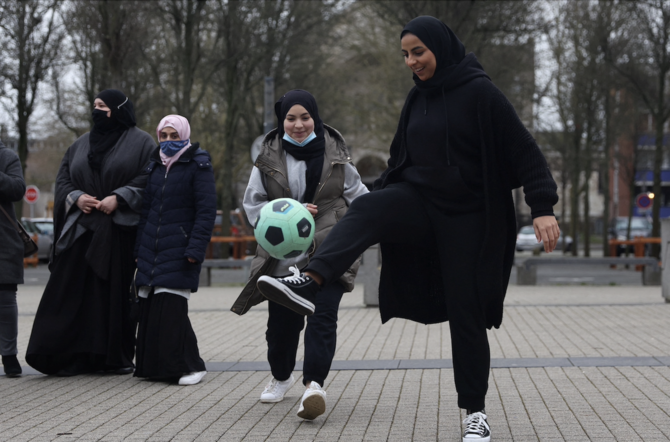
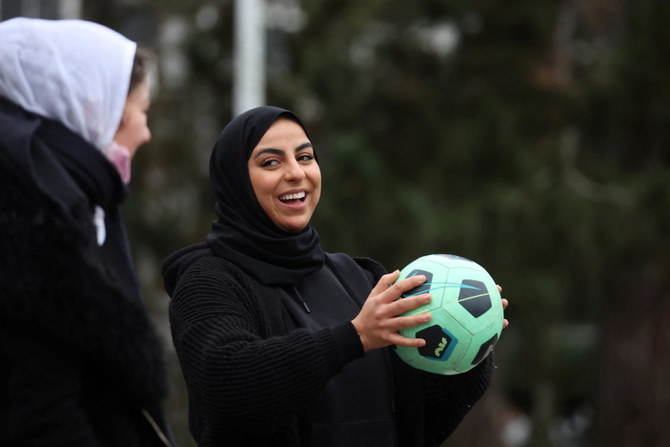
Supporters of the women soccer team “Les Hijabeuses” play soccer in front of the city hall in Lille as part of a protest on February 16, 2022. (Reuters)
2 / 3
Supporters of the women soccer team “Les Hijabeuses” play soccer in front of the city hall in Lille as part of a protest on February 16, 2022. (Reuters)
3 / 3
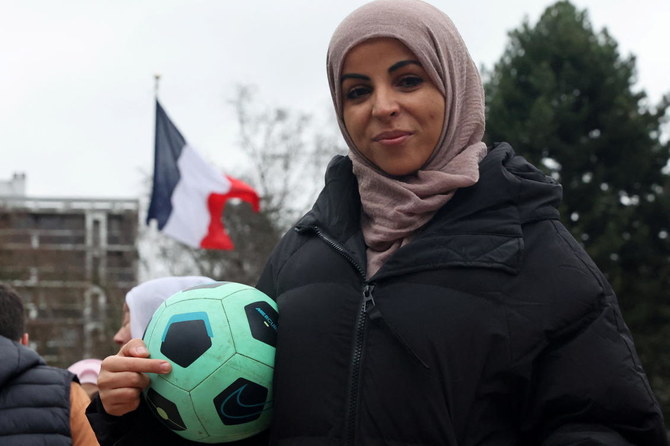
Majid Siham poses with a ball during a gathering to support the women soccer team “Les Hijabeuses” in Lille on February 16, 2022. (Reuters)
Short Url
Updated 16 February 2022
Follow

French bill banning hijabs in sports events moves to National Assembly

  • The place of religion and religious symbols worn in public is a long-running matter of controversy in France
  • Identity and Islam’s place in French society are hot-button issues ahead of April’s presidential election

PARIS: A draft bill that would ban the wearing of the hijab in sporting competitions will pass on to France’s National Assembly after the Senate on Wednesday declined to vote on the legislation.
The broader bill is devoted to “democratizing sport,” including how the big sporting federations are governed. But it includes a clause, previously attached as an amendment by the conservative-dominated upper house, stipulating that the wearing “of conspicuous religious symbols is prohibited” in events and competitions organized by sports federations.
The move is, however, opposed by President Emmanuel Macron’s centrist government and its allies who command a majority in the National Assembly, which has the final vote.
The place of religion and religious symbols worn in public is a long-running matter of controversy in France, a staunchly secular country and home to Europe’s largest Muslim minority.
Identity and Islam’s place in French society are hot-button issues ahead of April’s presidential election, with two far-right candidates whose nationalist programs question Islam’s compatibility with the Republic’s values polling nearly 35 percent of voter support between them.
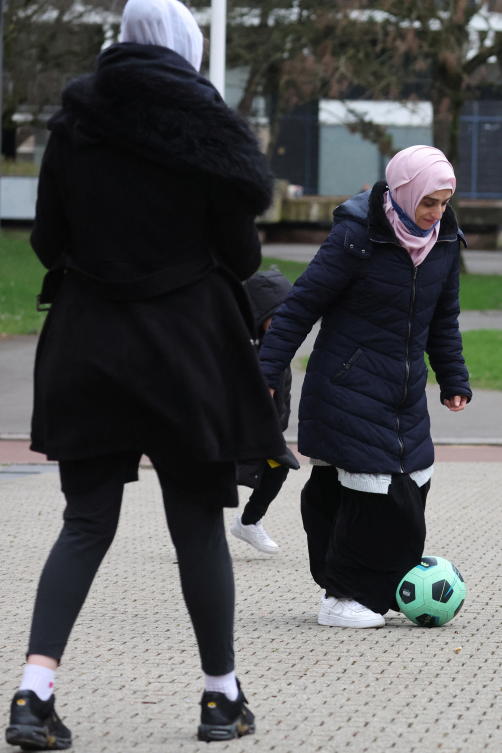


Supporters of the women soccer team “Les Hijabeuses” play soccer in front of the city hall in Lille as part of a protest on February 16, 2022. (Reuters)


Elsewhere, divisions over the hijab — the traditional covering of the hair and neck worn by Muslim women — have fanned protests in the Indian state of Karnataka after authorities there banned the garment in school classrooms.
Macron’s government had been swift to denounce the amendment. Given the majority wielded by his party and its allies in the lower house, the amendment is likely to be removed from the broader bill.
“Our enemy is radical Islamism, not Islam,” Marlene Schiappa, junior minister for citizenship, said on Tuesday.
France will host the Summer Olympics in 2024 and critics of the legislation have questioned how it would affect protocol at the Games, whose participants will include conservative Muslim countries, if it were adopted.
Right-wing Senator Stéphane Piednoir said the Olympic Charter provided for political and religious neutrality.
“We cannot compromise secularism and France cannot undercut the Olympic movement,” Piednoir told the upper house.
He said the bill was designed to allow “all women to participate in sports competitions without any differentiation, without any sign of discrimination, without any symbol linked to the veil which we know is a political tool.”
The Olympics charter states that “no kind of demonstration or political, religious or racial propaganda is permitted in any Olympic sites, venues or other areas.”


Indonesia’s new state mosque to hold first Eid prayers this year

Worshippers pray at Masjid Negara in Nusantara, East Kalimantan for the first taraweeh this year on Feb. 18, 2025. (OIKN)
Updated 4 sec ago
Follow

Indonesia’s new state mosque to hold first Eid prayers this year

  • Mosque is located in Nusantara Capital City on Borneo island, a $32bn project set for 2045 completion
  • Famous sculptor Nyoman Nuarta designed mosque, other government structures in new capital

JAKARTA: The state mosque in Indonesia’s planned new capital city, Nusantara, will hold its inaugural Eid Al-Fitr prayer this year, as the $62 million facility opens for its first run of Ramadan programs.

The Indonesian government has plans to relocate the capital to Borneo island to replace the overcrowded and sinking Jakarta on Java island, with the $32 billion megaproject scheduled for completion in 2045.

With a capacity of about 60,000 people, the mosque in East Kalimantan opened to the public last month, at the beginning of Ramadan.

“This mosque symbolizes that we are building the Nusantara Capital City with careful attention to spiritual, social and environmental aspects,” Troy Pantouw, spokesperson for the Nusantara Capital City Authority — the agency overseeing the new capital city — told Arab News on Saturday.

“We will hold Eid Al-Fitr prayers here and we are hoping that it would mark a historic momentum of unity here at Nusantara Capital City.”

Locally known as Masjid Negara, construction of the state mosque began in 2024. Its design was spearheaded by Balinese sculptor Nyoman Nuarta at the request of former President Joko Widodo.

Nuarta is one of Indonesia’s most famous visual artists and creator of the country’s tallest statue, Garuda Wisnu Kencana, located in Bali.

The 72-year-old is also the designer behind other main structures in Nusantara, including the new state palace.

This Ramadan marked many firsts for Masjid Negara, including its first taraweeh on Feb. 18, which was attended by thousands of worshippers in East Kalimantan.

In the same complex where the state mosque is located, the government has plans to build Christian churches, and Buddhist, Hindu and Confucian temples.

Indonesia, home to the world’s largest population of Muslims, officially recognizes Islam, Protestantism, Catholicism, Buddhism, Hinduism and Confucianism as religions.

“A church is now being built in the complex, and in the future there will also be houses of worship belonging to other religions. This reflects Nusantara’s values of harmony and respect,” Pantouw said.

“From the start, this area was designed to represent inter-religious harmony. We want the Nusantara Capital City to stand as a concrete example of how physical developments can be parallel to efforts to build tolerance in society.”