Judge extends subpoena after Banque du Liban governor skips hearing

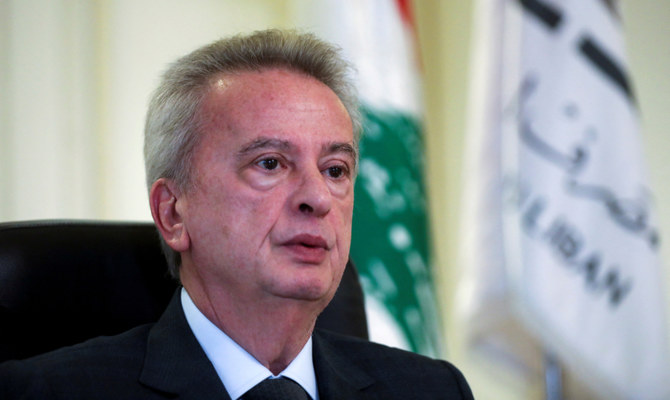
Lebanese Central Bank Gov. Riad Salameh. (Reuters/File)
Short Url
Updated 15 February 2022
Follow

Judge extends subpoena after Banque du Liban governor skips hearing

  • Aoun has sought to interrogate Salameh as a witness in several cases alleging financial impropriety

BEIRUT: Judge Ghada Aoun, the state prosecutor of Mount Lebanon, indefinitely extended on Tuesday a subpoena issued earlier this month for Banque du Liban Gov. Riad Salameh after he failed to appear at a hearing.

Aoun has sought to interrogate Salameh as a witness in several cases alleging financial impropriety.

The subpoena is related to a criminal lawsuit filed against Salameh by a group called “The People Want to Reform the System” who accuse the governor of “illegal enrichment,” “money laundering,” and “wasting public funds.”

Lebanese State Security personnel sent to the central bank’s headquarters in Ras Beirut and to Salameh’s house in Rabieh were denied entry by members of the Internal Security Forces.

It was the fourth hearing set by Aoun, who is affiliated to the Free Patriotic Movement, to question Salameh, who did not attend under the pretext that he had previously submitted a request to have Aoun removed from the case.

Salameh’s nearly three decades at the helm of the central bank have come under increased scrutiny since the country’s financial meltdown in 2019.

He is being investigated in Lebanon and several European country’s, including Switzerland, for alleged money laundering and embezzlement of hundreds of millions of dollars at the BDL — allegations he has repeatedly denied.

In a TV statement, Aoun said she “will keep prosecuting BDL Gov. Riad Salameh until he is brought to justice.”

The group that filed the lawsuit against Salameh accused Maj.-Gen. Imad Othman, director general of the Internal Security Forces, of “violating the law by protecting the governor, and rebelling against the judicial order issued against him.”

It added that “the state security agents are responsible for the execution of the summons. However, Maj-Gen. Othman, his officers and his generals have committed a cold-blooded crime that automatically deprives them of any functional immunity.”

The group, which includes a number of lawyers active in the civil movement, said they decided to “lodge a personal lawsuit against Othman and his agents, who have confronted the security of the state.”

A judicial source told Arab News: “Judge Aoun is the one violating the laws. The public prosecutor at the Court of Cassation, Judge Ghassan Oueidat, had previously removed her from cases related to important financial crimes, referring them to judicial inspection last April. However, no decision has been taken yet because of the difficulty of voting within this body due to political interference.”

The judicial source clarified that “Judge Aoun violates the law by issuing a subpoena against the BDL governor, as he is not a defendant but a witness. How does she give herself the right to issue a subpoena against him? Salameh’s representatives had previously submitted a request to have Aoun removed from the case, but she refused to receive the request.”

According to the source, Aoun cannot issue a subpoena in absentia against Salameh, and can only postpone the hearing.

The act of sending the State Security to places where Salameh might be found caused widespread shock in the Palace of Justice in Beirut.

The internal dispute over the BDL governor is intense between the political party of President Michel Aoun, who is trying to overthrow Salameh, and his backers.

Salameh’s camp is of the view that “Judge Aoun’s move … reflects a political decision to replace the governor with someone affiliated to the president.”

Prime Minister Najib Mikati, though, wants the veteran central bank chief to remain in his post while Lebanon battles its economic crisis.

Judge Aoun issued a decision to freeze all the governor’s properties and cars on Jan. 18, and imposed a travel ban on him.

The governor has been the target of a political and popular campaign against him since protests broke out in 2019 following the start of Lebanon’s economic collapse, holding him accountable for seizing people’s deposits in banks and lending to the state.

The governor, however, insists that he is working to “protect the social security of the Lebanese people and to secure their minimal needs in spite of the financial situation.”

He has said that “the problem will be solved when the parties concerned assume their responsibilities instead of holding the central bank accountable for the crises.”

Meanwhile, as political tensions rise, Hezbollah challenged the decision of the Ministry of Interior to ban the activity of a prohibited Bahraini group on Monday.

Interior Minister Bassam Mawlawi, after consulting Mikati, sent two notices last weekend to the Directorate General of Internal Security Forces and the Directorate General of Public Security to prevent two activities on Feb. 14 and 15, held by “Al-Wefaq National Islamic Society” and the “Coalition of 14 February Youth.”

The notices were sent for “failure to obtain legal authorization” and asked to “take all the necessary investigative measures to collect information about organizers, advocates and invitees.”

Neither security organization carried out the order, however.


Aoun reassures Lebanon that risk of war is ‘fading’ in year-end message

Addressing Internal Security officials, Aoun said that the “situation is among the best.”
Updated 10 sec ago
Follow

Aoun reassures Lebanon that risk of war is ‘fading’ in year-end message

BEIRUT: Lebanese President Joseph Aoun on Wednesday sought to reassure citizens in his year-end address, saying “the overall atmosphere remains positive and the risk of war is fading,” amid widespread concern over a possible Israeli escalation against Hezbollah.

Fear of renewed attacks followed Israeli criticism of a Lebanese Army weapons-confiscation operation that is set to enter its second phase at the start of the 2026. The plan include the expansion from areas north of the Litani River to the Awali River, after the first phase was completed south of the Litani.

President Aoun cautioned that this does not mean “completely eliminating the risk of war,” stressing that “work is underway with various friendly and brotherly countries to completely neutralize the threat of war.”

Addressing Internal Security officials, Aoun said that the “situation is among the best,” noting that this assessment has been echoed by foreign visitors to Lebanon, despite the strain caused by large numbers of Syrian and Palestinian refugees.

He added that security forces were fully carrying out their duties and solving crimes with notable speed, pointing to the successful visit of Pope Leo XIV earlier this year as further evidence of progress.

On Monday, Egyptian Ambassador to Lebanon Alaa Moussa stressed during a Beirut press conference that implementing “international agreements and resolutions, foremost among them the Nov. 27, 2014 agreement and Resolution 1701, constitutes the fundamental approach to sparing Lebanon further security tensions,” speaking of “dire consequences that could result from continued escalation.”

The Egyptian diplomat indicated that “there are no hidden warnings or threats directed at Lebanon, but rather a clear commitment to the agreements signed by the concerned parties, which must be fully implemented by everyone.”

The ambassador stated that his country, under the directives of President Abdel Fattah El-Sisi, is “exerting intensive efforts to reduce tensions in southern Lebanon and the region in general, through active diplomatic contacts led by the Minister of Foreign Affairs Badr Abdelatty with relevant regional and international parties.”

Israeli military spokesman Avichai Adraee published on Wednesday a summary of Israeli attacks on Hezbollah in Lebanon in 2025.

“The Army targeted approximately 380 armed operatives, including Ali Tabatabai (chief of staff), Hassan Kamal (responsible for anti-tank missiles on the southern front), Abbas Hassan Karky (logistics officer in the southern command), and Khodr Saeed Hashem (commander of the naval force in the Radwan Unit),” he said.

“It also attacked approximately 950 military targets, including 210 launch sites and weapons depots, 140 military buildings, and about 60 tunnel entrances,” Adraee added.

In the statement, he accused Hezbollah of committing about 1,920 ceasefire violations and said the military would continue its raids and targeting operations in the new year.

UNIFIL Com. Gen. Diodato Abagnara said in his end-of-the-year message that “UNIFIL will continue to support Lebanon and Israel in implementing their obligations under Resolution 1701, building on the stability achieved in 2025 and strengthening efforts toward a lasting peace.”

As part of the weapons restriction plan, on Tuesday, the Fatah movement — the Palestinian National Security Forces in Lebanon — handed over a new batch of heavy and medium weapons from the Ain Al-Hilweh Palestinian refugee camp to the Lebanese Army in four trucks, away from the media.

This is the second batch of weapons to be handed over from the camp, which is the largest Palestinian refugee camp in Lebanon. It represents the fifth phase of the Palestinian weapons handover process in the camps, four of which were completed between Aug. 21 and Sept. 13, 2025, encompassing nine camps, including Ain Al-Hilweh.

The handover follows and implements an agreement reached between Aoun and Palestinian President Mahmoud Abbas after the latter’s visit to Lebanon in May.

Abbas had announced “the Palestinian Authority’s support for the Lebanese state’s plan to extend its authority over all Lebanese territory, including the Palestinian camps.”

Hamas continues to refuse to hand over its weapons to the Lebanese Army, while Hezbollah maintains its weapons north of the Litani River.

The Lebanese Army implemented “exceptional security measures in various Lebanese regions on New Year’s Eve, with the aim of maintaining security.”

It called on citizens to “cooperate with the security measures taken to maintain public safety and prevent incidents,” warning of the consequences of firing weapons, which will be prosecuted as it poses a threat to public safety.

In another measure, authorities announced that gun licenses and traffic permits will be suspended until Jan. 2, 2026.

In Beirut’s southern suburbs, residents signed a pledge as part of an Internal Security Forces campaign against celebratory gunfire on New Year’s Eve, committing not to fire weapons in public and to report violations with photos or videos.