

No transfers abroad made from Lebanon’s central bank, says Gov. Salameh

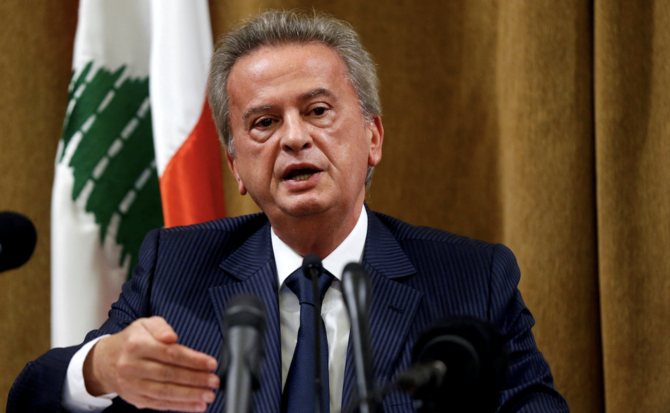
Riad Salameh denied that he had made any transfers of Banque Du Liban funds following a probe by Swiss authorities into money laundering and embezzlement. (Reuters)
Short Url
Updated 21 January 2021
Follow

No transfers abroad made from Lebanon’s central bank, says Gov. Salameh

  • Salameh said that “no money transfers were made abroad from the accounts or the budget of the central bank”
  • Salameh’s role has been under scrutiny for more than a year after depriving many Lebanese of access to deposits

BEIRUT: Lebanon’s prosecutor general, Judge Ghassan Oueidat, informed the governor of the Banque Du Liban (BDL), Riad Salameh, about a request from the Swiss Office of the Attorney General (OAG) for mutual legal assistance from Lebanese authorities related to an investigation into alleged money laundering and embezzlement tied to the central bank, at a meeting on Thursday.

The OAG gave Salameh the option of going to Switzerland to appear before a court there, or the Swiss Embassy in Lebanon, to be questioned by a judicial delegation. According to Reuters, Salameh has decided upon the former option.

In a statement made after meeting with Oueidat, Salameh said that “no money transfers were made abroad from the accounts or the budget of the central bank.”

Salameh told Oueidat that he was “ready to answer any further questions,” and added that he reserved the right to pursue legal action against “those who spread tendentious rumors and defamation that target me personally and the financial reputation of Lebanon.”

A judicial source said that no depositions were made during the meeting, and that the Swiss judiciary did not ask the Lebanese authorities to question Salameh themselves.

The source told Arab News: “The OAG has doubts about suspicious financial transfers, which could be related to money laundering, by a company related to Salameh’s brother, Raja Salameh. Riad Salameh is also a partner in this company, which has transferred over $240 million from the bank to Switzerland since 2002.”

The source expressed surprise at the involvement of “the Lebanese judiciary in this matter, knowing that Salameh often travels to Switzerland and the OAG could have informed him personally.”

The BDL denied claims about financial transfers made by Salameh or his brother on Tuesday, issuing a statement stressing the governor’s “commitment to Lebanese and international laws, and his willingness to cooperate with concerned entities.”

Another source told Arab News: “The governor is not entitled and has no right to make any financial transfers abroad from the central bank, and all transfers must be made through commercial banks. All BDL activities are monitored by the bank’s central council and the government’s commissioner.”

Salameh’s role has been under scrutiny for more than a year after depriving many Lebanese of access to deposits in their banks, as the BDL had been borrowing money from commercial banks to finance the state’s policies.

Lebanese President Michel Aoun and his party have insisted on a forensic audit of the BDL’s accounts, while Parliament decided few weeks ago that the audit should cover all state institutions, and not just the central bank.


First responders enter devastated Aleppo neighborhood after days of deadly fighting

Updated 12 January 2026
Follow

First responders enter devastated Aleppo neighborhood after days of deadly fighting

  • The US-backed SDF, which have played a key role in combating the Daesh group in large swaths of eastern Syria, are the largest force yet to be absorbed into Syria’s national army

ALEPPO, Syria: First responders on Sunday entered a contested neighborhood in Syria’ s northern city of Aleppo after days of deadly clashes between government forces and Kurdish-led forces. Syrian state media said the military was deployed in large numbers.
The clashes broke out Tuesday in the predominantly Kurdish neighborhoods of Sheikh Maqsoud, Achrafieh and Bani Zaid after the government and the Syrian Democratic Forces, the main Kurdish-led force in the country, failed to make progress on how to merge the SDF into the national army. Security forces captured Achrafieh and Bani Zaid.
The fighting between the two sides was the most intense since the fall of then-President Bashar Assad to insurgents in December 2024. At least 23 people were killed in five days of clashes and more than 140,000 were displaced amid shelling and drone strikes.
The US-backed SDF, which have played a key role in combating the Daesh group in large swaths of eastern Syria, are the largest force yet to be absorbed into Syria’s national army. Some of the factions that make up the army, however, were previously Turkish-backed insurgent groups that have a long history of clashing with Kurdish forces.
The Kurdish fighters have now evacuated from the Sheikh Maqsoud neighborhood to northeastern Syria, which is under the control of the SDF. However, they said in a statement they will continue to fight now that the wounded and civilians have been evacuated, in what they called a “partial ceasefire.”
The neighborhood appeared calm Sunday. The United Nations said it was trying to dispatch more convoys to the neighborhoods with food, fuel, blankets and other urgent supplies.
Government security forces brought journalists to tour the devastated area, showing them the damaged Khalid Al-Fajer Hospital and a military position belonging to the SDF’s security forces that government forces had targeted.
The SDF statement accused the government of targeting the hospital “dozens of times” before patients were evacuated. Damascus accused the Kurdish-led group of using the hospital and other civilian facilities as military positions.
On one street, Syrian Red Crescent first responders spoke to a resident surrounded by charred cars and badly damaged residential buildings.
Some residents told The Associated Press that SDF forces did not allow their cars through checkpoints to leave.
“We lived a night of horror. I still cannot believe that I am right here standing on my own two feet,” said Ahmad Shaikho. “So far the situation has been calm. There hasn’t been any gunfire.”
Syrian Civil Defense first responders have been disarming improvised mines that they say were left by the Kurdish forces as booby traps.
Residents who fled are not being allowed back into the neighborhood until all the mines are cleared. Some were reminded of the displacement during Syria’s long civil war.
“I want to go back to my home, I beg you,” said Hoda Alnasiri.