South Korean COVID-19 deaths rise, hope rests on high booster rate

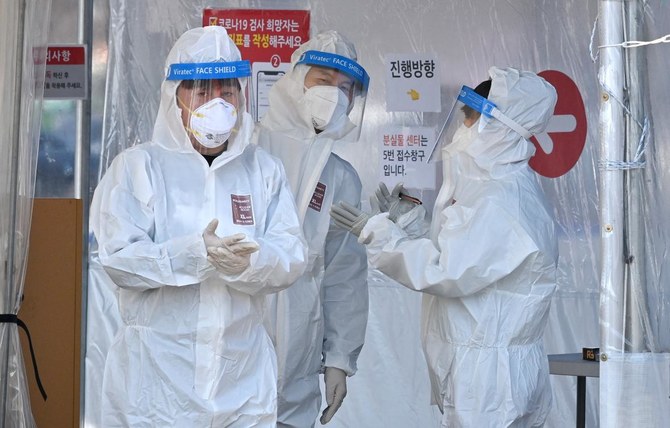
The 61 deaths reported by the Korea Disease Control and Prevention Agency on Tuesday was the highest daily tally since the 74 reported on Jan. 19, when the country was emerging from an outbreak driven by the delta variant. (File/AFP)
Short Url
Updated 15 February 2022
Follow

South Korean COVID-19 deaths rise, hope rests on high booster rate

  • South Korea has reshaped its COVID-19 response due to the unprecedented surge

SEOUL: South Korea reported its highest number of COVID-19 deaths in a month Tuesday as US health authorities advised Americans to avoid traveling to the country grappling with a fast-developing omicron surge.
The 61 deaths reported by the Korea Disease Control and Prevention Agency on Tuesday was the highest daily tally since the 74 reported on Jan. 19, when the country was emerging from an outbreak driven by the delta variant.
While omicron so far seems less likely to cause serious illness or death, the greater scale of the outbreak is fueling concerns that hospitalizations and fatalities could spike in coming weeks.
The 57,177 new cases reported by the KDCA was another one-day record and more than a 12-fold increase from the levels seen in mid-January, when omicron became the dominant strain.
The US Centers for Disease Control and Prevention updated its travel notice for South Korea to level 4, the highest risk, advising Americans to avoid travel to the country or to make sure they are fully vaccinated if traveling is necessary.
Park Hyang, a senior South Korean Health Ministry official, said the country’s hospital resources remain stable, with less than 27 percent of intensive care units designated for COVID-19 currently being occupied.
Officials have expressed cautious hope the country’s high vaccination rate – with nearly 58 percent of a population of more than 51 million having received booster shots – would prevent hospital systems from buckling. They plan to start offering fourth vaccination shots to people at nursing homes and other long-term care settings later this month.
“While unvaccinated people account for only 6 percent of the population 12 years or older, these people have accounted for 62 percent of serious cases and 66.5 percent of the deaths over the past eight weeks,” Park said during a briefing.
South Korea has reshaped its COVID-19 response due to the unprecedented surge. It has significantly eased quarantine restrictions so essential services won’t be disrupted by having huge numbers of people in quarantine. More than 245,000 infected people were being treated at home as of Tuesday, weeks after at-home treatment was made the standard for mild or moderate cases.
Testing practices are also now centered around rapid antigen tests, with the more accurate laboratory tests reserved mostly for high-risk groups. But there are concerns that infected people may falsely test negative and continue to stay out in public, which could worsen the spread of the virus.
“Compared to PCR (lab) tests, rapid antigen testing has limitations in accuracy. Our new testing policy is based on the thinking that such limitations must be tolerated as a tradeoff for detecting serious cases earlier amid a major viral spread like this one,” Health Ministry official Son Youngrae said.


US border agent shoots and wounds two people in Portland

Updated 5 sec ago
Follow

US border agent shoots and wounds two people in Portland

  • The Portland shooting unfolded Thursday afternoon as US Border Patrol ‌agents were ‌conducting a targeted vehicle stop, the Department of Homeland ‌Security ⁠said ​in a ‌statement

A US immigration agent shot and wounded a ​man and a woman in Portland, Oregon, authorities said on Thursday, leading local officials to call for calm given public outrage over the ICE shooting death of a Minnesota woman a day earlier.
“We understand the heightened emotion and tension many are feeling in the wake of the shooting in Minneapolis, but I am asking the community to remain calm as we work to learn more,” Portland police chief Bob Day said in a statement.
The Portland shooting unfolded Thursday afternoon as US Border Patrol ‌agents were ‌conducting a targeted vehicle stop, the Department of Homeland ‌Security ⁠said ​in a ‌statement.
The statement said the driver, a suspected Venezuelan gang member, attempted to “weaponize” his vehicle and run over the agents. In response, DHS said, “an agent fired a defensive shot” and the driver and a passenger drove away.
Reuters was unable to independently verify the circumstances of the incident.
Portland police said that the shooting took place near a medical clinic in eastern Portland. Six minutes after arriving at the scene and determining federal agents were involved in ⁠the shooting, police were informed that two people with gunshot wounds — a man and a woman — were asking for ‌help at a location about 2 miles (3 km) to the ‍northeast of the medical clinic.
Police said ‍they applied tourniquets to the man and woman, who were taken to a ‍hospital. Their condition was unknown.
The shooting came just a day after a federal agent from US Immigration and Customs Enforcement (ICE), a separate agency within the Department of Homeland Security, fatally shot a 37-year-old mother of three in her car in Minneapolis.
That shooting has prompted two days ​of protests in Minneapolis. Officers from both ICE and Border Patrol have been deployed in cities across the United States as part of Republican President Donald ⁠Trump’s immigration crackdown.
While the aggressive enforcement operations have been cheered by the president’s supporters, Democrats and civil rights activists have decried the posture as an unnecessary provocation.
US officials contend criminal suspects and anti-Trump activists have increasingly used their cars as weapons, though video evidence has sometimes contradicted their claims.
Portland Mayor Keith Wilson said in a statement his city was now grappling with violence at the hands of federal agents and that “we cannot sit by while constitutional protections erode and bloodshed mounts.”
He called on ICE to halt all its operations in the city until an investigation can be completed.
“Federal militarization undermines effective, community-based public safety, and it runs counter to the values that define our region,” Wilson said. “I will use ‌every legal and legislative tool available to protect our residents’ civil and human rights.”