

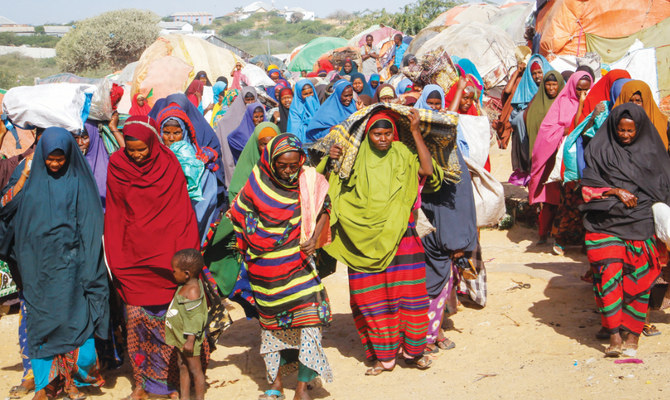
Fleeing drought, hunger in rural areas, thousands trek to Somalia’s capital

The impact is being felt more severely due to the result of droughts, a worsening security situation, locust infestations, soaring food prices, reduced remittances — and less money committed by donors. (AFP)
Short Url
Updated 13 February 2022
Follow

Fleeing drought, hunger in rural areas, thousands trek to Somalia’s capital

  • UN World Food Programme: 13m in the region, including parts of Ethiopia, Kenya face severe food crisis in first quarter of 2022

MOGADISHU: Sitting under the hot sun, hungry women and children await food aid in a camp on the outskirts of Somalia’s capital, Mogadishu. They have walked for days, fleeing the drought now ravaging a large part of rural Somalia. Their growing ranks are expected to swell further in the coming months as the Horn of Africa region faces its worst drought conditions in a decade.

This week the UN World Food Programme warned that 13 million people in the region, including parts of Ethiopia and Kenya, face severe hunger in the first quarter of 2022.

Immediate assistance is needed to avoid a major humanitarian crisis, the agency warned. The Horn of Africa has long been vulnerable to drought and hunger conditions often exacerbated by armed violence.

Somalia’s government in November declared a state of humanitarian emergency due to the drought, with the worst affected parts including the south-central areas of Lower Jubba, Geddo and Lower Shabelle regions.

“The impact on families is being felt more severely this season due to the result of multiple, prolonged droughts in quick succession, a worsening security situation, desert locust infestations, soaring food prices, reduced remittances — and less money committed by donors,” the aid group Save the Children said earlier this week of the drought in Somalia.

A survey in November covering 15 of Somalia’s 18 regions found the “majority of families were now going without meals on a regular basis,” it said in a statement.

In Somalia, 250,000 people died from hunger in 2011, when the UN declared a famine in some parts of the country. Half of them were children.

WFP has said it needs $327 million to look after the immediate needs of 4.5 million people over the next six months, including in Somalia.

Somali leaders also have been trying to mobilize local support, and many have responded.

A task force set up earlier this month by Prime Minister Mohamed Roble collects and distributes donations from the business community as well as Somalis in the diaspora. Some of what they give feeds hundreds of families residing in camps such as Ontorley, home to about 700 families.

“There are not (many) humanitarian agencies operating on the ground and these people urgently need support and assistance such as shelter, food, water and good sanitation,” said Abdullahi Osman, head of the charitable Hormuud Salaam Foundation and a member of the prime minister’s drought task force.

About five to 10 desperate families arrive at Ontorley camp each day, according to camp leader Nadiifa Hussein.

Faduma Ali said she hiked more than 500 km from her home in Saakow, a town in Middle Jubba province, to Mogadishu.

“The problems I face are all due to the drought,” she said. “We had no water and our livestock had perished and when I lost everything, I walked the road for seven days.”

Amina Osman, a visibly emaciated woman also from Saakow, said two women with them on their journey to Mogadishu died from hunger along the way.

“We came across many hardships, including lack of water and food,” said the mother of four. “We trekked all the way from our village to this settlement. We spent eight days on the road.”

More patients with acute malnutrition are arriving at Mogadishu’s Martino Hospital, and some have died, said director Dr. Abdirizaq Yusuf. Malnutrition patients are treated free of charge, he said.

“Due to the increased cases of acute malnutrition, the hospital now employs specialist doctors and nutritionists who help those most affected,” he said. “A large number are from remote regions of Somalia and now live in (displaced people’s) camps.”


Trump administration labels 3 Muslim Brotherhood branches as terrorist organizations

Updated 13 January 2026
Follow

Trump administration labels 3 Muslim Brotherhood branches as terrorist organizations

  • The State Department designated the Lebanese branch a foreign terrorist organization
  • “These designations reflect the opening actions of an ongoing, sustained effort to thwart Muslim Brotherhood chapters’ violence,” Rubio said

WASHINGTON: President Donald Trump’s administration has made good on its pledge to label three Middle Eastern branches of the Muslim Brotherhood as terrorist organizations, imposing sanctions on them and their members in a decision that could have implications for US relationships with allies Qatar and Turkiye.
The Treasury and State departments announced the actions Tuesday against the Lebanese, Jordanian and Egyptian chapters of the Muslim Brotherhood, which they said pose a risk to the United States and American interests.
The State Department designated the Lebanese branch a foreign terrorist organization, the most severe of the labels, which makes it a criminal offense to provide material support to the group. The Jordanian and Egyptian branches were listed by Treasury as specially designated global terrorists for providing support to Hamas.
“These designations reflect the opening actions of an ongoing, sustained effort to thwart Muslim Brotherhood chapters’ violence and destabilization wherever it occurs,” Secretary of State Marco Rubio said in a statement. “The United States will use all available tools to deprive these Muslim Brotherhood chapters of the resources to engage in or support terrorism.”
Rubio and Treasury Secretary Scott Bessent were mandated last year under an executive order signed by Trump to determine the most appropriate way to impose sanctions on the groups, which US officials say engage in or support violence and destabilization campaigns that harm the United States and other regions.
Muslim Brotherhood leaders have said they renounce violence.
Trump’s executive order had singled out the chapters in Lebanon, Jordan and Egypt, noting that a wing of the Lebanese chapter had launched rockets on Israel after Hamas’ Oct. 7, 2023, attack in Israel that set off the war in Gaza. Leaders of the group in Jordan have provided support to Hamas, the order said.
The Muslim Brotherhood was founded in Egypt in 1928 but was banned in that country in 2013. Jordan announced a sweeping ban on the Muslim Brotherhood in April.
Nathan Brown, a professor of political science and international affairs at George Washington University, said some allies of the US, including the United Arab Emirates and Egypt, would likely be pleased with the designation.
“For other governments where the brotherhood is tolerated, it would be a thorn in bilateral relations,” including in Qatar and Turkiye, he said.
Brown also said a designation on the chapters may have effects on visa and asylum claims for people entering not just the US but also Western European countries and Canada.
“I think this would give immigration officials a stronger basis for suspicion, and it might make courts less likely to question any kind of official action against Brotherhood members who are seeking to stay in this country, seeking political asylum,” he said.
Trump, a Republican, weighed whether to designate the Muslim Brotherhood a terrorist organization in 2019 during his first term in office. Some prominent Trump supporters, including right-wing influencer Laura Loomer, have pushed his administration to take aggressive action against the group.
Two Republican-led state governments — Florida and Texas — designated the group as a terrorist organization this year.