

Pakistan administers 2.24 million coronavirus vaccines in a single day

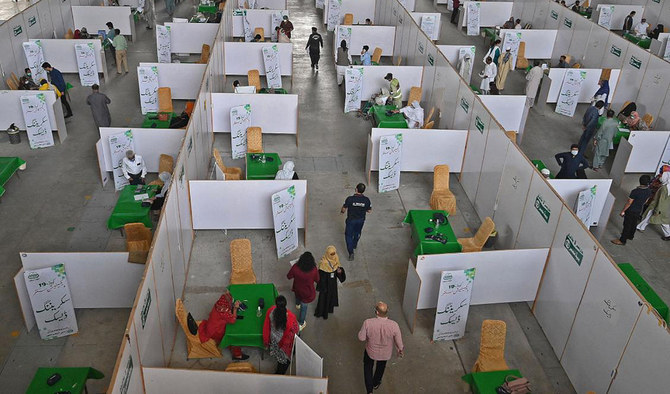
People gather to get themselves inoculated with the Chinese-made Sinopharm Covid-19 coronavirus vaccine at a vaccination camp organised at the Expo center in Lahore on April 28, 2021. (AFP/File)
Short Url
Updated 11 February 2022
Follow

Pakistan administers 2.24 million coronavirus vaccines in a single day

  • The government has been vaccinating over two million people on a daily basis for four consecutive days
  • Pakistan launched a door-to-door inoculation drive earlier this month to administer over 35 million shots

ISLAMABAD: The Pakistan government has set another record by administering 2.24 million coronavirus vaccines in a single day, said the country's planning minister Asad Umar in a Twitter post on Friday.

The National Command and Operation Center (NCOC), the country's main pandemic response body, announced to launch a door-to-door coronavirus vaccination drive earlier this month to administer over 35 million shots as officials said Pakistan was witnessing the fifth wave of the pandemic.

The initiative was taken to accelerate the official immunization campaign amid a surge in COVID-19 cases caused by the highly transmissible omicron variant of the virus.

"Another record set with 2.24 million vaccinations in a day," Umar said on Twitter. "Last 4 days in a row we have vaccinated more than 2 million each day. Every 3 out of 4 pakistani's eligible for vaccination have received at least 1 dose. 58% are fully vaccinated. Well done Pakistan."

Pakistan has reported a decline in the number of fresh COVID-19 infections in recent days.

It reported 8,183 new cases on January 27. Official statistics reveal, however, that only 3,498 people were diagnosed with the disease on Thursday when Pakistan conducted 58,077 tests and recorded a positivity ratio of 6.02 percent.

The country reported 39 deaths in the last 24 hours, with 1,663 patients were on critical care during the same period.

Umar, who also supervises the NCOC, said earlier this week the government's mobile inoculation campaign was "producing outstanding results," adding that its objective was to "reach all citizens to allow us to finally end all covid related restrictions."


Pakistan urges pilgrims to complete Saudi biometrics as Hajj preparations gain pace

Updated 30 January 2026
Follow

Pakistan urges pilgrims to complete Saudi biometrics as Hajj preparations gain pace

  • Government warns pilgrims biometric verification is required for Hajj visas
  • Step follows tighter oversight after last year’s Hajj travel disruptions

ISLAMABAD: Pakistan’s government on Friday urged aspiring pilgrims to complete mandatory Saudi biometric verification for Hajj visas, as preparations for the 2026 pilgrimage gather pace following stricter oversight of the Hajj process.

The announcement comes only a day after Pakistan’s Religious Affairs Minister Sardar Muhammad Yousuf said regulations for private Hajj operators had been tightened, reducing their quota following widespread complaints last year, when tens of thousands of pilgrims were unable to travel under the private Hajj scheme.

“Saudi biometric verification is mandatory for the issuance of Hajj visas,” the Ministry of Religious Affairs said in a statement, urging pilgrims to complete the process promptly to avoid delays.

“Hajj pilgrims should complete their biometric verification at home using the ‘Saudi Visa Bio’ app as soon as possible,” it added.

The statement said the pilgrims who were unable to complete biometric verification through the mobile application should visit designated Saudi Tasheer centers before Feb. 8, adding that details of the centers were available on Pakistan’s official Hajj mobile application.

Pakistan has been steadily implementing digital and procedural requirements for pilgrims ahead of Hajj 2026, including mandatory training sessions, biometric checks and greater use of mobile applications, as part of efforts to reduce mismanagement.

Saudi Arabia has allocated Pakistan a quota of 179,210 pilgrims for Hajj 2026, with the majority of seats reserved under the government scheme and the remainder allocated to private tour operators.