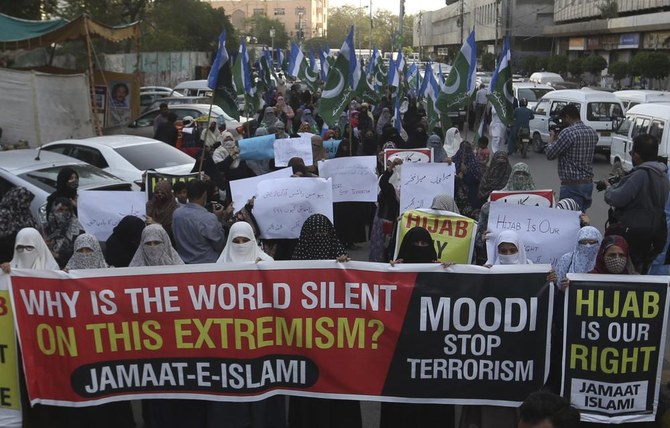
Pakistan women protest India’s ‘ban’ on hijabs in schools

Women supporters of Jamaat-e-Islami take part in demonstration to protest against barring Muslim girls wearing hijab from attending classes at some schools in the southern Indian state of Karnataka, in Karachi, Pakistan, Thursday, Feb. 10, 2022. (AP Photo)
Short Url
Updated 11 February 2022
Follow

Pakistan women protest India’s ‘ban’ on hijabs in schools

KARACHI: Pakistani women rallied Thursday to denounce a ban imposed in a region in neighboring India on the wearing of the traditional headscarf, or hijab, by Muslim girls in schools.

Hundreds of women took to the streets in the southern port city of Karachi in a protest organized by a Pakistani religious political party, the Jamaat-e-Islami. And in the eastern city of Lahore, dozens of women torched an effigy of Indian Prime Minister Narendra Modi and also demanded the lifting of the hijab ban.
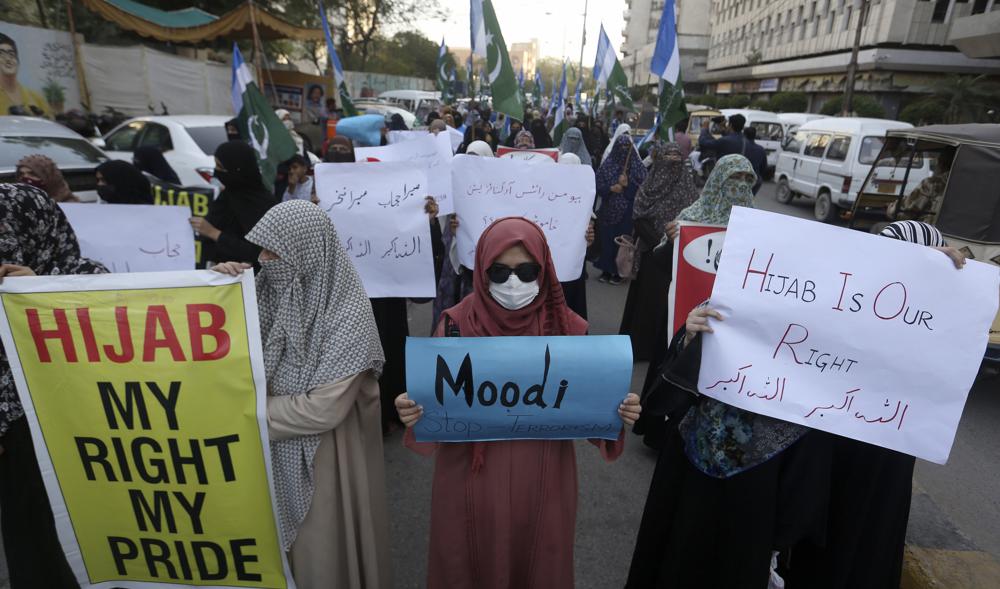


Women supporters of Jamaat-e-Islami hold a demonstration to protest against barring Muslim girls wearing hijab from attending classes at some schools in the southern Indian state of Karnataka, in Karachi, Pakistan, Thursday, Feb. 10, 2022. (AP Photo)

Earlier in the day, a court in Karnataka, a state in southern India, told students not to wear any religious clothing until it delivers a verdict on petitions seeking to overturn the ban on hijabs. The petitions were filed by students challenging the ban, which some schools implemented recently.

The issue grabbed headlines last month when a government-run school in Karnataka’s Udupi district barred students wearing hijabs from entering classrooms, triggering protests outside the school gate. More schools in the state followed with similar bans, forcing the state’s top court to intervene.

In the Hindu-majority India, where Muslims make up about 14 percent of the country’s almost 1.4 billion people, the traditional Muslim hijabs are not banned or restricted in public places and are a common sight.

However, violence and hate speech against Muslims have increased under Modi’s governing Hindu nationalist party, which also governs Karnataka.

Pakistan and India have a history of bitter relations. The two South Asian nuclear rivals have fought two of their three wars over Kashmir, which has been divided between them but claimed by both in its entirety.


Pakistan, China hold joint counterterrorism drills as military cooperation deepens

Updated 6 sec ago
Follow

Pakistan, China hold joint counterterrorism drills as military cooperation deepens

  • Warrior-IX exercise aims to boost counterterror coordination between the two nations’ armies
  • Drills come as both countries cite shared security concerns along regional militant routes

ISLAMABAD: Pakistan and China are conducting a two-week joint counterterrorism exercise, the Pakistan Army said on Thursday, marking another expansion in military cooperation between the two strategic partners.

The drills, known as Warrior-IX, run from Nov. 28 to Dec. 14 at Pakistan’s National Counter Terrorism Center (NCTC) in Pabbi, a major training hub for operations against militant networks that have carried out attacks across the country. Such exercises have become a recurring feature of Pakistan-China security ties, which span counterterrorism coordination, intelligence sharing, and defense technology partnerships.

Senior delegations attended the Distinguished Visitors Day on Thursday, including China’s ambassador to Pakistan, Jiang Zaidong, and Pakistan’s Chief of General Staff Field Marshal Syed Asim Munir. Officials observed field drills and received briefings on the objectives and scope of the exercise.

“The exercise reflects strong defense collaboration between Pakistan and China and reaffirms the commitment of both Armed Forces to working together for peace and stability,” the Pakistan military said.

According to the army, dignitaries viewed a range of counterterrorism demonstrations and praised the participating troops for their professionalism and operational readiness. China’s People’s Liberation Army (PLA) and Pakistan Army units regularly train together as both countries cite shared security threats, including attacks targeting Chinese nationals and projects inside Pakistan.

Pakistan and China have maintained one of Asia’s closest defense partnerships since the 1960s, rooted in shared strategic interests and long-term military cooperation. China is Pakistan’s largest supplier of military hardware, providing fighter aircraft, naval vessels, air-defense systems and armored platforms, including co-production of the JF-17 fighter jet under a major joint program launched in 1999. The two militaries routinely collaborate on training, intelligence exchange and counterterrorism coordination, and conduct regular joint exercises across all three services: army, navy, and air force.

Security cooperation has deepened further under the China–Pakistan Economic Corridor (CPEC), where Beijing has sought enhanced protection for Chinese workers and infrastructure targeted by insurgent groups. In recent years, the two sides have carried out joint counterterrorism drills, maritime security exercises in the Arabian Sea, and high-level defense consultations aimed at improving interoperability and responding to shared threats, including militant violence and regional instability. Both governments publicly describe their military ties as a “strategic partnership” and “ironclad friendship.”