ISLAMABAD: Pakistan has condemned the Indian government for the “reprehensible act” of denying education rights to Muslim women who wear the hijab, summoning the Indian Charge d’ Affaires in Islamabad on Wednesday to convey Pakistan’s “grave concern.”
India’s southern Karnataka state on Tuesday ordered schools and colleges to shut for three days after protests erupted over some institutes refusing entry to students wearing the headscarf. Local media reported last week that several schools in the coastal city of Udupi had denied entry to Muslim girls wearing the hijab citing an education ministry order, prompting protests from parents and students and raising fears among the state’s Muslim students who say they are being deprived of their religious rights.
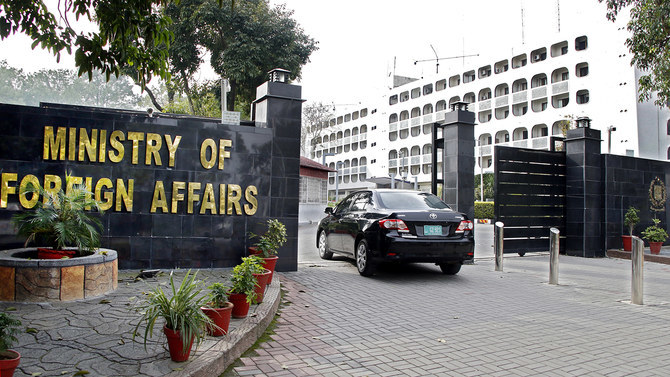
“Pakistan deplores the reprehensible act of banning Muslim girl students from wearing hijab in the Indian state of Karnataka,” the foreign ministry said in a statement, adding that it had summoned the Indian Charge d’ Affaires.
“The Charge d’ Affaires was urged to convey to the Government of India, Pakistan’s extreme concern over the anti-hijab campaign, … which is part of its [Indian’s government’s] larger exclusionist and majoritarian agenda aimed at dehumanizing and demonizing Muslim women,” the statement said. “Government of India must fulfill its responsibility to hold the perpetrators of harassment against women in Karnataka to account and take adequate measures to ensure safety, security and well-being of Muslim women.”
The government of Karnataka, where 12 percent of the population is Muslim and which is ruled by Prime Minister Narendra Modi’s Hindu nationalist Bharatiya Janata Party (BJP), has said in a recent order that students should follow dress codes set by schools.
Opposition parties and critics accuse the BJP government at federal and state level of discriminating against the minority Muslim population. Modi has defended his record and says his economic and social policies benefit all Indians.
Separately, Pakistani Prime Minister Imran Khan’s adviser on religious harmony, Dr. Tahir Mahmood Ashrafi, announced the government’s decision to mark Friday as ‘Solidarity Day’ with Indian women for standing up to the hijab ban.
The announcement was made a day after videos of an Indian Muslim girl named Muskan went viral on social media, showing her standing her ground against a charged crowd of Hindu students wearing saffron shawls typically worn by Hindus. In the video clip, the mob can be seen heckling and jeering at Muskan before she turns toward them and defiantly shouts “Allahu Akbar.”


Pakistan condemns India for ‘banning’ Muslim women from wearing hijab
https://arab.news/nf53v
Pakistan condemns India for ‘banning’ Muslim women from wearing hijab

- Protests have erupted in India’s southern Karnataka state over some schools refusing entry to students wearing headscarf
- Indian Charge d’ Affaires urged to convey to Indian government Pakistan’s “extreme concern over the anti-hijab campaign”

High-level Libyan delegation meets Pakistan PM, discusses areas for future cooperation
- The meeting comes over a month after Pakistan reportedly struck a $4 billion defense deal to sell military equipment to Libyan National Army
- PM Sharif reaffirms Pakistan’s commitment to fostering friendly ties with Libya, emphasizes the importance of continued engagement and dialogue
ISLAMABAD: A high-level delegation from Libya on Tuesday called on Pakistan Prime Minister Shehbaz Sharif in Islamabad and discussed areas for future cooperation between the two sides, PM Sharif’s office said.
The delegation comprised Dr. Osama Saad Hamad, who governs eastern Libya, Libyan National Army (LNA) Commander-in-Chief Khalifa Abu-al-Qasim Haftar and his deputy, Lt. Gen. Saddam Khalifa Haftar.
During the discussions, both sides exchanged views on matters of mutual interest and underscored the importance of strengthening bilateral relations, according to PM Sharif’s office.
“The meeting reflected the shared desire to enhance cooperation in areas of common concern and to promote peace, stability, and development at regional and international levels,” Sharif’s office said in a statement.
The development comes more than a month after reports suggested Pakistan had struck a $4 billion defense deal to sell military equipment, including JF-17 fighter jets and Super Mushshak trainer aircraft, to the LNA that controls eastern Libya.
The reports followed the visit of Pakistani Defense Forces Chief Field Marshal Asim Munir to Libya in December. There has been no official confirmation of the deal so far.
Libya has been subject to a UN arms embargo since 2011, requiring approval from the UN for transfers of weapons and related material. It was not clear whether Pakistan or Libya had applied for any exemptions to the UN embargo.
PM Sharif reaffirmed Pakistan’s commitment to fostering friendly relations with Libya and emphasized the importance of continued engagement and dialogue, according to his office. The Libyan leadership appreciated Pakistan’s role and expressed interest in expanding collaboration between the two countries.
“The meeting concluded with an understanding to maintain close contact and explore avenues for future cooperation,” Sharif’s office said.
On Monday, LNA Commander-in-Chief Haftar also met Field Marshal Munir and discussed with him military cooperation and regional security, according to the Pakistani military.
“Both sides exchanged views on matters of mutual interest, with particular focus on security dynamics in respective regions and professional cooperation,” the Pakistani military said.
“The discussion underscored the importance of continued engagement and collaboration between the Armed Forces of Pakistan and Libya.”


