NEW YORK: Apple said Tuesday it is expanding the iPhone’s capabilities to accept contactless payments, making it easier for merchants to conduct tap-to-pay transactions without having to buy additional hardware.
It will also give Apple a competitive edge in the growing world of contactless payments, in which the iPhone, as well as Apple Pay, play a dominant role by effectively turning the iPhone into a point-of-sale terminal.
The iPhone has been used as a contactless way to pay for goods and services since Apple Pay launched in 2014. But it required merchants to have their own point-of-sale hardware in order to accept contactless payments. Shares of payment platform company Block, formerly known as Square Inc. with its well-known iPhone dongle used to accept payments, fell more than 1 percent on Tuesday after Apple’s announcement.
Those devices ranged in price from $50 for contactless payment device that sat next to a cash register, to devices that cost hundreds of dollars and would allow an employee or shop owner to accept payments anywhere in a store or restaurant. The cheaper devices often have to be kept charged and paired to an existing point-of-sale system, which can be frustrating when they fail.
Because of the cost, often only large retailers would have mobile tap-to-pay devices. Apple’s own retail employees have used a device bolted onto an iPhone to accept contactless payments in its stores, for example.
“Oftentimes our contactless reader has issues or is finicky so it’ll be great to offer this new way to pay as a backup and not have to buy new hardware to do it,” said Mimi Striplin, owner of The Tiny Tassel, jewelry store in Charleston, South Carolina.
Now the iPhone will be able to act as a payment terminal itself, without any additional hardware, Apple said. The tap-to-pay feature will use the iPhone’s existing NFC chip that was being used to transmit payments down to a payment terminal. It will be available to developers via an iOS software update this spring. It will be up to developers and payment-services companies to add the capability to their point-of-sale software.
Stripe will be the first point-of-sale company to use the iPhone as a tap-to-pay payment terminal through its Shopify app, Apple said.
Contactless, or tap-to-pay, payment systems have long been popular outside the US as the default way of paying for goods and services. But tap-to-pay has grown in popularity in the US in recent years, particularly during the pandemic when customers and merchants wanted to avoid as much physical interaction with cash and cards as possible.
Google and Samsung have unveiled Android devices that would allow merchants to use those devices as contactless payment terminals as well, but those announcements have been largely aimed at outside the US, where contactless payment habits are already well established. The new iPhone feature is aimed at the US, a much more lucrative market where contactless payments are still growing.
The feature will only be available on iPhones XS or later, Apple said, and will not be available on iPads. Just like with Apple Pay, the company said it will keep transaction data private and will not know what merchants and customers are buying.


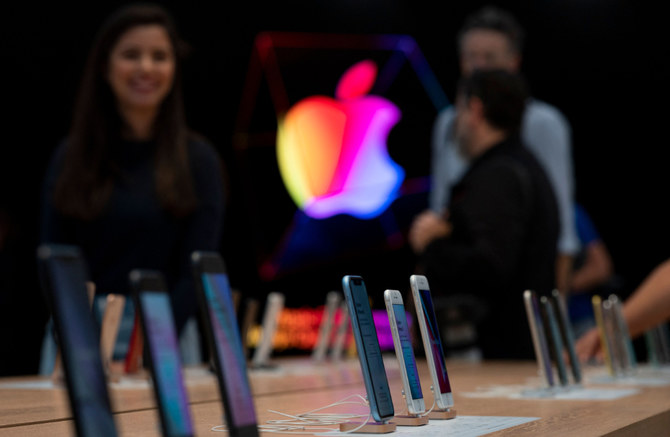
Apple says iPhone to accept tap-to-pay without more hardware
https://arab.news/y48q9
Apple says iPhone to accept tap-to-pay without more hardware

- The iPhone has been used as a contactless way to pay for goods and services since Apple Pay launched in 2014


Apple, Google offer app store changes under new UK rules
LONDON: Apple and Google have pledged changes to ensure fairness in their app stores, the UK competition watchdog said Tuesday, describing it as “first steps” under its tougher regulation of technology giants.
The Competition and Markets Authority placed the two companies under “strategic market status” last year, giving it powers to impose stricter rules on their mobile platforms.
Apple and Google have submitted packages of commitments to improve fairness and transparency in their app stores, which the CMA is now consulting market participants on.
The proposals cover data collection, how apps are reviewed and ranked and improved access to their mobile operating systems.
They aim to prevent Apple and Google from giving priority to their own apps and to ensure businesses receive fairer terms for delivering apps to customers, including better access to tools to compete with services like the Apple digital wallet.
“These are important first steps while we continue to work on a broad range of additional measures to improve Apple and Google’s app store services in the UK,” said CMA chief executive Sarah Cardell.
The commitments mark the first changes proposed by US tech giants in response to the UK’s digital markets regulation, which came into force last year.
The UK framework is similar to a tech competition law from the European Union, the Digital Markets Act, which carries the potential for hefty financial penalties.
“The commitments announced today allow Apple to continue advancing important privacy and security innovations for users and great opportunities for developers,” an Apple spokesperson said.
The CMA in October found that Apple and Google held an “effective duopoly,” with around 90 to 100 percent of UK mobile services running on their platforms.
A Google spokesperson said existing practices in its Play online store are “fair, objective and transparent.”
“We welcome the opportunity to resolve the CMA’s concerns collaboratively,” they added.
The changes are set to take effect in April, subject to the outcome of a market consultation.


