

Saudi authorities sign deal to develop cultural, entertainment sectors

1 / 3
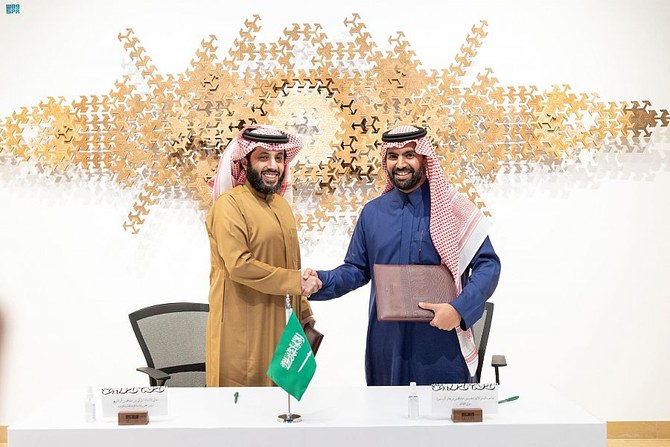
Minister of Culture Prince Badr bin Abdullah bin Farhan and Chairman of the General Entertainment Authority Turki Alalshikh sign a memorandum of understanding. (SPA)
2 / 3
Minister of Culture Prince Badr bin Abdullah bin Farhan and Chairman of the General Entertainment Authority Turki Al-Asheikh sign a memorandum of understanding. (SPA)
3 / 3
Deputy Minister of Culture Hamed Fayez and CEO of the Tourism Development Fund Qusai Al-Fakhri sign a cooperation agreement. (SPA)
Short Url
Updated 05 October 2023
Follow

Saudi authorities sign deal to develop cultural, entertainment sectors

  • The MoU included cooperation in implementing the strategies of the Kingdom’s eleven cultural bodies
  • Ministry of Culture also signs cooperation agreement with Tourism Development Fund

RIYADH: Saudi Arabia’s Ministry of Culture and the General Entertainment Authority signed an agreement to develop the cultural and entertainment sectors, in line with the goals of the Kingdom’s Vision 2030, Saudi Press Agency reported Tuesday.
Prince Badr bin Abdullah bin Farhan, minister of culture, and Chairman of the General Entertainment Authority, Turki Alalshikh signed the memorandum of understanding, the ministry said on Tuesday.
The MoU included cooperation in implementing the strategies of the Kingdom’s eleven cultural bodies, and coordinating between the two sectors to issue licenses and permits, and content approval.
It also included cooperation between the two parties to develop capacities, classify cultural and entertainment professions, stimulate investment in both sectors, and jointly implement recreational cultural activities.
The ministry said the signing of the deal falls within the framework of its aim to enrich cultural content, develop cultural and entertainment events organized by the Kingdom, enhance investment opportunities to diversify sources of domestic product, and consolidate the Kingdom’s position globally.
Meanwhile, the Ministry of Culture signed a cooperation agreement with the Tourism Development Fund to spread cultural awareness and enrich visitor experiences at tourist sites.
The agreement aims to add “a cultural imprint in tourism projects” by developing heritage sites and transforming them into tourist destinations, and allocating cultural activities in existing or planned tourism projects.
This will help support local creative talents to benefit from tourism and cultural gains and develop their skills to achieve the objectives of the ministry and the fund, and the national strategies for culture and tourism.


Two Holy Mosques authority launches smart interactive map system

Updated 4 sec ago
Follow

Two Holy Mosques authority launches smart interactive map system

MADINAH: A new smart interactive map system has been inaugurated for the Grand Mosque and the Prophet’s Mosque.

CEO of the General Authority for the Care of the Affairs of the Grand Mosque and the Prophet’s Mosque Ghazi Al-Shahrani said that the smart interactive map facilitated the movement of visitors and worshipers while significantly enhancing navigational efficiency within the two holy mosques. The system is designed to guide visitors along the most suitable routes, support real-time updates, ensure safe navigation and enhance the overall quality of the experience.

Al-Shahrani said that the results achieved were part of the authority’s efforts to advance digital transformation and leverage smart technologies in serving pilgrims. He said that this system was one of dozens launched recently that contributed to generating operational data that supported decision-making, enhanced understanding of challenges and paved the way for developing future digital systems.

Interactive maps are part of a smart digital system that provides real-time spatial guidance, powered by live operational data linked to control rooms. This enables visitors to be directed to the most appropriate routes during closures or congestion, with immediate and accurate updates.

Executive vice president of digital transformation at the authority, Mohammed Al-Saqr, said that the pilot phase of the maps, which began during Ramadan, was integrated with the color coding and metric addressing system, which divided the Two Holy Mosques into clear geographical zones that supported smart operations and activated spatial data as part of an integrated services and analytics ecosystem. He said that this launch represented the first step in a project that would continue to evolve over the coming years, with further development planned through 2026.

Al-Saqr said that the system featured more than 950 points of interest across 13 service categories, supported by more than 650 QR codes for easy access. It could also generate more than 100,000 dynamic routes, automatically optimized in real time based on operational conditions and crowd flow.

Director of business solutions at the authority, Waheeb Al-Mutrafi, said that the maps enabled precise location-based reporting and contributed to accelerating access to electric carts through ticket numbers via a smart platform built on field data verified over several months, enhancing operational efficiency and improving the quality of services provided to worshippers.