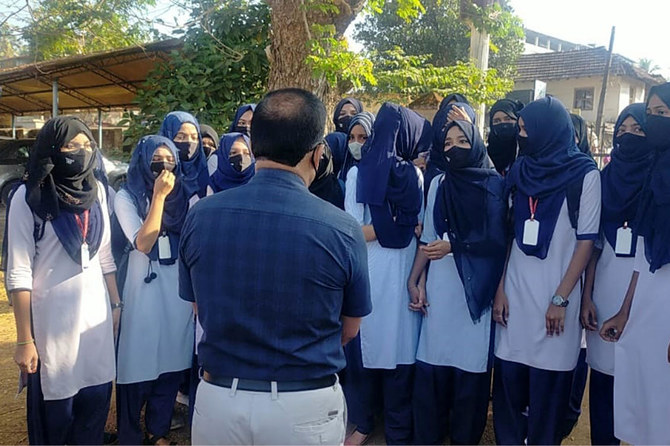
NEW DELHI: When the students were barred last month from entering their classrooms and told not to wear hijab, a headscarf used by Muslim women, they began camping outside the all-girls high school.
The story cascaded across the Internet, drawing news crews to the front of the government-run school in Udupi district, in the southern Indian state of Karnataka.
Battle lines were swiftly drawn. The students began protesting outside the school gate and sat huddled in a group, reading their lessons. The school staff, which said the students were defying uniform rules, remained unmoved.
A month on, more schools have begun implementing a similar ban on hijabs, forcing the state’s top court to step in. It will hear petitions filed by the protesting students on Tuesday and rule on whether to overturn the ban.
But the uneasy standoff has raised fears among the state’s Muslim students who say they are being deprived of their religious rights. On Monday, hundreds of them, including their parents, took to the streets against the restrictions, demanding that students should be allowed to attend classes even if they are wearing hijab.
“What we are witnessing is a form of religious apartheid. The decree is discriminatory and it disproportionately affects Muslim women,” said A. H. Almas, an 18-year-old student who has been part of the weeks-long protests.
So far several meetings between the staff, government representatives and the protesting students have failed to resolve the issue. The state’s education minister, B. C. Nagesh, has also refused to lift the ban. He told reporters Sunday that “those unwilling to follow uniform dress code can explore other options.”
For many Muslim women, the hijab is part of their Islamic faith. It has for decades been a source of controversy in some western countries, particularly in France, which in 2004 banned it from being worn in public schools. But in India, where Muslims make up almost 14 percent of the country’s near 1.4 billion people, it is neither banned nor is its use restricted in public places.
In fact, women wearing hijab are a common sight in India, and for many of them, it symbolizes religious identity and is a matter of personal choice.
Because the debate involves alleged bias over a religious item worn to cover hair and maintain modesty, some rights activists have voiced concerns that the decree risks raising Islamophobia. Violence and hate speech against Muslims have increased under Prime Minister Narendra Modi’s ruling Hindu nationalist party, which also governs the Karnataka state.
“Singling out hijab for criticism is unfair and discriminatory. Those opposing it are on record decrying secularism and for openly espousing majoritarianism,” said Zakia Soman, founder of a Muslim women’s group, the Bharatiya Muslim Mahila Andolan.
Others contend it underscores the potential isolation and marginalization of Muslims who feel Modi and his Hindu nationalist party are slowly isolating them, compounding an already growing unease felt by the minority community, in a multicultural country that has guarantees of religious freedom enshrined in its constitution.
“What we are seeing is an attempt to invisibilize Muslim women and push them out of public spaces,” said Afreen Fatima, a New Delhi-based student activist. She said the ban is the culmination of a growing climate of hate against Muslims “which has now manifested itself in the physical realm.”
The protests have drawn public condemnation, with the hashtag #HijabIsOurRight circulating widely on social media, but also led to a rather unexpected pushback.
For the last week, some Hindu students in the state have started wearing Saffron-colored shawls, a symbol of Hindu nationalist groups. They have also chanted praises to Hindu gods, while protesting against the Muslim girls’ choice of headgear, signifying India’s growing religious faultlines and bitter tensions between the country’s Hindu majority and its large Muslim minority.
The events have prompted the state government to ban clothes it said “disturb equality, integrity and public order” and some high schools to declare a holiday to avoid communal trouble.
On Monday one of the schools yielded partially and allowed its Muslim students to attend class with a hijab but made them sit in separate classrooms. The move was heavily criticized, with Muslim students alleging the staff of segregating them on the basis of faith.
“It is humiliating,” said Almas. “How long are we going to accept that citizens can be stigmatized because of their religion?”

In India, wearing hijab bars some Muslim students from class
Short Url
https://arab.news/nkr5j
In India, wearing hijab bars some Muslim students from class
Greenland PM prefers Denmark ties over US
- Jens-Frederik Nielsen reiterated Greenland’s commitment to Denmark ahead of JD Vance meeting
- White House officials have been discussing various plans to bring Greenland under US control
NUUK: Residents in Greenland’s snow-covered capital, Nuuk, expressed support for remaining part of Denmark and called for a pause in independence discussions ahead of high-level talks in Washington on Wednesday, as US President Donald Trump intensifies his interest in the Arctic island.
Greenlandic and Danish foreign ministers will meet US Vice President JD Vance and Secretary of State Marco Rubio in Washington on Wednesday after renewed threats of taking control over Greenland, an autonomous territory Denmark.
Greenland’s Prime Minister Jens-Frederik Nielsen reiterated Greenland’s commitment to Denmark, dismissing the prospect of becoming a US territory.
“We face a geopolitical crisis, and if we have to choose between the US and Denmark here and now, then we choose Denmark,” Nielsen told reporters in Copenhagen on Tuesday, standing alongside Danish Prime Minister Mette Frederiksen. “We stand united in the Kingdom of Denmark.”
Greenland’s political landscape appears to be shifting, with leaders and residents focusing on long-term independence rather than immediate autonomy.
“In the current circumstances, I think it would be wise for Greenland to commit to Denmark for a very, very long time and remain under the NATO security umbrella,” said Finn Meinel, a Nuuk-based lawyer.
Some Greenlanders are worried about potential US intervention. Charlotte Heilmann, a pensioner in Nuuk, shared her reservations: “I can’t imagine living as an American. We are part of Denmark, and NATO, so I don’t understand why he keeps saying he wants to take our country.”
Casper Frank Moller, a tour operator, noted how US threats have brought Greenlanders closer together.
“Last year, some people were still focused on fast independence. But after what has happened, there’s more unity among us because we have to stand against this possible annexation. Hopefully, tomorrow’s meeting will lead to a diplomatic solution.”
’FOR US, IT’S HOME’
Greenland has been moving toward greater self-governance since 1979. However, cabinet minister Naaja Nathanielsen, responsible for business, energy, and minerals, acknowledged there is no immediate rush.
“For others, this might be a piece of land, but for us, it’s home,” she said in London. Nathanielsen added that Greenlanders are content being part of Denmark and see themselves as allies of the US, not as Americans.
Trump’s administration has repeatedly claimed Greenland’s strategic importance to US national security. White House officials have been discussing various plans to bring Greenland under US control, including potential use of the US military and lump-sum payments to Greenlanders as part of a bid to convince them to secede from Denmark.
’THE HARDEST PART IS AHEAD'
Danish Foreign Minister Lars Lokke Rasmussen and Greenlandic counterpart Vivian Motzfeldt had requested the upcoming meeting in Washington in response to Trump’s remarks. Rasmussen emphasized the importance of addressing disputes diplomatically. “Our aim is to move the discussion into a meeting room where we can look each other in the eye,” he said.
Denmark, which has managed Greenland for centuries, faces growing pressure to bolster Arctic defenses to counter geopolitical tensions. Danish Defense Minister Troels Lund Poulsen plans to meet NATO Secretary General Mark Rutte in Brussels next week, with multinational NATO exercises in Greenland scheduled by 2026.
Danish Prime Minister Frederiksen acknowledged the challenges presented by the heightened US interest. “It is hard to stand up to the US, our most important ally,” she said on Tuesday. “But the hardest part may still be ahead of us.”
Greenlandic and Danish foreign ministers will meet US Vice President JD Vance and Secretary of State Marco Rubio in Washington on Wednesday after renewed threats of taking control over Greenland, an autonomous territory Denmark.
Greenland’s Prime Minister Jens-Frederik Nielsen reiterated Greenland’s commitment to Denmark, dismissing the prospect of becoming a US territory.
“We face a geopolitical crisis, and if we have to choose between the US and Denmark here and now, then we choose Denmark,” Nielsen told reporters in Copenhagen on Tuesday, standing alongside Danish Prime Minister Mette Frederiksen. “We stand united in the Kingdom of Denmark.”
Greenland’s political landscape appears to be shifting, with leaders and residents focusing on long-term independence rather than immediate autonomy.
“In the current circumstances, I think it would be wise for Greenland to commit to Denmark for a very, very long time and remain under the NATO security umbrella,” said Finn Meinel, a Nuuk-based lawyer.
Some Greenlanders are worried about potential US intervention. Charlotte Heilmann, a pensioner in Nuuk, shared her reservations: “I can’t imagine living as an American. We are part of Denmark, and NATO, so I don’t understand why he keeps saying he wants to take our country.”
Casper Frank Moller, a tour operator, noted how US threats have brought Greenlanders closer together.
“Last year, some people were still focused on fast independence. But after what has happened, there’s more unity among us because we have to stand against this possible annexation. Hopefully, tomorrow’s meeting will lead to a diplomatic solution.”
’FOR US, IT’S HOME’
Greenland has been moving toward greater self-governance since 1979. However, cabinet minister Naaja Nathanielsen, responsible for business, energy, and minerals, acknowledged there is no immediate rush.
“For others, this might be a piece of land, but for us, it’s home,” she said in London. Nathanielsen added that Greenlanders are content being part of Denmark and see themselves as allies of the US, not as Americans.
Trump’s administration has repeatedly claimed Greenland’s strategic importance to US national security. White House officials have been discussing various plans to bring Greenland under US control, including potential use of the US military and lump-sum payments to Greenlanders as part of a bid to convince them to secede from Denmark.
’THE HARDEST PART IS AHEAD'
Danish Foreign Minister Lars Lokke Rasmussen and Greenlandic counterpart Vivian Motzfeldt had requested the upcoming meeting in Washington in response to Trump’s remarks. Rasmussen emphasized the importance of addressing disputes diplomatically. “Our aim is to move the discussion into a meeting room where we can look each other in the eye,” he said.
Denmark, which has managed Greenland for centuries, faces growing pressure to bolster Arctic defenses to counter geopolitical tensions. Danish Defense Minister Troels Lund Poulsen plans to meet NATO Secretary General Mark Rutte in Brussels next week, with multinational NATO exercises in Greenland scheduled by 2026.
Danish Prime Minister Frederiksen acknowledged the challenges presented by the heightened US interest. “It is hard to stand up to the US, our most important ally,” she said on Tuesday. “But the hardest part may still be ahead of us.”
© 2026 SAUDI RESEARCH & PUBLISHING COMPANY, All Rights Reserved And subject to Terms of Use Agreement.


