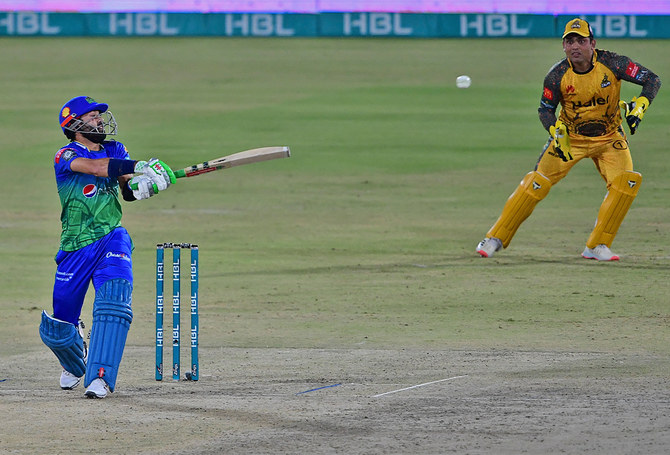
Multan Sultans crush Peshawar Zalmi in PSL clash

Multan Sultans' Mohammad Rizwan plays a shot during the Pakistan Super League (PSL) Twenty20 cricket match between Multan Sultans and Peshawar Zalmi in Karachi on February 5, 2022. (AFP_
Short Url
Updated 05 February 2022
Follow

Multan Sultans crush Peshawar Zalmi in PSL clash

  • Sultans set a target of 222 runs after Zalmi asked Rizwan-led side to bat first
  • In response, Zalmi could only score 165 at a loss of eight wickets in 20 overs

KARACHI: An unbeaten Multan Sultans defeated Peshawar Zalmi by 57 runs in their Pakistan Super League (PSL) 2022 match at Karachi’s National Stadium on Saturday. 
Zalmi won the toss and sent in Sultans to bat, but failed to stop rival batters from setting a gigantic target of 222 runs at a loss of three wickets. 
Skipper Muhammad Rizwan and his opening partner, Shan Masood, made 85 runs to provide a solid foundation to their side. Masood lost his wicket to Shoaib Malik after scoring 35 runs. Sohaib Maqsood scored 25 off 17 balls before Salman Irshad took his wicket. Sultans’ captain was the third to go but only after taking the score to 196 with his 82 off 53 deliveries. 
Tim David’s blitzing 51 off 17 balls, which is the second fastest fifty of the PSL seventh edition, and 21 off just seven balls by Khushdil Shah with his 3 huge sixes helped Sultans put 222 on the score board. 
Wahab Riaz proved the most expensive bowler for Zalmi by conceding 55 runs in four overs without taking any wicket. Salman Irshad, Shoaib Malik and Usman Qadir grabbed one wicket each. Muhammad Umar, who had played an important role in Zalmi’s victory against Karachi Kings on Friday, couldn’t take a wicket. He gave away 36 runs in his four overs. Saqib Mahmood, who played the first match of the season, conceded 37 in just 3 overs. 
In response, Zalmi lost quick wickets with Hazratullah Zazai and Haider Ali being the only batters providing some respite to the side. Zazai scored 43 off 32 balls. Kamran Akmal was the first to go after adding ten runs to his team’s total. Haider Ali lost his wicket to Shahnawaz Dahani after scoring 24 runs. 
Zalmi’s Ben Cutting scored 52 off 30 balls — his second half-century in the tournament. His last-over blitz was not enough to save his side from a defeat. 
Zalmi scored 165 at a loss of eight wickets in 20 overs. 
Imran Tahir dismissed three Zalmi players by conceding just 25 runs. Dahani, who made a comeback after being dropped from the last match, secured three wickets for 41 runs. Abbas Afridi took one wicket in his three overs and gave away 20 runs. 
Both sides will play their second match against each other in Lahore on Thursday. 
Peshawar defeated Quetta Gladiators in their first match by four wickets and successfully chased a target of 190 runs on January 28. The Wahab Riaz-led side lost their next match to Islamabad United, which chased a target of 168 runs in just 15.5 overs. 
In the next contest, Zalmi could only score 170 runs at a loss of nine wickets in their chase of 199-run target set by Lahore Qalandars. In the fourth contest against Karachi, Peshawar made a comeback with some brilliant individual performances and set a target of 174 runs. Opener Hazratullah Zazai and Shoaib Malik shined with their 41 off 27 and 52 off 28, respectively. Zalmi bowlers restricted Karachi to 164 at a loss of six wickets. Debutant Muhamad Umar, Salman Irshad and Malik put up a tremendous show with the ball. 
Umar grabbed three wickets after conceding just 22 runs in his four overs. Malik secured one wicket in his one over, while Salman Irshad couldn’t grab a wicket but bowled his four overs by giving away just 24 runs. 
Sultans also started their PSL journey with a victory and defeated Kings in the opening match of PSL last month. The Muhammad Rizwan-led side successfully chased a huge target of 206 runs set by Lahore Qalandars in the third match of the tournament. 
Sultans defended their score of 174 against Quetta Gladiators, breaking the jinx of the chasing side winning the first six contests. Multan in their next match set a target of 217 runs against Islamabad United, which fell 20 runs short of their chase. 


Pakistan says it backs Gaza peace plan, hopes next phase leads to Palestinian state

Updated 9 sec ago
Follow

Pakistan says it backs Gaza peace plan, hopes next phase leads to Palestinian state

  • Foreign Office says it is not concerned about who joins or stays out of the Abraham Accords
  • Pakistan reaffirms rejection of Israel’s recognition of Somaliland, warns of regional instability

ISLAMABAD: Pakistan’s Foreign Office said on Thursday it supported the Gaza peace plan endorsed by the United Nations Security Council, expressing hope its next phase would stabilize the situation in the war-ravaged territory, scale up humanitarian assistance and lead to an independent Palestinian state.

The United States said on Wednesday it was moving into the next phase of a Gaza ceasefire plan. President Donald Trump’s Middle East envoy Steve Witkoff said in a post on X that the second phase will establish “a transitional technocratic Palestinian administration in Gaza” and mark the beginning of “the full demilitarization and reconstruction of Gaza, primarily the disarmament of all unauthorized personnel.”

Commenting on the development, Foreign Office Spokesperson Tahir Andrabi said Pakistan had taken note of the announcement.

“We have seen this social media post about the next phase of the ceasefire agreement in Gaza, and we express the hope that these steps will lead to further stabilization of the situation, and upscaling the humanitarian assistance and end of the sacrifices of the people,” he said while addressing his weekly news conference.

Andrabi said Pakistan had been engaged in the Gaza peace effort as part of a group of Arab and Islamic countries since the initiative was presented by the US president and supported both the plan and the UN Security Council resolution endorsing it.

“We also hope that these efforts will lead to a credible time bound, political process consistent with international legitimacy and relevant UN resolutions to establish an independent, sovereign, contiguous state of Palestine, based on pre-1967 borders with East Jerusalem as its capital,” he added.

Asked about Pakistan’s position on the Abraham Accords, a series of US-brokered agreements normalizing relations between Israel and several Arab states, Andrabi said Islamabad’s stance remained unchanged.

“Our position with respect to it is that there are certain benchmarks that have to be achieved ... And [these relate do] a viable, contiguous state of Palestine, with East Jerusalem as its capital.”

He said Pakistan did not judge other countries’ choices on the accords.

“We are not concerned about who does or who does not join the Abraham Accords,” he said.

SOMALILAND ISSUE

Earlier in his opening remarks, Andrabi reiterated Pakistan’s rejection of Israel’s recognition of Somaliland, a self-declared breakaway region of Somalia, calling the move illegal and warning it could destabilize the Horn of Africa and Red Sea region.

Somaliland declared independence from Somalia in 1991 but is not recognized by the United Nations or the African Union.

Israel’s recent steps to recognize the territory have drawn criticism from Somalia and several Muslim-majority countries.

Pakistan’s Deputy Prime Minister and Foreign Minister Ishaq Dar raised the issue during the 22nd Extraordinary Session of the Organization of Islamic Cooperation Council of Foreign Ministers held in Jeddah on Jan. 10.

“In his address, the DPM-FM strongly condemned the illegal and unlawful recognition by Israel of the Somaliland region, as well as subsequent unwarranted and highly provocative visits of Israeli officials to the territory,” the Foreign Office spokesman said.

“He termed such acts as political aggression and a direct assault on Somalia’s internationally recognized borders, setting a perilous precedent and threatening peace and security in the Horn of Africa, the Red Sea region, and beyond.”

Andrabi said Dar also addressed the Palestinian issue during the session, rejecting proposals for the displacement of Palestinians and reaffirming Pakistan’s long-standing support for a two-state solution.