

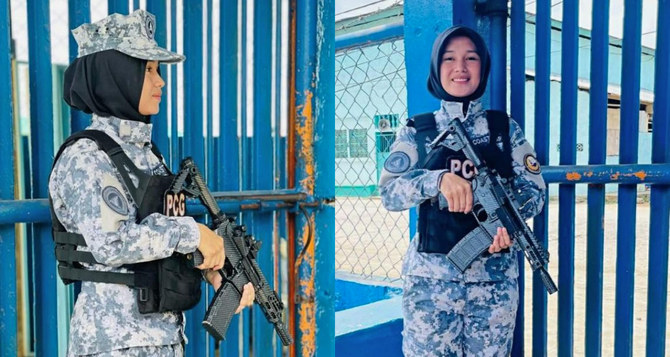
Philippine Coast Guard allows female Muslim personnel to wear hijab

Female Muslim members of the Philippine Coast Guard don the hijab as part of their new uniform. (PCG photo)
Short Url
Updated 03 February 2022
Follow

Philippine Coast Guard allows female Muslim personnel to wear hijab

  • PCG has about 1,850 Muslim personnel, 200 of whom are women
  • New regulations see PCG following moves made by the Philippine military and police 

MANILA: The Philippine Coast Guard announced on Thursday it had approved a new dress policy allowing the use of headscarves in uniform as it makes a bid for more Muslim women to join the service.

Muslims make up about 6 percent of the country’s 110 million citizens.

The PCG currently has 1,850 Muslim personnel, 200 of whom are women.

“The Philippine Coast Guard has approved the inclusion of hijab in the uniform of female Muslim Coast Guard personnel,” the force said in a statement, adding that the policy has been effective since last week.  

“The Muslim community in the PCG conveyed their sincere gratitude,” it said. “Members of the said community hope that the inclusion of hijab in the official PCG uniform will encourage more Muslim women to join the Coast Guard workforce.”

The service’s imam, Capt. Alicman S. Borowa, had proposed the inclusion of the hijab in the force’s uniform last year, arguing it would help foster inclusivity.

The National Commission on Muslim Filipinos welcomed the development. 

“GOOD NEWS! The Philippine Coast Guard released a statement allowing Muslim women under their office to wear their hijab as part of the official uniform,” the commission said in a social media post on Thursday.

The PCG is following in the footsteps of the Armed Forces of the Philippines, the Philippine National Police, and the Bureau of Jail Management and Penology, which have already allowed the use of headscarves as part of the official uniform for their Muslim personnel. 

In 2017, security forces deployed hijab-clad women soldiers, or “hijab troopers,” in Marawi, to provide vital support to communities traumatized by the siege of the city — a months-long armed conflict in northwest-central Mindanao between Philippine security forces and militants affiliated with Daesh.


UK pays Guantanamo detainee ‘substantial’ compensation over US torture questions

Updated 5 sec ago
Follow

UK pays Guantanamo detainee ‘substantial’ compensation over US torture questions

  • Abu Zubaydah has been held at Guantanamo Bay without charge for 20 years
  • British security services knew he was subjected to ‘enhanced interrogation’ but failed to raise concerns for 4 years

LONDON: A Saudi-born Palestinian being held without trial by the US has received a “substantial” compensation payment from the UK government, the BBC reported.

Abu Zubaydah has been imprisoned at Guantanamo Bay in Cuba for almost 20 years following his capture in Pakistan in 2002, and was subjected to “enhanced interrogation” techniques by the CIA.

He was accused of being a senior member of Al-Qaeda in the aftermath of the Sept. 11 terror attacks on the US. The allegations were later dropped but he remains in detention.

The compensation follows revelations that UK security services submitted questions to the US to be put to Abu Zubaydah by their US counterparts despite knowledge of his mistreatment.

He alleged that MI5 and MI6 had been “complicit” in torture, leading to a legal case and the subsequent compensation.

Dominic Grieve, the UK’s former attorney general, chaired a panel reviewing Abu Zubaydah’s case.

He described the compensation as “very unusual” but said the treatment of Abu Zubaydah had been “plainly” wrong, the BBC reported.

Grieve added that the security services had evidence that the “Americans were behaving in a way that should have given us cause for real concern,” and that “we (UK authorities) should have raised it with the US and, if necessary, closed down co-operation, but we failed to do that for a considerable period of time.”

Abu Zubaydah’s international legal counsel, Prof. Helen Duffy, said: “The compensation is important, it’s significant, but it’s insufficient.”

She added that more needs to be done to secure his release, stating: “These violations of his rights are not historic, they are ongoing.”

Duffy said Abu Zubaydah would continue to fight for his freedom, adding: “I am hopeful that the payment of the substantial sums will enable him to do that and to support himself when he’s in the outside world.”

He is one of 15 people still being held at Guantanamo, many without charge. Following his initial detention, he arrived at the prison camp having been the first person to be taken to a so-called CIA “black site.”

He spent time at six such locations, including in Lithuania and Poland, outside of US legal jurisdiction. 

Internal MI6 messages revealed that the “enhanced interrogation” techniques he was subjected to would have “broken” the resolve of an estimated 98 percent of US special forces members had they been subjected to them.

CIA officers later decided he would be permanently cut off from the outside world, with then-President George W. Bush publicly saying Abu Zubaydah had been “plotting and planning murder.”

However, the US has since withdrawn the allegations and no longer says he was a member of Al-Qaeda.

A report by the US Senate Select Committee on Intelligence said Abu Zubaydah had been waterboarded at least 83 times, was locked in a coffin-like box for extended periods, and had been regularly assaulted. Much of his treatment would be considered torture under UK law.

Despite knowledge of his treatment, it was four years before British security services raised concerns with their American counterparts, and their submission of questions within that period had “created a market” for the torture of detainees, Duffy said.

A 2018 report by the UK Parliament’s Intelligence and Security Committee was deeply critical of the behavior of MI5 and MI6 in relation to Abu Zubaydah. 

It also criticized conduct relating to Guantanamo detainee Khalid Sheikh Mohammed, widely regarded as a key architect of the Sept. 11 attacks, warning that the precedent set by Abu Zubaydah’s legal action could be used by Mohammed to bring a separate case against the UK.

MI5 and MI6 failed to comment on Abu Zubaydah’s case. Neither the UK government nor Mohammed’s legal team would comment on a possible case over his treatment.