

Pakistan eyes economic gains as PM Khan reaches China on Beijing Olympics trip

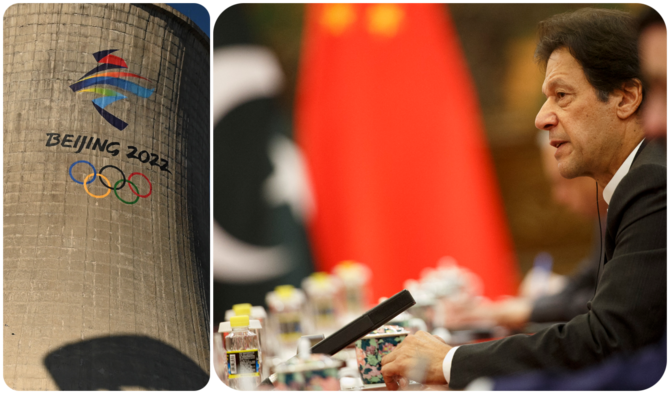
The combination of photos show the Olympic logo painted on a factory chimney in China on January 13, 2022, and Pakistan Prime Minister Imran Khan during his Beijing visit on November 2, 2018. (AFP/File)
Short Url
Updated 03 February 2022
Follow

Pakistan eyes economic gains as PM Khan reaches China on Beijing Olympics trip

  • The prime minister was accorded a red-carpet welcome upon arrival at the Beijing International Airport
  • The country's commerce chief says Khan's visit is expected to lead to a significant increase in Pakistan's exports

ISLAMABAD: Prime Minister Imran Khan began his official visit to China on Thursday night when his plane touched down at the Beijing International Airport where he was given a red-carpet welcome by the Chinese authorities, his office confirmed in a Twitter post.

Senior Pakistani officials said earlier in the day the premier's visit to China was expected to bring economic gains for the country.

Khan is scheduled to attend the opening ceremony of the 2022 Winter Olympics which will take place from Feb. 4 to Feb. 20 in the Chinese capital and venues near neighboring towns of Yanqing and Chongli. Some 2,900 athletes from over 90 countries are expected to attend the event.

Amid geopolitical tensions, the US, UK, Canada and Australia announced a diplomatic boycott of the event over China's human rights record. Their athletes will still participate in the games, but no government official will be present.

“Prime Minister @ImranKhanPTI was accorded a red carpet welcome upon his arrival at Beijing Capital International Airport, Beijing,” his office in Islamabad announced in a social media message.

PM Khan has gone to China on a three-day visit that will include talks with Chinese President Xi Jinping and Prime Minister Li Keqiang.

Pakistan’s finance minister, Shaukat Tarin, said in a video message shared on social media, that the prime minister’s trip to China was “important not only for political but also economic reasons.”

"The prime minister will also ask them to help us in our agriculture transformation plan,” he added. “This is because Pakistan attaches special importance to agriculture. Our overall economic growth is spurred by agricultural growth.”

The Pakistani prime minister's adviser for commerce and investment, Abdul Razak Dawood, said in a separate video message that the visit to China will be a “very important one.”

"We will derive a lot of benefits which will also lead to a significant increase in our exports and we will import technology from there as well,” he added.

Pakistan’s Foreign Ministry said on Wednesday several agreements would be concluded during the visit.

Beijing has pledged over $60 billion for infrastructure projects in Pakistan under the China-Pakistan Economic Corridor (CPEC) established in 2013. The initiative is a central part of the Belt and Road Initiative, in which China’s aims to forge “Silk Road” land and sea ties to markets in the Middle East and Europe.


Pakistan, UK sign £35 million Green Compact to strengthen climate resilience

Updated 21 December 2025
Follow

Pakistan, UK sign £35 million Green Compact to strengthen climate resilience

  • Pakistan ranks among nations most vulnerable to climate change and has seen erratic changes in its weather patterns
  • UK will help Pakistan mobilize climate finance, strengthen regulatory frameworks and develop bankable climate projects

ISLAMABAD: Pakistan and the United Kingdom (UK) have formalized a comprehensive climate partnership with the launch of a Green Compact that aims to enhance climate resilience, accelerate clean energy transition and scale up nature-based solutions, including mangrove conservation, Pakistani state media reported on Sunday.

The agreement, signed in Islamabad by Federal Minister for Climate Change and Environmental Coordination Dr. Musadik Malik and UK Minister for International Development Jennifer Chapman, unlocks £35 million in targeted support for green development and long-term climate action, according to Radio Pakistan broadcaster.

Pakistan ranks among nations most vulnerable to climate change and has seen erratic changes in its weather patterns that have led to frequent heatwaves, untimely rains, storms, cyclones, floods and droughts in recent years. In 2022, monsoon floods killed over 1,700 people, displaced another 33 million and caused over $30 billion losses, while another 1,037 people were killed in floods this year.

Mohammad Saleem Shaikh, a spokesperson for Pakistan’s Ministry of Climate Change, described the compact as a “decisive move toward action-oriented climate cooperation,” noting that its implementation over the next decade will be critical for Pakistan which regularly faces floods, heatwaves and water stress.

“The Compact is structured around five core pillars: climate finance and investment, clean energy transition, nature-based solutions, innovation and youth empowerment, and adaptation and resilience,” the report read.

“Under the agreement, the UK will work with Pakistan to mobilize public and private climate finance, strengthen regulatory frameworks for green investment, and develop bankable climate projects.”

Clean energy forms a central component of Pakistan’s transition, with Islamabad planning to expand solar and wind generation to reduce fossil fuel dependence, improve energy security and stabilize power costs, according to Shaikh.

“Renewable energy is now economically competitive, making the transition both environmentally and financially viable,” he was quoted as saying.

“Nature-based solutions, particularly large-scale mangrove restoration, will protect coastal communities from storm surges and erosion while enhancing biodiversity and carbon sequestration.”

Under the Compact, technical support, mentoring and access to investors will be provided to climate-smart startups and young innovators, reflecting Pakistan’s recognition of youth-led initiatives as central to future climate solutions.

On the occasion, Chapman, on her first official visit to Pakistan, underscored the urgency of climate action, highlighting the UK’s support for renewable energy, mangrove and ecosystem restoration, early-warning systems, climate budgeting and international investment flows into Pakistan.

Shaikh described the Green Compact as “a strategic turning point” in Pakistan–UK relations on climate change, saying its effective implementation is essential for Pakistan to meet its national climate targets.