Pakistan’s Sindh province declares two islands ‘protected forests’ amid ownership dispute

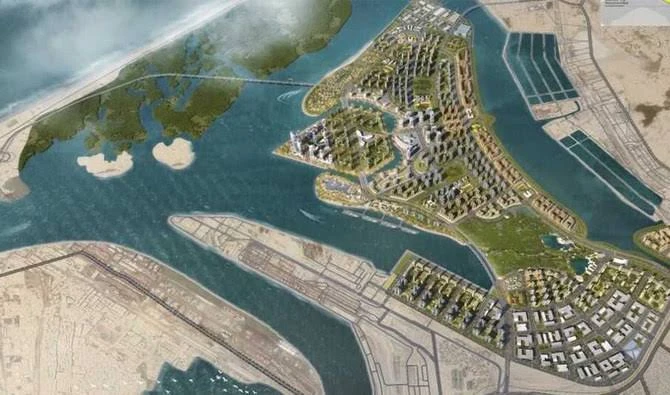
An aerial view of comprehensive plan of Karachi coastal development zone, part of the China Pakistan Economic Corridor. (Ministry of Maritime Affairs)
Short Url
Updated 03 February 2022
Follow

Pakistan’s Sindh province declares two islands ‘protected forests’ amid ownership dispute

  • The country has been planning to develop Bundal and Buddo islands for commercial purposes since 2008
  • The current federal administration’s decision to set up Pakistan Island Development Authority created friction with the Sindh government

KARACHI: Pakistan’s southern Sindh province on Wednesday declared two islands off the coast of Karachi “protected forests” while instructing its wildlife department to notify the decision.

The proclamation was made against the backdrop of an ownership dispute on Bundal and Buddo islands between the federal and provincial authorities.

Sindh Governor Imran Ismail announced in October 2020 the federal government was interested in developing new cities over the islands with an investment of $50 billion to “surpass Dubai.”

The plan was opposed by Sindh’s ruling Pakistan People’s Party (PPP) which is also a major opposition faction on the national level.

“The cabinet after thorough discussion and deliberations declared Bundal and Buddo Islands as ‘Protected Forests’ and directed the Forest department to notify the decision,” said an official statement issued after the provincial cabinet meeting on Wednesday.

The islands have been claimed by the Sindh Forest Department (SFD) and Port Qasim Authority which works under the federal government.

The Port Qasim Authority sent a legal notice to the Sindh government against any change to the status of the islands on Monday, saying: “Both Bundal Islands and Buddo Islands (collectively the ‘Islands’) fall within the declared boundaries of Port Qasim and were transferred by the Federal Government to PQA.”

The notice served to the chief secretary said “these Islands are situated at the entrance of the Port Qasim Navigation Channel and are owned by our client. Any action in relation to these Islands without consulting our client and obtaining its consent would be illegal and void ab initio.”

“In view of the foregoing,” it added, “you are hereby requested and advised to refrain from altering/changing the status of the Islands in any manner since the same belong to and vest in our client.”

The federal government in August 2020 had promulgated an ordinance to establish Pakistan Island Development Authority (PIDA) to manage landmasses in the internal and territorial waters of the country.

The development created friction between the federal and provincial administrations, though Prime Minister Imran Khan offered the authorities in Sindh to jointly work on the project with his government.

Many petitions were filed against the federal administration’s decision to turn the islands into commercial ventures. Following the Sindh cabinet decision, lawyer and social activist Jibran Nasir said the islands were declared protected on judicial instructions.

“Finally #Buddu #Bundal islands declared protected on Hon' SHC [Sindh High Court] orders in our petition,” he said in a Twitter post, adding: “Sindh Govt left out the islands mangroves from list of protected forest in its 2010 notification telling SHC it was a ‘lapse/omission’. But we all know it was no innocent mistake.”

Pakistan has been thinking of developing these islands since 2008 when the country’s former military ruler General (r) Pervez Musharraf struck a deal with a Dubai-based construction company to build a model city over 12,000 acres along with a 1.5-kilometer-long bridge.

However, the plan did not materialize.


Pakistani student launches ‘Urdu ChatGPT’ AI model

Updated 5 sec ago
Follow

Pakistani student launches ‘Urdu ChatGPT’ AI model

  • Developer says “Qalb” is largest large language model built exclusively for Urdu
  • Project highlights push to localize artificial intelligence for non-English users

ISLAMABAD: A Pakistani student studying in the United States has launched an artificial intelligence model designed exclusively for the Urdu language, a development its creator says could help bridge longstanding gaps in access to advanced digital tools for millions of speakers worldwide.

The project, called Qalb, is positioned as an Urdu-first large language model at a time when most generative AI systems are primarily trained on English and other widely used global languages. Supporters of language-specific models argue they can improve accuracy, cultural relevance and accessibility for users in education, business and public services.

Urdu is spoken by more than 230 million people globally, including in Pakistan, India and diaspora communities, but remains under-represented in advanced AI systems. Efforts to localize artificial intelligence have increasingly been seen as critical for widening participation in digital economies, particularly in developing countries.

“Qalb is now recognized as the world’s largest Large Language Model created exclusively for the Urdu language,” Taimoor Hassan, the project’s developer, was quoted this month in a report in state-run news agency APP. 

“Trained on a massive dataset of 1.97 billion tokens and benchmarked across seven-plus international evaluation frameworks, Qalb outperforms existing Urdu-focused AI models on key real-world performance indicators, setting a new standard for natural language processing in Pakistan,” Hassan said.

“This is a development model and in the next phase we would soon launch App for mobile and web so that people could use and benefit from Qalb ChatGPT.”

Hassan completed his undergraduate degree in computer science at FAAST University’s Peshawar campus and is currently studying for a master’s degree in computer science and software engineering at Auburn University in the United States. According to APP, he is a serial entrepreneur who has previously launched and exited multiple startups and has represented Pakistan at international technology forums.

“I had the opportunity to contribute in a small way to a much bigger mission for the country,” Hassan said.

“Together with my undergraduate roommates and teammates, Jawad Ahmed and Muhammad Awais, we are committed to continuously fine-tuning localized models for niche industries, which we believe can become a major breakthrough for Pakistan.”

Both collaborators are also graduates of FAAST University Peshawar Campus and are currently studying in Germany, APP reported.

The team behind Qalb said the model is intended to support local businesses, startups, educational platforms and voice-based digital services, arguing that meaningful innovation is no longer limited to large technology firms.

“Technology is no longer locked behind big budgets or big teams. With the right mindset, even a small group can build products that educate, automate, and serve millions,” Hassan told APP.