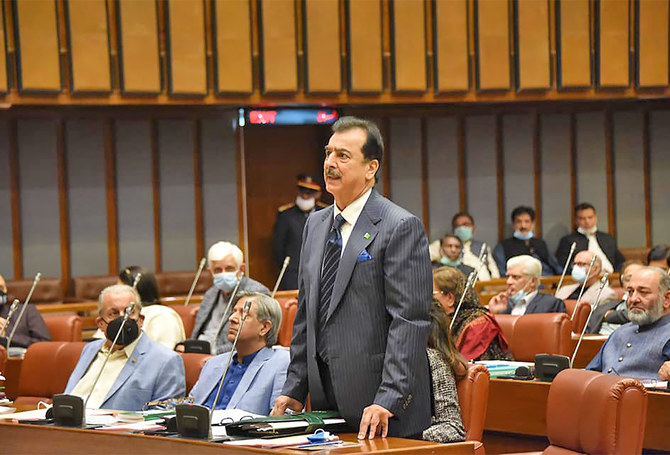
ISLAMABAD: Yousaf Raza Gillani, the opposition leader in Pakistan’s Senate, on Monday announced his resignation, days after the upper house passed a controversial bill as a precondition by the International Monetary Fund (IMF) to revive the country’s $6 billion loan program.
The government had the State Bank of Pakistan (Amendment) Bill passed by the lower house of parliament, the National Assembly, on January 13 to secure the next tranche of the IMF’s Extended Funds Facility. The central bank autonomy bill also required approval of the Pakistani parliament’s upper house to become a law.
The passage of the bill from parliament was a pre-requisite for the disbursement of around $1 billion from the IMF. The global lender’s executive board is scheduled to meet on February 2 for Pakistan’s sixth review under the $6 billion program.
The opposition has a majority of at least 14 votes in the Senate, but some of its members, including Gillani, were absent from the January 28 session, during which the bill was passed.
“I am not astonished by the harsh words of my opponents, but I am astonished by the silence of my well-wishers,” Gillani said in his address with the Senate on Monday.
“But those, who do not have credibility and who are turncoats, they are saying that I helped the government. I have already submitted my resignation to my party that I don’t want to be the leader of the opposition.”
The SBP Amendment Bill had been a major source of contention between the government and the opposition as the latter believed the legislation would compromise Pakistan’s economic sovereignty.
But the government was of the view that an autonomous central bank would help boost economic growth and stability in the country.
The revival of the IMF program would make available $1,059 million that would bring total disbursements to Pakistan to about $3,027 million and help unlock significant funding from bilateral and multilateral partners.
Pakistan secured the $6 billion Extended Funds Facility in 2019, which has been stalled since March 2021.


![]()

Opposition leader announces resignation after Pakistan’s Senate adopts IMF-backed bill
Short Url
https://arab.news/9u4vg
Opposition leader announces resignation after Pakistan’s Senate adopts IMF-backed bill
- The central bank autonomy bill had been a major source of contention between government, opposition
- Yousaf Raza Gillani was among senators missing in last week’s session of opposition-majority upper house
Latest updates


© 2026 SAUDI RESEARCH & PUBLISHING COMPANY, All Rights Reserved And subject to Terms of Use Agreement.