

Farhan’s maiden ton fires Pakistan into T20 World Cup Super Eight

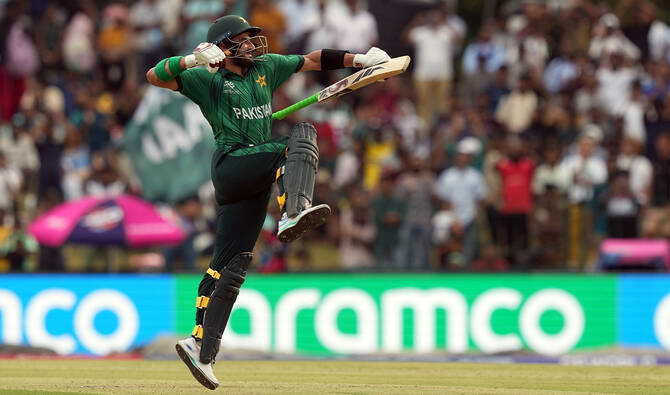
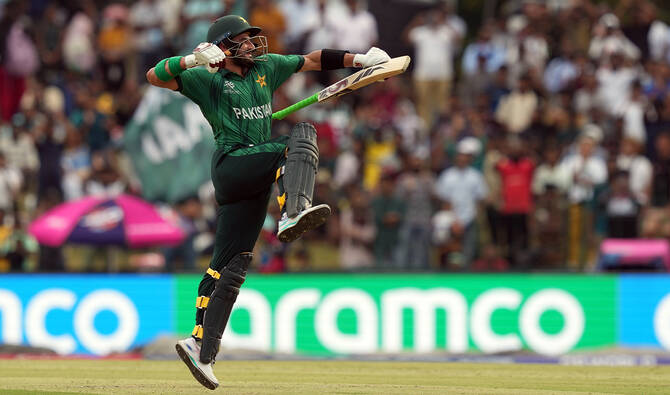
Pakistan’s Sahibzada Farhan celebrates his century during the T20 World Cup cricket match between Namibia and Pakistan in Colombo, Sri Lanka, on February 18, 2026. (AP)
Short Url
Updated 18 February 2026
Follow

Farhan’s maiden ton fires Pakistan into T20 World Cup Super Eight

  • Sahibzada Farhan remained unbeaten with 100 off 58 balls, guiding Pakistan to 199 in Group A clash
  • Pakistan’s Usman Tariq, Shadab Khan take four, three wickets, respectively, to dismiss Namibia for 97

Pakistan became the ‌final team to qualify for the Super Eight of the Twenty20 World Cup after Sahibzada ​Farhan’s maiden international century powered them to a thumping 102-run victory over Namibia in Colombo on Wednesday.

Farhan remained unbeaten on exactly 100 off 58 balls, reaching his landmark in the final over as Pakistan posted 199 in ‌their must-win ‌Group A encounter at ​the ‌Sinhalese ⁠Sports ​Club Ground.

The ⁠opener’s explosive knock featured 11 boundaries and four sixes, with skipper Salman Agha contributing a useful 38 and Shadab Khan adding an unbeaten 36 that included two sixes in the final ⁠over of the innings.

Namibia’s chase never ‌gained momentum despite ‌a promising start from ​opener Louren Steenkamp, ‌who raced to 23 before the African ‌side began losing wickets at regular intervals.

Shadab (3-19) proved instrumental with the ball as well, dismissing skipper Gerhard Erasmus before having Alexander ‌Busing-Volschenk stumped for 20 when the middle-order batter charged down the ⁠pitch ⁠as the required run rate mounted.

Spinner Usman Tariq cleaned up the tail and finished with career-best figures of 4-16 as Namibia were dismissed for 97, ending their World Cup campaign without a win to finish bottom of the group.


Pakistan engages Saudi Arabia, China in bid to ease surging Middle East tensions 

Updated 8 sec ago
Follow

Pakistan engages Saudi Arabia, China in bid to ease surging Middle East tensions 

  • Pakistan’s foreign minister stresses need for de-escalation in conversations with Chinese, Saudi counterparts
  • Tensions in the Middle East continue to remain high as conflict between US, Israel and Iran intensifies

ISLAMABAD: Pakistan’s Deputy Prime Minister Ishaq Dar spoke to the foreign ministers of Saudi Arabia and China on Tuesday, stressing the importance of diplomatic engagement to de-escalate tensions in the Middle East as the Iran war intensifies. 

Pakistan has constantly engaged regional countries in efforts to broker a ceasefire in the Middle East, after the US and Isreal launched coordinated strikes against Iran on Feb. 28. 

Iran launched fresh attacks on Gulf countries on Tuesday morning, where it has targeted US military bases in recent weeks. In addition to firing missiles and drones at Israel and American bases in the region, Iran has also been targeting energy infrastructure which, combined with its stranglehold on the Strait of Hormuz, has sent oil prices soaring worldwide. 

Dar spoke to Saudi Foreign Minister Prince Faisal bin Farhan to discuss developments in the Middle East and ongoing deliberations at the UN Security Council, Pakistan’s foreign office said in a statement. 

“DPM/FM shared Pakistan’s perspective, underscoring the importance of continued coordination and diplomatic engagement to support de-escalation and promote peace and stability across the region and beyond,” the statement said. 

Dar, who also serves as Pakistan’s foreign minister, spoke to Chinese foreign minister Wang Yi over the telephone separately. The two discussed the evolving regional situation and broader global developments.

Dar underscored the need to ease tensions in the Middle East and the wider region during the conversation, the foreign office said. 

Yi appreciated Pakistan’s constructive efforts aimed at promoting de-escalation and stability in the region, it added. 

“The two leaders stressed the importance of de-escalation and emphasized the need to pursue dialogue and diplomacy in accordance with the principles of the UN Charter,” the foreign office’s statement said. 

The conflict in the Middle East has hit Pakistan hard as well, forcing Islamabad to hike petrol and diesel prices by Rs55 per liter last Friday. 

Pakistan’s government has also announced a set of austerity measures, which include closing schools and cutting down on government expenditures, as it evaluates petrol stocks and looks for alternative supply routes.