



KARACHI: Business leaders on Monday said they were “disappointed” over the suspension of gas supply to industries in the southern Pakistani commercial and industrial hub of Karachi for more than three months, which they said was causing Rs22 billion ($125 million) per day losses in export revenue.
Representatives of 14 industrialist bodies, including Karachi Chamber of Commerce and Industry (KCCI) President Muhammad Idrees and Businessmen Group Chairman Zubair Motiwala, appealed to Prime Minister Imran Khan and his aides to immediately restore gas supply to all industrial zones in Karachi.
“Our industrial activities are suspended for last 68 days and the situation is affecting thousands of laborers,” Motiwala said at a joint press conference in Karachi. “On account of exports, industries are suffering Rs22 billion losses on a daily basis.”
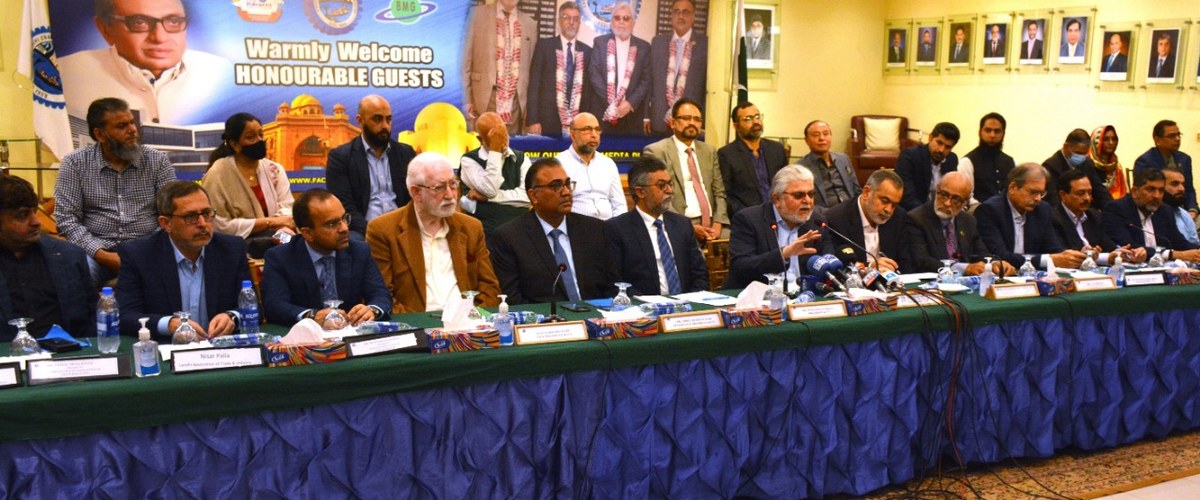
Zubair Motiwala, chairman of Businessmen Group, addresses a joint press conference in Karachi, Pakistan on January 30, 2022. (Photo courtesy KCCI)
They said they were “deeply shocked and totally disappointed with the government for neglecting and ignoring repeated appeals over natural and regasified liquefied natural gas (RLNG) crises and for remaining indecisive in resolving the matter after more than 100 days.”
The chronic gas shortage amid depleting local reserves worsens Pakistan’s energy woes in winters and leaves industrial and domestic consumers struggling for survival. This year the situation was further complicated when prices of liquefied natural gas (LNG) skyrocketed globally, making it unaffordable for the South Asian nation to import it.
More recently, suppliers denied two LNG cargoes as they backed out from deliveries amid skyrocketing rates and increasing global demand.
“The country is currently facing around 200 million cubic feet per day (mmcfd) gas shortage due to cargo defaults and about 9 percent yearly depletion of gas from indigenous fields,” Muzzamil Aslam, a spokesperson for the Pakistani energy ministry told Arab News.
“Despite global crunch, high demand and prices, Pakistan was able to import 90 percent of the LNG cargoes.”
The Karachi-based industrialists said the government’s promises to supply gas to export industries appeared to be an eyewash and a mere lip-service.
“It is extremely unfair to deprive Karachi of gas or RLNG as the city, being the textile and industrial hub of Pakistan, alone contributes 68 percent revenue to the national exchequer, 54 percent to national exports and 52 percent to textile exports,” Motiwala said.
“Karachi continues to face discrimination that has led to causing severe production losses of more than 66 percent due to reduced or no supply of gas.”
Jawed Bilwani, chairman of Pakistan Apparel Forum, said the value-added textile export industries were beset by such behavior of the government.
“Government is well aware that a decline in exports will translate into downward revision of national revenue and negatively impact the foreign exchange coming into Pakistan,” Bilwani said.
“Industrialists have invested more than $3 billion on the purchase of machineries and equipment, which was likely to promote industrialization but this policy will be wasted due to unavailability and unjustified distribution of gas.”
Industrial consumers alone have not been bearing the brunt of Pakistan’s gas shortages, but domestic consumers also face frequent gas outages and are compelled to look for alternative sources, mainly the liquefied petroleum gas (LPG).
“We are suffering from gas outages on a daily basis,” Kashif Hussain, a resident of Karachi’s Nazimabad area, told Arab News. “The supply is restored during night times with extremely low pressure causing severe problems in cooking food.”
Similar situation is being witnessed in other parts of the country, including the eastern city of Lahore. “The situation of gas supply is not normal. In some areas, supply resumes at night but with low pressure,” Asif Ali Khan, a Lahore resident, said.
Since the shortfall hit the country, LPG prices have gone up by 52 percent, according to the official weekly inflation data.
Responding to a question about gas supply situation in Sindh, Aslam said industrialists had obtained a stay from the court, due to which the load management plan could not be implemented to divert gas to domestic consumers.
“Every year gas to non-exporting industries is disconnected and diverted to domestic consumers, but due to the court’s stay order obtained by some industrialists, the government is unable to divert gas to domestic consumers as per the load management plan,” the energy ministry spokesperson said. “That is why domestic consumers are facing problems.”
Aslam, however, said the situation would improve in the first week of February.


