



KARACHI: In a first in Asia, officials of the World Wide Fund-Pakistan and the Sindh wildlife department have safely tagged three dolphins in the Indus River with satellite transmitters, they said on Sunday, aiming to boost conservation and scientific assessment of the endangered species.
While two of the world’s four species of fresh water dolphins — the Ganges river dolphin or Susu and the Yangtze River dolphin, called Baiji — are almost non-existent, the number of Indus dolphins has strangely grown from 150 in 1974 to 918 in 2012, and to 1,419 in April 2019, according to wildlife officials.
In a survey in April 2019, the Sindh wildlife department found the number of Indus river dolphins, nicknamed the ‘Indus Queen,’ had increased by at least 500 in the last seven years. The 1,419-figure included baby, juvenile and adult dolphins.
This was achieved despite knowing little about the movement and behavior of dolphins in the Indus River that is naturally so full of sediment that it is very difficult to track or study them, according to WWF-Pakistan officials. The river is so murky that the Indus dolphins are functionally blind and have evolved the use of echolocation to catch prey.
“Three of the Indus dolphins have been successfully tagged with satellite transmitters to assess their movement upstream and downstream and their movement during low and high flows of the river,” Hammad Naqi Khan, the WWF-Pakistan director general, told Arab News.
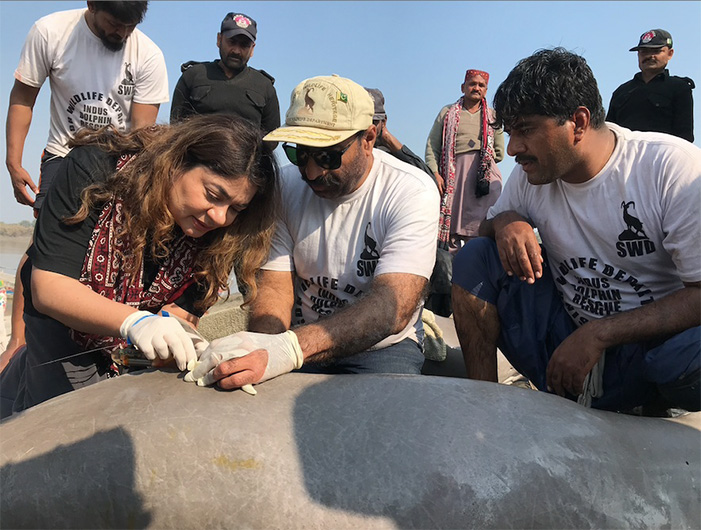
Dr Uzma Khan, Asia coordinator for World Wide Fund’s river dolphin initiative, and members of the WWF-Pakistan satellite-tag Indus River dolphins in Sukkur, Pakistan on January 15, 2022. (Photo By Janan Sindhu)
“The study will also help us get concrete evidence of their behavior and feed,” he said, adding it was a joint initiative of the WWF Pakistan and the Sindh wildlife department.
Javed Mahar, the Sindh wildlife department chief, said while marine life had been extensively studied and researched on, there was hardly any study on the creatures found in Pakistani rivers.
“The river water in Pakistan is turbid and there is hardly any information about the behavior and movement of the creatures, including dolphins,” Mahar told Arab News.
He said the study would not only help assess the behavior of Indus dolphins, but it would also be useful in protecting them from going to small streams at barrages on the river.
“A dolphin is rescued almost every two weeks and we can tag more dolphins when funds are available as it has been successful. At present, we are doing DNA tests of the dolphins as well to know about them,” the official said.
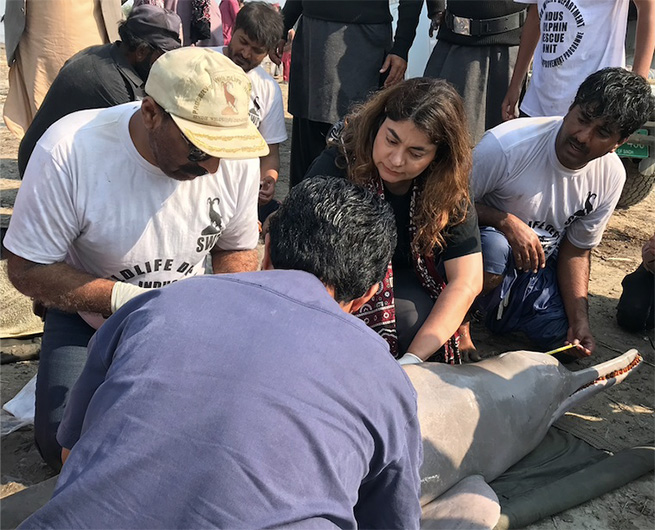
Dr Uzma Khan, Asia coordinator for World Wide Fund’s river dolphin initiative, and members of the WWF-Pakistan satellite-tag Indus River dolphins in Sukkur, Pakistan on January 15, 2022. (Photo By Janan Sindhu)
The three river dolphins — two adult females and a young male — were satellite-tagged after being rescued from irrigation canals in Sukkur and later released into the Indus River.
Preliminary satellite data appears to show that the technology is working and scientists are expecting unprecedented information about Indus dolphins in the coming weeks, according to the WWF-Pakistan.
“This pioneering project is a major milestone for the long-term conservation of the Indus River dolphin as we are expecting it to reveal a wealth of information about the movement, behavior and habitats of this iconic species,” said Dr. Uzma Khan, the Asia coordinator for WWF’s river dolphin initiative, who led the tagging team.
“I am so honored to have been part of the team that satellite-tagged the first river dolphins in Pakistan — and indeed in Asia. It could help transform our knowledge of these incredible animals.”
For the first time in Asia, satellite tags will allow scientists to build up an accurate picture of the activities of these dolphins, which only surface for a very short time to breathe.
The data is expected to help answer many questions, including how they use different habitats, how effectively they travel through the large irrigation barrages on the river, how far they move in a day, and any difference between the movement of male and female dolphins.
Satellite-tagging of river dolphins was pioneered in South America, where around 50 Amazon River dolphins have been successfully tagged, providing critical information for conservation. A Yangtze finless porpoise was also once tagged in China.


