Ecuador private pipeline operator suspends pumping crude following burst

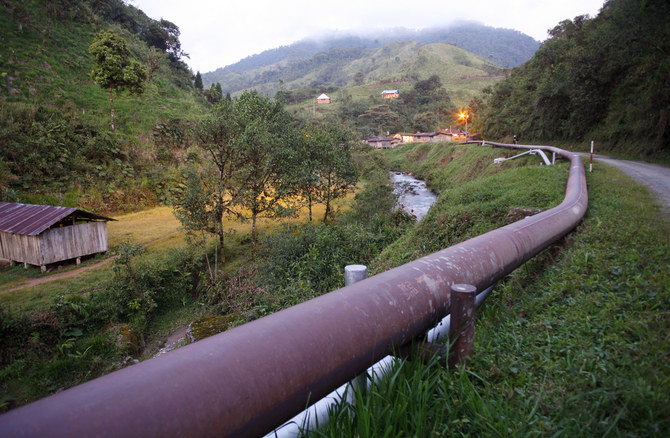
The Trans-Andean oil pipeline on the western slope of the Andes, Ecuador. Sutterstock.
Short Url
Updated 30 January 2022
Follow

Ecuador private pipeline operator suspends pumping crude following burst

  • Remedial action includes containing the spilled crude so it cannot contaminate bodies of water, the company said

OCP Ecuador, the operator of Ecuador’s privately held heavy crude pipeline, suspended pumping crude on Saturday as a preventative measure after it ruptured in the Amazon, and began cleaning and repairs.


The burst happened late on Friday in the Piedra Fina zone, an area in Ecuador’s Amazon where regressive erosion caused the OCP pipeline and the state-owned SOTE pipeline to halt pumping in December, forcing the government to declare force majeure over its oil exports and production.


“OCP Ecuador S.A. informs that the pumping of crude oil has been stopped as a preventive measure, and that it will be restarted when the conditions are right,” the company said in a statement.


Remedial action includes containing the spilled crude so it cannot contaminate bodies of water, the company said. Repairs had also begun on the tube, it said.


Regressive erosion has advanced steadily in the area since 2020, threatening pipelines and causing problems for water sources for Ecuador’s largest hydroelectric plant and a highway.


OCP Ecuador said on Friday that the pipeline burst in an area which is not directly exposed to rivers, and that it had controlled the oil flow. However, Indigenous organization CONFENIAE said communities were already being affected.


“The impact of the oil spill has reached the Kichwa community of Panduyaku in the province of Sucumbíos,” CONFENIAE said in a message on Twitter, along with a video showing crude contamination in a river.


Both pipelines burst in 2020 due to the erosion, causing an oil spill in the Coca river and affecting numerous Amazon communities.


Energy Minister Juan Carlos Bermeo said he was keeping an eye on the situation.


OCP Ecuador has employed measures to make sure neither the flow of oil nor the country’s export of crude is affected, it said.


KAIA records busiest week with new operational records

Updated 7 sec ago
Follow

KAIA records busiest week with new operational records

JEDDAH: King Abdulaziz International Airport started 2026 on a strong note, handling 5.45 million passengers in January, a 7.3 percent increase over the same month last year.

Flight movements reached 29,200, up 11 percent, while total baggage throughput rose 8 percent to 6.6 million items.

The airport recorded its busiest operational week from Jan. 11 to 17, serving 1.28 million travelers.

Passenger numbers peaked on Jan. 17, marking the airport’s busiest day ever with 195,300 travelers and 1,089 flights, underscoring the efficiency of its operations and the capacity of its infrastructure to accommodate growing travel demand.

These results reflect Jeddah Airports Co.’s ongoing efforts to enhance the passenger experience, expand travel options, and manage rising air traffic in line with the National Aviation Program and Saudi Vision 2030.

Since its establishment in 2022, the company, known as JEDCO, has overseen the management and operations of KAIA, driving the implementation of the Aviation Program under the National Transport and Logistics Strategy.

In 2025, the airport reached a historic milestone, welcoming 53.4 million passengers, the highest annual total ever recorded at a Saudi airport, placing it among the world’s mega airports in terms of traffic.

The airport handled a total of 310,000 flights and 60.4 million bags, representing a 12 percent increase compared to 2024. It also handled 9.57 million Zamzam water containers and 2,968 cargo flights.

This achievement reflects the airport’s qualitative transformation and its position as a regional hub and national gateway connecting the Kingdom to the world. It also highlights its role in facilitating the movement of visitors and pilgrims, promoting tourism in line with the goals of Vision 2030, diversifying the economy, and providing a distinguished travel experience.

The January milestone at KAIA is part of a broader success story for Saudi airports, with 2025 statistics showing unprecedented growth in the Kingdom’s air traffic, surpassing regional averages and cementing Saudi Arabia’s status as one of the world’s fastest-growing and most advanced aviation markets.

Passenger numbers rose 9.6 percent, fueled by tourism, international events, and expanding global connectivity.

This growth reflected both increased capacity and enhanced connectivity, with Saudi airports handling approximately 140.9 million passengers, 76 million international and 65 million domestic passengers. Flight movements rose 8.3 percent to around 980,400, highlighting the sector’s sustained recovery.

KAIA accounted for 38 percent of total passenger traffic, averaging 146,000 passengers daily and operating at 107 percent of capacity. King Khalid International Airport handled 29 percent of passengers, with a daily average of 112,000. Madinah and Dammam airports also recorded historic surges, operating at 137 percent and 112 percent of capacity, respectively.