

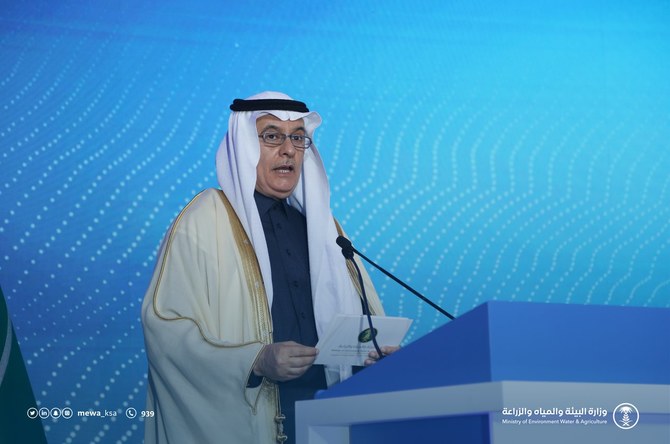
Saudi Arabia aims to create regional center for fisheries: minister

(Supplied)
Short Url
Updated 30 January 2022
Follow

Saudi Arabia aims to create regional center for fisheries: minister

  • Saudi Minister of Environment, Water, and Agriculture Abdulrahman Al-Fadley said the government is keen to develop fish farming

RIYADH: Saudi Arabia is working to establish a regional center for fisheries, a Saudi minister told a conference in Riyadh on Sunday, as part of its bigger goals to diversify the economy and address food security. 

Saudi Minister of Environment, Water, and Agriculture Abdulrahman Al-Fadley said the government is keen to develop fish farming, describing it as one of the fastest-growing food sectors in the world.

“We have created initiatives that involve the private sector in developing this sector,” he said during the opening of the Saudi international Marine and Exhibition Conference or SIMEC. 

The Saudi minister, who also heads the National Fisheries Development Program, said investing in fisheries is also in line with the Kingdom’s efforts to address food security, which is a common issue across the Gulf. 

“We are working on establishing a regional center for fisheries, and establishing an academy dedicated to fisheries,” Al-Fadley added. 

One of the projects the Saudi government is working on is developing seaweed, the minister said. 

He said the government has invested in research and development to enhance the capabilities of the sector, and align the Kingdom’s efforts to international benchmarks.

The ministry is working with several Saudi universities to produce scientific research that could lead to many benefits such as decreased production costs and improved export capabilities, Al-Fadley explained.

Manuel Barange, director of fisheries and aquaculture division of UN unit Food and Agriculture Organization, highlighted the important role the Kingdom could play in the region.

He said the Kingdom produces 49 percent of the total aquaculture across the Gulf, adding the event is a “great opportunity” to capitalize on this.

Barange echoed the importance of creating a regional hub for fisheries in the Middle East, especially with areas such as the Red Sea, which has been studied to have a vibrant marine ecosystem. 

The Saudi minister said they are working with their partners at FAO to develop sustainable marine resources and highlight the importance of research. 

Al-Fadley also mentioned the importance of having easy regulations for investors to participate in the local economy.

The statements were made during the SIMEC event in Riyadh, which gathered regional and international stakeholders in the fisheries sector to talk about the potential of the region. 

Under its Vision 2030, the Saudi government has identified several industries to drive economic diversification away from oil dependence. 

The Kingdom wants to generate as much as SR17 billion ($4.3 billion) from the sector, creating 200,000 jobs to support local fishing communities.

Ministers from China, Denmark, Norway, and other Arab countries are expected to attend the three-day forum.

Aside from the ministry, the event is also hosted by the National Fisheries Development Program, which is the Saudi government’s executive arm of its Vision 2030 fisheries policy.


GCC chambers plan Gulf Guarantee project to boost intra-regional trade

Updated 16 February 2026
Follow

GCC chambers plan Gulf Guarantee project to boost intra-regional trade

DAMMAM: The Federation of GCC Chambers, in cooperation with the Customs Union Authority, intends to launch the Gulf Guarantee Project to provide a unified mechanism for exports and trade transactions and to enhance the efficiency of intra-GCC trade, which reached about $146 billion by the end of 2024, Saleh Al-Sharqi, Secretary-General of the federation, told Al-Eqtisadiah.  

Al-Sharqi said, on the sidelines of his meeting with media representatives at the federation’s headquarters in Dammam, that the initiative represents a qualitative leap in supporting intra-GCC trade by facilitating transit movement through a single point, contributing to cost reduction, accelerating the flow of goods, and enhancing the reliability of trade operations among Gulf markets.   

Saleh Al-Sharqi, Secretary-General of the Federation of GCC Chambers. Al-Eqtisadiah

He explained that the federation recently launched a package of strategic initiatives, including the Tawasul initiative aimed at strengthening communication among Gulf business owners and supporting the building of trade and investment partnerships, in addition to the Gulf Business Facilitation initiative, which seeks to address challenges facing Gulf investors and traders, simplify procedures, and improve the business environment across member states.    

He noted that these initiatives fall within an integrated vision to address obstacles hindering investment and intra-regional trade flows by developing regulatory frameworks, activating communication channels between the public and private sectors, and supporting Gulf economic integration in line with the objectives of the Gulf Common Market.    

In a related context, the Secretary-General affirmed the direction of GCC countries to leverage artificial intelligence technologies to support trade and investment flows, stressing the importance of establishing a unified Gulf committee for artificial intelligence to coordinate efforts and exchange expertise among member states. He said the federation will support this direction in the coming phase, drawing on leading international experiences, particularly the Chinese experience in this field.    

Regarding the recently announced electric railway project between Riyadh and Doha, Al-Sharqi revealed that technical and advisory committees are working to complete the necessary studies for the project, confirming that it will positively impact passenger and freight movement between the two countries, enhance Gulf logistical integration, and support regional supply chains.  

On investment opportunities available to Gulf nationals in the Syrian market, he said the federation is coordinating with private sector representatives in Syria to overcome obstacles that may face the flow of Gulf investments, in addition to working to provide adequate guarantees to protect these investments and ensure a stable and attractive investment environment.  

In response to a question from Al-Eqtisadiah about the impact of tariffs imposed by the US on imports of iron, steel, and aluminum, he said that economic and technical committees in GCC countries are continuously monitoring the repercussions of these tariffs on the Gulf private sector, assessing their effects, and taking the necessary measures to protect it from any potential negative impacts.    

Al-Sharqi also pointed to the launch of two specialized committees in the transport and logistics sectors and in real estate activities, given their pivotal role and active contribution to Gulf gross domestic product, stressing that developing these two sectors is a fundamental pillar for enhancing economic diversification and increasing the competitiveness of GCC economies.    

He added that during the past year the federation held more than 40 meetings and official engagements with Gulf and international entities, participated in nine regional and international events to strengthen the presence of the Gulf private sector on the global stage, and signed 12 agreements and memoranda of understanding with Gulf, regional, and international entities to open new horizons for economic and investment cooperation.    

During the same year, the federation launched four digital platforms to support the Gulf private sector, bringing the total number of its digital platforms to eight serving the business community across member states.    

The Secretary-General affirmed that the federation will continue working with relevant economic entities to unify procedures and regulations, reduce non-tariff barriers, and accelerate mutual recognition of products and standard specifications, in a way that enhances the competitiveness of the Gulf economy and supports the growth of intra-GCC trade.