

Pakistan issues visa to Indian man separated from brother during partition 

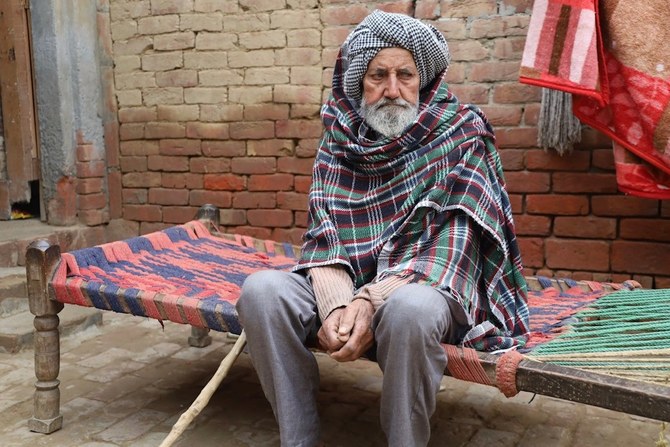
Sikka Khan sits at his home in Phulewala village, Punjab, India on January 16, 2022. (AN photo by Sanjay Kumar)
Short Url
Updated 28 January 2022
Follow

Pakistan issues visa to Indian man separated from brother during partition 

  • In 1947, Pakistan and India’s independence from Britain triggered one of the biggest forced migrations in history 
  • Brothers Sikka Khan and Sadiq Khan, who remained on opposite sides of border, met in Kartarpur, Pakistan last week 

ISLAMABAD: The Pakistani high commission in India on Friday issued visa to an Indian citizen to allow him to meet his family members in Pakistan who had been separated during the 1947 partition of the Subcontinent. 

Sikka Khan, 76, met his 84-year-old brother Sadiq Khan in Kartarpur, Pakistan on January 10. But the brothers’ reunion did not last long, as each of them had to return to their countries. For the past seven decades, India-Pakistan cross-border visits have been limited by tensions and conflict. 

Kartarpur is a border city where Pakistan, in late 2019, opened a visa-free crossing to allow Indian Sikh pilgrims access to one of the holiest sites of their religion, Gurdwara Darbar Sahib, which found itself on the Pakistani side of the border after the partition. 

“Today, Pakistan High Commission issues visa to Sika Khan to visit his brother, Muhammed Siddique and other family members in Pakistan,” the Pakistani high commission said on Twitter. 

“The two brothers, separated in 1947, were recently reunited after 74 years at Kartarpur Sahib Corridor.” 

When British India split into two independent states in August 1947, Sikka’s father and elder brother, Sadiq, left Phulewala village in what became the Indian part of Punjab and returned to their paternal village of Bogran, which found itself in Pakistan. Just two years old at the time, Sikka was too young to go and stayed behind in India with his mother. 

They got in touch in 2019, when Pakistani YouTuber Nasir Dhillon visited Bogran village, where Sadiq still lives, and heard his story. He shared the footage on social media and soon received a message from Jagsir Singh, a doctor in Phulewala, who connected him to Sikka. 

The story of the two brothers is a powerful illustration of how the historic opening of the visa-free Kartarpur corridor is bringing people living on either side of the border close to each other. 

Sikka also met with Pakistan’s Chargé d’Affaires Aftab Hasan Khan and interacted with other officials at the Pakistani high commission in New Delhi on Friday. 

“I am very happy. I have received the visa, will go and meet (my brother). I thank everyone,” he said in a video message while being at the high commission. 

Earlier an emotional video of the siblings’ reunion went viral on social media. “I told you we would meet again,” Sikka, 76, said through tears, as he embraced his 84-year-old brother when they met in Kartarpur, Pakistan. 


After mosque bombing, Islamabad intensifies patrols, surveillance during Ramadan prayers, iftar

Updated 7 sec ago
Follow

After mosque bombing, Islamabad intensifies patrols, surveillance during Ramadan prayers, iftar

  • Police chief orders enhanced screening at capital city’s entry and exit points after Feb. 6 blast
  • Safe City cameras to monitor Islamabad round the clock as special pre-iftar traffic plan enforced

ISLAMABAD: Police in the federal capital have been instructed to step up patrols, surveillance and checkpoint inspections during Ramadan prayers and iftar hours, an official statement said on Wednesday, as the city’s police chief chaired a security meeting following a deadly mosque bombing earlier this month.

Inspector General of Police Syed Ali Nasir Rizvi directed senior officers to ensure “foolproof security” across the city, with special focus on mosques during peak congregational times.

The meeting comes after a suicide bombing at a mosque on the outskirts of Islamabad on Feb. 6 that killed at least 32 people. The blast targeted the Qasr-e-Khadijatul Kubra mosque and imambargah during Friday prayers and was claimed by Daesh that said one of its militants detonated an explosive vest inside the congregation.

“All officers must ensure their presence in the field and properly brief personnel about their duties,” Rizvi said, according to a statement issued by the police.

“Strict security arrangements should be ensured at mosques, imambargahs and Ramadan bazaars,” he continued. “Special patrols should be conducted during Fajr, iftar and Taraweeh hours.”

The police chief said Safe City cameras would be used for round-the-clock effective monitoring across the capital.

In addition to security measures, he reviewed traffic arrangements and directed strict implementation of a special traffic plan during pre-iftar rush hours, calling for additional deployment on major roads and at commercial centers.

Islamabad, which has generally seen fewer large-scale militant attacks than some other parts of Pakistan, has faced sporadic security incidents in the past, prompting authorities to tighten monitoring during religious gatherings and other high-risk events.