OUAGADOUGOU: Burkina Faso’s new military leader said he was going to bring security and order back to the conflict-ridden nation and unite the country, but warned that betrayal wouldn’t be tolerated by the new regime.
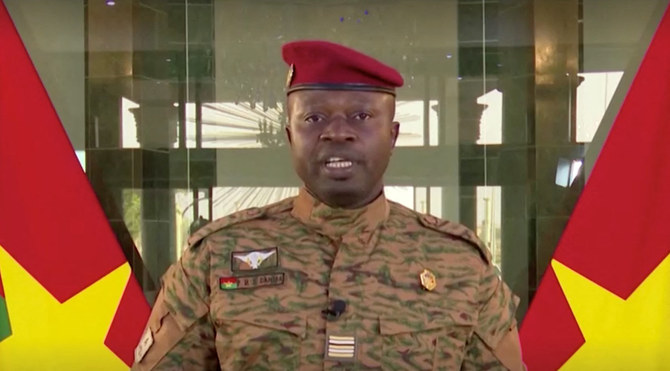
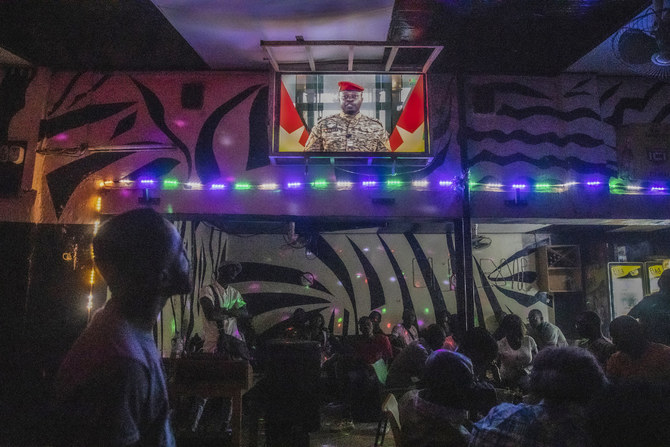
Lt. Col. Paul Henri Sandaogo Damiba, leader of the Patriotic Movement for Safeguarding and Restoration, spoke Thursday evening in his first public address to the nation since seizing power from President Roch Marc Christian Kabore earlier this week.
“I warn all those who will be guided only by their selfish interests that I will be uncompromising with the acts of betrayal of the aspirations of our people,” he said in an address aired on Burkina Faso’s state broadcaster.
Speaking from the presidential palace, Damiba said the country was facing an unprecedented crisis and the junta’s priority would be to restore security by renewing the will to fight among its soldiers and by listening to people to form a path forward.
“In its history, our country has rarely been confronted with adversity. But more than six years now our people have been living under the yoke of an enemy that succeeded,” said Damiba. “The task before us is immense. Fortunately, it is not only mine, it is all of ours. It will require great individual and collective efforts and certainly sacrifices on our part.”
Mutinous soldiers ousted democratically elected President Kabore on Monday after months of growing frustration at his government’s inability to stem jihadist violence that has spread across the country, killing thousands including security forces. Kabore has not been heard from since he was detained by the military and resigned, though the junta has said he is in a safe place.
Since taking over, the junta has spent the last few days trying to shore up support from religious and community leaders, security forces and unions. On Thursday it met with the labor union in the presidential palace and explained its motives for the coup, saying it would correct the previous regime’s flaws, said Moussa Diallo, the secretary general for the union who was at the meeting.
While Damiba said he had no problem with the unions, he also issued a veiled threat, ordering citizens not to speak out against the regime, said Diallo.
The international community has condemned the coup, despite widespread local support.
The US State Department in a statement expressed deep concern about the dissolution of the government, suspension of the constitution and the detention of government leaders. United Nations Secretary-General Antonio Guterres called on coup leaders to lay down their arms. He reiterated the UN’s “full commitment to the preservation of the constitutional order” in Burkina Faso and support for the people in their efforts “to find solutions to the multifaceted challenges facing the country,” UN spokesman Stephane Dujarric said.
The West African regional economic bloc, known as ECOWAS, has also condemned the coup and will be holding a summit Friday to discuss the mutiny.
Damiba on Thursday also called on the international community not to turn its back on Burkina Faso.
“In these particularly difficult times for our country, Burkina Faso needs its partners more than ever. This is why I call on the international community to support our country so that it can emerge from this crisis as quickly as possible and resume its march toward development,” he said.


![]()
![]()

Burkina Faso’s junta leader promises security, order
Short Url
https://arab.news/8ypjk
Burkina Faso’s junta leader promises security, order
- Mutinous soldiers ousted democratically elected President Kabore on Monday
- Kabore's government was chided for failing to stem jihadist violence
Latest updates


© 2026 SAUDI RESEARCH & PUBLISHING COMPANY, All Rights Reserved And subject to Terms of Use Agreement.